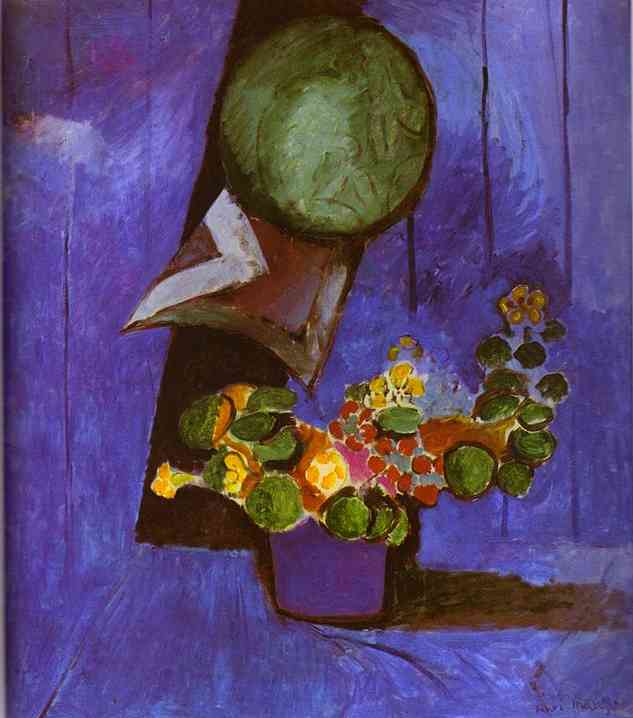
A Moment of Stillness: The Essence of Matisse’s “Flowers and Ceramic Plate”
Henri Matisse, a name synonymous with vibrant color and joyous expression, possessed an extraordinary ability to transform the mundane into the magnificent. His 1911 painting, "Flowers and Ceramic Plate," isn't merely a depiction of objects; it’s a carefully orchestrated symphony of hues and forms designed to evoke a profound sense of serenity and delight. This intimate still life, housed within the Baltimore Museum of Art among his extensive collection, offers a window into Matisse’s revolutionary approach to art – one that prioritized feeling over strict representation.
The painting immediately captivates with its bold palette. A striking blue vase dominates the composition, anchoring the scene while simultaneously inviting the eye to explore the surrounding elements. This cool tone is masterfully contrasted by the warm, earthy tones of the table and the fruits nestled within the vase – a deliberate juxtaposition that creates visual tension and dynamism. The inclusion of books adds an unexpected layer of intellectual curiosity, hinting at Matisse’s own engagement with knowledge and the relationship between art and human understanding. It's not simply a collection of objects; it’s a carefully considered arrangement designed to stimulate both the eye and the mind.
The Fauvist Revolution: Embracing Color as Truth
“Flowers and Ceramic Plate” stands firmly within the realm of Fauvism, a movement that Matisse himself spearheaded. Fauvism, meaning “wild beasts” in French, rejected the muted tones and realistic depictions favored by Impressionism, instead embracing intense, arbitrary colors – using color not to represent reality but to express emotion and create visual impact. Matisse’s use of color is utterly unrestrained; he employs blues, greens, yellows, and reds with a freedom that borders on ecstatic. The painting's palette isn’t descriptive; it’s purely expressive, conveying mood and atmosphere through the sheer intensity of its hues.
This approach was partly inspired by Paul Cézanne, whose exploration of color and form paved the way for Matisse’s innovations. Cézanne’s still lifes, particularly his studies of fruit, demonstrated a shift towards analyzing shapes and colors independently, laying the groundwork for Matisse's later emphasis on simplified forms and vibrant hues. However, unlike Cézanne’s more structured approach, Matisse’s work is characterized by an almost childlike exuberance – a celebration of color that feels utterly spontaneous and joyful.
A Dialogue with Tradition: Influences and Legacy
While firmly rooted in the Fauvist movement, “Flowers and Ceramic Plate” also reflects influences from Post-Impressionism and even hints at the geometric explorations of Cubism. Matisse’s use of flattened planes and simplified forms echoes Cézanne's emphasis on underlying structure, while his bold color choices align with the expressive tendencies of artists like Van Gogh. The painting is a testament to Matisse’s ability to synthesize diverse influences into a uniquely personal style.
Matisse’s legacy extends far beyond the Fauvist movement. His innovative use of color and composition profoundly impacted subsequent generations of artists, influencing movements such as Abstract Expressionism and Pop Art. The Baltimore Museum of Art holds a significant collection of Matisse's works, serving as a vital resource for understanding his artistic development and enduring influence. His work continues to resonate with audiences today, offering a timeless reminder of the power of color and form to evoke emotion and inspire wonder.
For those seeking a stunning hand-painted reproduction of this iconic masterpiece, ArtsDot offers meticulously crafted reproductions that capture the essence of Matisse’s vision. Explore our collection at ArtsDot.com to bring a touch of Matisse's vibrant world into your home.
To delve deeper into the history and significance of the nude in art, refer to Wikipedia’s comprehensive article: https://en.wikipedia.org/wiki/History_of_the_nude_in_art