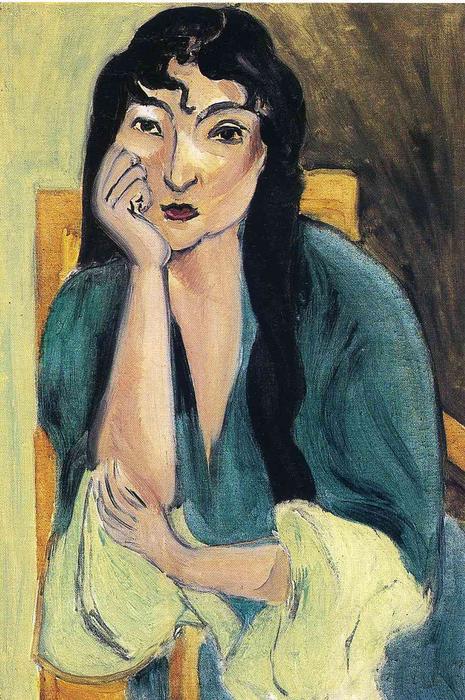
Laurette in Green: A Study in Color and Contemplation
Henri Matisse’s “Laurette in Green,” painted around 1916 during his pivotal Fauvist period, is more than just a portrait; it's an immersion into a world of vibrant color and distilled emotion. This captivating work, often referred to as "Lorette in a Green Robe against a Black Background" (a variation found on WikiArt), offers a glimpse into Matisse’s revolutionary approach to painting – one that prioritized the emotional impact of color over strict representation. The image depicts Laurette Assaf, a dancer and muse who became a frequent subject for Matisse during this period, seated in a relaxed pose, her hand gently resting upon her chin, suggesting a moment of quiet reflection.
The painting’s immediate power lies in its audacious color palette. A dominant field of emerald green envelops Laurette, not as a realistic depiction of fabric but as an embodiment of mood and feeling. This intense hue is juxtaposed with the stark simplicity of the black background – a deliberate choice that amplifies the vibrancy of the subject and creates a dramatic visual contrast. Subtle yellows peek through in her dress and accessories, adding warmth and complexity to the composition. Matisse’s masterful use of color isn't merely decorative; it’s a language, conveying serenity, introspection, and perhaps even a hint of melancholy. The brushstrokes themselves are loose and expressive, contributing to the painting’s dynamic energy despite its overall sense of calm.
The Fauvist Revolution and Matisse’s Innovation
“Laurette in Green” is firmly rooted within the Fauvist movement, a radical artistic response to Impressionism. Emerging around 1905, Fauvism championed the use of pure, non-naturalistic colors – often applied with little regard for traditional shading or perspective – to express emotion and create an immediate visual impact. Matisse was a key figure in this movement, alongside artists like André Derain and Maurice de Vlaminck. Unlike Impressionists who sought to capture fleeting moments of light and atmosphere, the Fauves aimed to evoke feelings directly through color. Matisse’s shift towards these bold colors stemmed from his time studying Turner's work in London, where he was profoundly moved by the artist's expressive use of color and light.
This painting exemplifies Matisse’s exploration of simplified forms and flattened perspective – hallmarks of Fauvist style. The figure is rendered with broad, gestural strokes, reducing her features to their essential elements. Details are minimized, allowing the colors to dominate and create a sense of immediacy. The background is almost entirely devoid of recognizable shapes, further emphasizing Laurette’s presence as the focal point of the composition. This deliberate simplification wasn't about lacking skill; it was about prioritizing emotional expression over meticulous realism.
Symbolism and the Portraiture of Intimacy
While seemingly a straightforward portrait, “Laurette in Green” is rich with subtle symbolism. The green robe itself can be interpreted as representing tranquility, growth, or even envy – colors often associated with nature and vitality. Laurette’s pose, with her hand resting on her chin, suggests contemplation and perhaps a touch of vulnerability. She appears lost in thought, inviting the viewer to share in her inner world. Matisse frequently depicted his muses in intimate settings, capturing their personalities and moods through carefully considered compositions and color choices.
The choice of black as the background is particularly significant. It’s not merely a neutral space; it acts as a powerful counterpoint to the vibrant green, intensifying its impact and creating a sense of drama. The darkness also subtly frames Laurette, drawing attention to her face and emphasizing her presence within the composition. This portrait isn't just a likeness; it’s an exploration of mood, emotion, and the complex relationship between subject and artist.
A Timeless Masterpiece – Perfect for Reproduction
“Laurette in Green” remains one of Henri Matisse’s most celebrated works, admired for its bold color palette, innovative composition, and profound emotional resonance. ArtsDot offers meticulously crafted hand-painted reproductions that faithfully capture the essence of this iconic painting. Whether you're an art enthusiast, a collector seeking to expand your collection, or simply looking to add a touch of artistic sophistication to your interior design, a ArtsDot reproduction of “Laurette in Green” is a stunning and enduring investment – bringing the vibrant spirit of Matisse’s studio into your home.