Henri Matisse: A Master of Color and Fluid Draughtsmanship
Henri Matisse (1869–1954) stands as one of the most influential figures in modern art, revered for his groundbreaking exploration of color and his remarkably expressive draughtsmanship. Born in Le Cateau-Cambrésis, Northern France, Matisse’s artistic journey began with a fascination for classical painting—particularly Chardin and Poussin—influenced by formative encounters with Impressionism and Van Gogh during his early years in Paris. This initial grounding provided him with invaluable technical skills that would underpin his subsequent stylistic innovations.
A pivotal moment arrived in 1896 when Matisse visited John Russell on Belle Île, sparking a transformative shift toward Fauvism. Russell’s encouragement to embrace bold color palettes and liberate draughtsmanship from academic constraints proved decisive. Immediately captivated by the vibrancy of Impressionist landscapes, Matisse abandoned muted tones for intense hues—reds, yellows, blues—creating canvases that pulsed with energy and emotion. This stylistic rebellion challenged prevailing artistic conventions and cemented his position as a pioneer of Fauvist aesthetics.
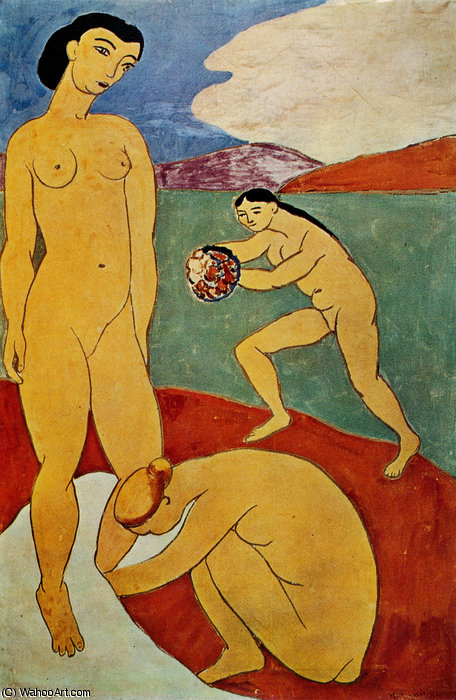
“Luxe II Peinture à la Caséine sur Toile Copenhague Museum for Kunst,” created in 1907, exemplifies Matisse’s masterful command of Fauvist principles. The painting depicts three women engaged in seemingly simple activities—holding a ball, reaching for something—yet it embodies profound symbolic resonance. Set against a striking red landscape, the figures are rendered with fluid brushstrokes and flattened forms, prioritizing color over meticulous detail. This deliberate simplification reflects Matisse’s belief that art should convey emotion directly, bypassing intellectual contemplation.
The choice of red is particularly significant. As Professor Mehammed Mack eloquently articulated during an interview about Matisse's artistic vision, “He existed in France during the colonial time when artists felt that Europe had run out of ideas, that everything that there was to be said had been said, and people turned to the colonized world to look for new forms, new ideas. They’re looking for authenticity, purity, striking colors, vivacious bodies, aliveness.” Matisse consciously rejected the traditional association of white skin with purity—a convention prevalent in European art at the time—making red a deliberate assertion of defiance against established norms and signaling an embrace of vibrant color as a vehicle for artistic expression.
Lisa Yuskavage added insight into Matisse’s approach: “What happens when you take your place within a grand tradition is that you have to affect it. You have to do something to it, you have to change it. You paint something quite traditional and make it be seen in a way that's never been seen before.” Matisse’s legacy extends far beyond his stylistic innovations; he inspired generations of artists to explore the expressive potential of color and form—a testament to his enduring influence on the trajectory of modern art.
- Henri Matisse was a French artist known for his use of color and fluid draughtsmanship.
- “Luxe II Peinture à la Caséine sur Toile Copenhague Museum for Kunst” is a painting that exemplifies the essence of Fauvism.
- The bold red landscape serves as a symbol of defiance against traditional aesthetic conventions.
- Matisse’s masterful technique—flattened forms and expressive brushstrokes—captures the immediacy of emotion.
Painting by 'Henri Matisse' | Henri Matisse:Luxe II Peinture à la Caséine sur Toile Copenhague Museum for Kunst (210 x 139 cm,Fauvism,)
ArtsDot.com offers high-quality, handmade oil painting reproductions of “Luxe II” and other works by Henri Matisse. Visit
Henri Matisse to explore more of his art.
For a deeper understanding of Matisse’s life and work, refer to the comprehensive information available on
Wikipedia: Henri Matisse.
Photo Description: The image is a painting of three women in a red landscape. The first woman on the left holds a ball, while the second woman behind her appears to be reaching for something. The third woman is positioned further back, closer to the right edge of the canvas. Two sports balls are visible in the scene, one near the center-left and another towards the right side. A chair is placed on the left side of the image, accompanied by a handbag.
Size: 210 x 139 cm
Date: Unknown
ARTIST INFORMATION:
==================
Artist: Henri Matisse
Birth Year: 1869
Death Year: 1954
Birth City: Le Cateau-Cambrésis
Birth Country: France
Biography:
Henri Matisse: A Life in Color
## Early Life and Education
Matisse was born in Le Cateau-Cambrésis, in the Nord department in Northern France on New Year's Eve in 1869, the oldest son of a grain merchant. He grew up in Bohain-en-Vermandois, Picardie, the son of grain merchants. In 1887, he went to Paris to study law, working as a court administrator in Le Cateau-Cambrésis after gaining his qualification. He first started to paint in 1889, after his mother brought him art supplies during a period of convalescence following an appendicitis attack. He discovered “a kind of paradise” as he later described it, and decided to become an artist, deeply disappointing his father.
## Early Artistic Development & Influences
He studied at the Académie Julian under William-Adolphe Bouguereau and later at the École Nationale des Beaux-Arts with Gustave Moreau. Initially he painted still lifes and landscapes in a traditional style, at which he achieved reasonable proficiency. He was influenced by the works of earlier masters such as Jean-Baptiste-Siméon Chardin, Nicolas Poussin, and Antoine Watteau, as well as by modern artists, such as Édouard Manet, and by Japanese art. Chardin was one of the painters Matisse most admired; as an art student he made copies of four of Chardin's paintings in the Louvre.
## Fauvist Breakthrough & Artistic Vision
His encounter with John Russell on Belle Île marked a pivotal moment—Russell introduced him to Impressionism and to the work of Vincent van Gogh—who had been a friend of Russell—and gave him a Van Gogh drawing. Matisse’s style changed completely: abandoning muted tones for bright colors. He later said Russell was his teacher, and that Russell had explained color theory to him. The same year, Matisse exhibited five paintings in the salon of the Société Nationale des Beaux-Arts, two of which were purchased by the state. With the model Caroline Joblau, he had a daughter, Marguerite, born in 1894. In 1898, he married Amélie Noellie Parayre; the two raised Marguerite together and had two sons, Jean (born 1899) and Pierre (born 1900). Marguerite and Amélie often served as models for Matisse.
## Later Years & Legacy
Matisse continued to produce paintings throughout his life, experimenting with new techniques and exploring diverse themes—from decorative patterns to monumental sculptures—solidifying his reputation as one of the most prolific and celebrated artists of the twentieth century. His unwavering commitment to color and form ensured that Henri Matisse's artistic legacy would endure for generations to come.