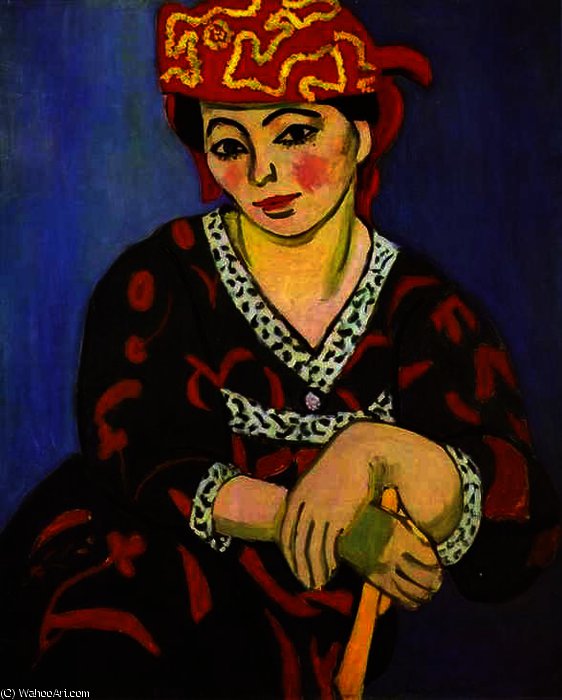
Henri Matisse's 'Portrait de Madame Matisse' (1905) showcases bold Fauvist colors & intimate portrayal of his wife, Amélie. Explore this iconic masterpiece at Statens Museum for Kunst.
Explore Henri Matisse (1869-1954): Fauvism's master of color! Discover iconic paintings, cut-paper collages & his influence on modern art. A leading French painter.
A Symphony of Color: Exploring Henri Matisse’s “Madame Matisse”
Henri Matisse, born December 31, 1869, in Le Cateau-Cambrésis, wasn't destined for a life consumed by artistic pursuits. Initially focused on law studies in Paris after secondary school—a path abruptly altered by an appendicitis attack in 1889—he found solace and inspiration in painting following convalescence. This serendipitous discovery ignited a passion that would define his extraordinary career, steering him away from legal arguments toward a realm where color reigned supreme and canvas became his instrument of expression. Growing up in Bohain-en-Vermandois, the son of grain merchants, Matisse’s upbringing instilled in him an appreciation for simplicity and observation—qualities that would prove invaluable as he honed his artistic vision. He enrolled at the Académie Julian before progressing to the École Nationale des Beaux-Arts, establishing a foundation for his future achievements.
The Fauvist Revelation: Bold Strokes and Vibrant Hue
Matisse’s artistic breakthrough arrived in 1905 with “Madame Matisse,” a painting that catapulted him into the forefront of the burgeoning Fauvist movement. This revolutionary style, spearheaded by Picasso and Georges Braque, rejected Impressionistic realism in favor of unrestrained color—a deliberate defiance of academic conventions. Artists like Matisse prioritized emotional impact over accurate representation, utilizing hues deemed arbitrary yet powerfully expressive. The resulting canvases pulsated with intense reds, yellows, blues, and greens, applied in thick, impasto strokes that created a tactile surface brimming with energy. This bold technique wasn’t merely stylistic; it reflected Matisse's belief that color possessed inherent power to convey feeling and stimulate the viewer’s imagination.
Portrait of Domestic Tranquility: Composition and Symbolism
“Madame Matisse” depicts Amélie Matisse, Henri’s wife, seated gracefully in a chair against a backdrop of muted tones—a striking contrast to the dominant hues of the figure itself. The woman's scarlet dress is adorned with shimmering gold leaf designs, subtly hinting at wealth and refinement – elements that would have resonated deeply within Matisse’s bourgeois upbringing. Her gaze directs towards the viewer, establishing an intimate connection between artist and subject, inviting contemplation on themes of femininity, serenity, and domestic harmony. The inclusion of a scarf draped around her head adds to the portrait's visual richness and reinforces its symbolic significance as a representation of comfort and protection.
Technique and Impression: Capturing Light and Emotion
Matisse’s masterful handling of pigment is evident throughout “Madame Matisse.” He meticulously layered paint onto the canvas, building up texture and creating luminous surfaces that capture the subtleties of light. The artist skillfully employed color theory—particularly complementary hues—to heighten visual impact and create a harmonious balance within the composition. Furthermore, Matisse's approach mirrored his broader artistic philosophy: to distill emotion into form, prioritizing feeling over meticulous detail. As evidenced by similar works like “The Green Stripe,” he sought to evoke an emotional response in the viewer, transporting them beyond mere observation into a realm of sensory experience.
Legacy and Influence: An Enduring Masterpiece
“Madame Matisse” stands as a testament to Henri Matisse’s artistic genius—a pivotal piece that solidified his position as one of the most influential painters of the 20th century. Its bold chromatic palette, innovative technique, and profound psychological depth continue to inspire artists and collectors alike. Reproductions of this iconic artwork offer an opportunity to appreciate Matisse's visionary aesthetic and immerse oneself in the captivating beauty of Fauvist art. Statens Museum for Kunst proudly showcases this masterpiece, allowing visitors to experience firsthand the transformative power of color and form.