Madame Yvonne Landsberg: A Glimpse into Matisse's Poetic Portraiture
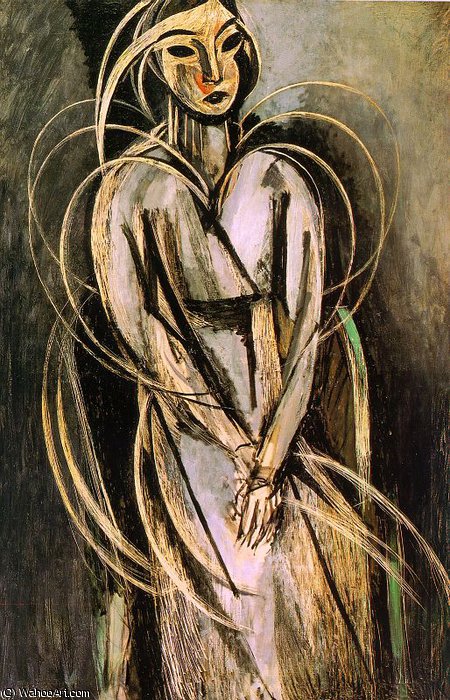
The painting Madame Yvonne Landsberg by Henri Matisse is a stunning example of Post-Impressionist art. Created in 1914, this oil on canvas piece showcases the artist's unique style and technique. The subject of the painting, Madame Yvonne Landsberg, is depicted with long hair and a dress, holding her hands together in front of her chest. The heart-shaped design on her chest adds an interesting detail to the painting.
Artistic Style and Technique
Henri Matisse was a prominent figure in the Post-Impressionist movement, known for his bold and vibrant use of color. In Madame Yvonne Landsberg, he employs a range of colors to create a dynamic and visually engaging environment. The background features swirls and circles that add to the overall sense of energy and movement in the painting. This style is characteristic of Post-Impressionism, which emphasized the emotional and psychological depth of a subject over realistic representation.
Matisse’s technique in this portrait moves beyond mere representation; it's an exploration of form and emotion. The flattened perspective, simplified shapes, and expressive lines contribute to a sense of stylized elegance. Notice how Matisse uses color not to mimic reality but to evoke mood – the muted tones create a contemplative atmosphere, while subtle accents of gold and green add depth and visual interest. The visible brushstrokes reveal his process, adding texture and dynamism to the canvas.
Historical Context & The Landsberg Family
This portrait was commissioned in 1914 by the Landsberg family, who sought a likeness of their daughter, Yvonne. Initially, they considered Paul-César Helleu but were persuaded by Matthew Stewart Pritchard, an Englishman studying philosophy with Henri Bergson, to choose Matisse. The commission itself reveals a fascinating intersection of art and intellectual circles in early 20th century Paris.
Interestingly, the family was initially hesitant about Matisse’s unconventional approach. Albert Landsberg, Yvonne's brother, reportedly remarked that the finished painting resembled a Byzantine icon – a testament to Matisse’s departure from traditional portraiture. Despite this initial reaction, the work eventually found its way into the esteemed collection of Walter and Louise Arensberg, demonstrating its growing recognition within artistic circles.
Symbolism & Emotional Resonance
Beyond the surface depiction, Madame Yvonne Landsberg carries a subtle symbolic weight. The heart-shaped design on her chest is an obvious motif of love and emotion, but within Matisse’s context, it also suggests a sense of vulnerability and introspection. The swirling patterns in the background can be interpreted as representing inner turmoil or spiritual energy – a reflection of the complex emotions often associated with young adulthood.
The painting evokes a feeling of quiet contemplation. Yvonne's posture, her hands clasped gently in front of her chest, suggests a moment of introspection and perhaps even melancholy. Matisse masterfully captures not just a likeness but also a sense of the sitter’s inner world, inviting viewers to connect with her on an emotional level.
Similar Works by Henri Matisse
Some of Henri Matisse's other notable works include Luxe I Huile sur Toile Paris, Musée d'Art Moderne and Danseuse, fond noir, fauteuil rocaille Huile sur Toile Collection Particulière. These paintings demonstrate Matisse's innovative use of color and composition, which has had a lasting impact on the development of modern art.
The painting Madame Yvonne Landsberg is a testament to Henri Matisse's skill as an artist and his contribution to the development of Post-Impressionism. As a handmade oil painting reproduction, it can be appreciated in a new light, allowing viewers to experience the beauty and emotion of the original work.