A Portrait of Quiet Intensity: Henri Matisse's "Moroccan in Green"
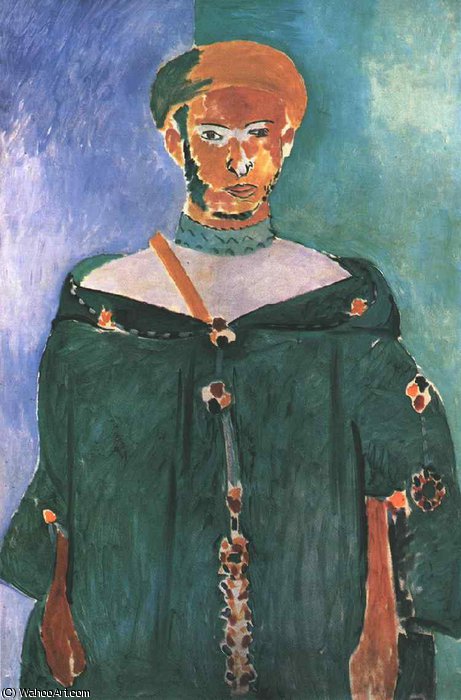
Henri Matisse’s “Moroccan in Green,” painted in 1913, is more than just a depiction of a woman; it’s an embodiment of the artist’s revolutionary approach to color and form. This intimate portrait, measuring 145 x 97 cm, immediately draws the viewer into its world of saturated hues and deliberate simplicity. The subject, a woman adorned in a vibrant green dress and accented with gold, possesses a captivating gaze that seems to hold both serenity and a subtle awareness – an effect masterfully achieved through Matisse’s signature technique.
- Subject & Composition: The painting centers on a single figure, a deliberate choice reflecting the burgeoning modernist movement's interest in isolating subjects and exploring their essence. Her direct address to the viewer creates an immediate connection, inviting contemplation rather than passive observation.
- Color as Language: Matisse’s use of color is profoundly expressive. The dominant green, applied with broad, confident strokes, isn’t merely descriptive; it evokes a sense of exoticism and perhaps even mystery, referencing the title's Moroccan inspiration. The interplay between warm gold and cool blue creates a dynamic tension that anchors the composition.
The Dawn of Fauvism: A Revolutionary Style
“Moroccan in Green” stands as a pivotal work within Matisse’s development and, crucially, as an early example of Fauvism – a movement he largely defined. Emerging in France around 1905, Fauvism rejected the traditional academic approach to color, advocating for its unrestrained use to convey emotion and create visual impact. Unlike Impressionists who sought to capture fleeting moments of light, Matisse and his fellow Fauves aimed to express subjective experience through bold, non-naturalistic colors. This painting exemplifies this radical shift, prioritizing expressive color over realistic representation.
- Breaking with Tradition: Prior to this period, portraiture typically adhered to strict rules of realism and tonal harmony. Matisse’s deliberate distortion of form and his vibrant palette signaled a decisive break from these conventions.
- Influence of Post-Impressionism: While Fauvism was distinct, it built upon the foundations laid by Post-Impressionist artists like Van Gogh and Gauguin, who had already explored the expressive potential of color.
Symbolic Resonance & Emotional Impact
Beyond its formal qualities, “Moroccan in Green” resonates with a quiet emotional depth. The woman’s posture – relaxed yet alert – suggests a sense of inner peace and self-possession. The scarf draped around her head adds an element of veiled mystery, hinting at hidden thoughts or desires. The blue background isn't merely a backdrop; it actively contributes to the painting's mood, creating a sense of space and emphasizing the figure’s presence. This combination of visual elements generates a powerful emotional response – one of quiet contemplation and perhaps even a touch of melancholy.
- The Power of Suggestion: Matisse rarely offered explicit interpretations of his work, preferring to allow viewers to engage with it on their own terms.
- A Moment Frozen in Time: The painting captures a fleeting moment, inviting the viewer to step into that instant and contemplate the subject's inner world.
Provenance & Significance
Created in 1913, a period of immense artistic experimentation and change, “Moroccan in Green” represents a crucial juncture in Matisse’s career. It demonstrates his growing confidence in his revolutionary style and foreshadowed the monumental impact he would have on 20th-century art. This particular version, part of the Hermitage collection, offers a rare opportunity to experience firsthand the brilliance of one of the most influential artists of all time. A hand-painted reproduction allows you to bring this captivating work into your own space, celebrating its beauty and historical significance for generations to come.