A Symphony of Color and Form: Exploring Matisse’s Still Life
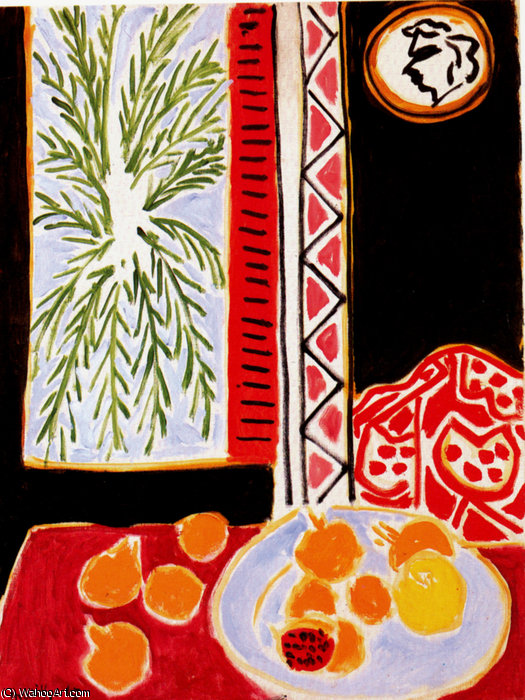
Henri Matisse's *Nature morte aux grenades* (“Still Life with Pomegranates”) is a radiant example of his pivotal role in the development of Fauvism, a movement that liberated color from its descriptive function and embraced it as a purely expressive element. Painted circa 1906-1908, this oil on canvas (81 x 60 cm) currently resides at the Musée Matisse in Nice, France, offering viewers a glimpse into a world where vibrant hues and simplified forms reign supreme.
Subject Matter & Composition
The painting depicts a carefully arranged still life featuring pomegranates – their ruby-red interiors hinting at abundance and fertility – alongside other fruits like oranges and apples. A vase, subtly rendered, adds a decorative element, while the presence of a clock in the background introduces a quiet contemplation on the passage of time. The composition isn’t about meticulous realism; rather, it's a deliberate arrangement of shapes and colors designed to create visual harmony and emotional resonance. Matisse eschews traditional perspective, flattening the picture plane and emphasizing the two-dimensionality of the canvas.
Fauvism & Artistic Technique
*Nature morte aux grenades* is a quintessential expression of Fauvist principles. The artist employs bold, non-naturalistic colors – intense reds, yellows, and greens – to convey emotion and create a heightened sense of visual excitement. Brushstrokes are visible and energetic, contributing to the painting’s lively atmosphere. Matisse doesn't aim to replicate reality; instead, he *interprets* it through color and form. The technique is characterized by a freedom from academic constraints, prioritizing subjective experience over objective representation. He uses color not to describe light or shadow but as an independent force, creating a dynamic interplay of hues that captivate the eye.
Historical Context & Matisse’s Evolution
Born in 1869, Henri Matisse initially trained in law before dedicating himself to art. His early work showed influences from Impressionism and Post-Impressionism, but he soon began to forge his own path. The Fauvist movement, of which he was a leading figure alongside artists like André Derain and Maurice de Vlaminck, emerged as a reaction against the prevailing artistic conventions of the time. This period marked a radical departure from traditional representation, paving the way for further experimentation in modern art. *Nature morte aux grenades* exemplifies this pivotal moment in Matisse’s career, showcasing his growing confidence in using color to express emotion and create a unique visual language.
Symbolism & Emotional Impact
While not overtly symbolic, the painting evokes feelings of warmth, abundance, and sensual pleasure. The pomegranates, with their association with mythology and fertility, suggest themes of life and vitality. The simplified forms and vibrant colors create a sense of joy and optimism. The clock subtly reminds us of time’s relentless march, perhaps adding a touch of melancholy to the overall mood. Ultimately, *Nature morte aux grenades* is an invitation to savor the beauty of everyday objects and appreciate the power of color to evoke emotion.
Legacy & Collecting
Matisse's influence on 20th-century art is immeasurable. His exploration of color and form paved the way for numerous artistic movements, including Expressionism and Abstract Art. Today, his works are highly sought after by collectors and museums worldwide. A high-quality reproduction of *Nature morte aux grenades* can bring a touch of Matisse’s vibrant energy into any space – adding a sophisticated focal point to a living room, dining area, or office. Its bold colors and simplified forms make it particularly well-suited for modern and contemporary interiors.
- Style: Fauvism
- Medium: Oil on Canvas
- Dimensions: 81 x 60 cm
- Location: Musée Matisse, Nice, France