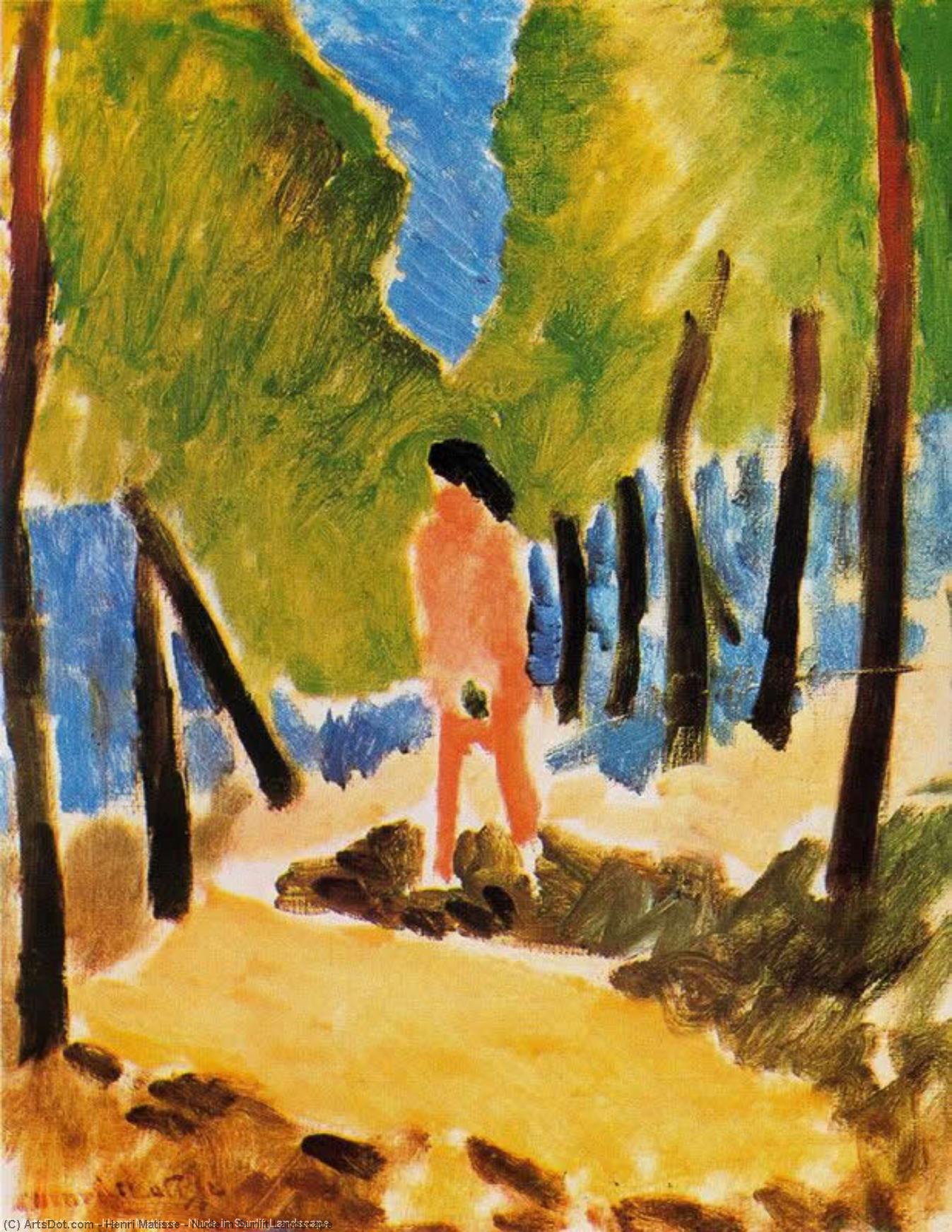
Nude in Sunlit Landscape: A Fauvist Embrace of Joy
Henri Matisse’s “Nude in Sunlit Landscape,” painted in 1909, isn't merely a depiction of a woman strolling through a forest; it’s an explosion of color and emotion—a quintessential example of the Fauvist movement at its most vibrant. This oil on canvas, now residing within the esteemed Musée National d’Art Moderne in Paris, invites us into a world where form is secondary to feeling, and the very act of painting becomes a celebration of life's simple pleasures. The scene unfolds with an almost childlike spontaneity, capturing a moment of serene beauty against a backdrop of lush greenery. The woman herself, rendered with bold, simplified lines, appears utterly unconcerned, lost in her own thoughts as she navigates the path before her. Notice how Matisse deliberately avoids precise detail, opting instead for broad strokes and intense hues that seem to shimmer and vibrate with energy.
At the heart of this painting lies Matisse’s revolutionary approach to color. He abandons traditional perspective and realistic representation in favor of a palette saturated with joyful, non-naturalistic tones. Deep greens, vibrant yellows, and fiery oranges dominate the landscape, creating an atmosphere that is both luminous and dreamlike. These colors aren't meant to mimic reality; they are instruments of pure expression—a visual embodiment of Matisse’s belief that color itself could evoke emotion. The woman’s skin tone, a delicate peach, provides a subtle counterpoint to the surrounding intensity, drawing our eye directly to her figure while still contributing to the overall sense of harmony.
The Fauvist Revolution and Artistic Influences
“Nude in Sunlit Landscape” emerged during a period of profound artistic upheaval—the early 20th century witnessed the rise of numerous avant-garde movements, most notably Fauvism. This movement, spearheaded by Matisse alongside artists like André Derain and Maurice de Vlaminck, rejected the constraints of Impressionism and championed the use of bold, arbitrary color as a primary means of artistic expression. Matisse’s earlier work, influenced by masters such as Poussin and Watteau, demonstrated a more classical sensibility; however, in this painting, he fully embraces his newfound freedom, discarding academic conventions in favor of a radically subjective approach.
The influence of Post-Impressionist painters like Van Gogh is palpable. Van Gogh’s expressive use of color and brushstrokes—particularly the visible impasto—provided Matisse with a model for conveying emotion through paint itself. Furthermore, Matisse's exploration of flattened space and simplified forms echoes the work of Cézanne, whom he greatly admired. However, unlike Cézanne’s attempts to capture the underlying structure of nature, Matisse uses simplification as a means of intensifying color and creating an immediate emotional impact.
A Glimpse into 1909: Context and Legacy
To understand “Nude in Sunlit Landscape,” it's crucial to consider its historical context. Paris in 1909 was a city teeming with artistic innovation, fueled by the burgeoning café culture and the intellectual ferment of the avant-garde. The Fauvist exhibition of 1905 had already caused a sensation, challenging established notions of beauty and representation. Matisse’s painting reflects this spirit of experimentation and rebellion—a bold assertion of individual vision against the conservative forces of the art establishment.
The painting's placement within the Musée National d’Art Moderne underscores its significance as a cornerstone of modern art. It stands alongside other masterpieces by Matisse and his contemporaries, offering visitors a comprehensive overview of the Fauvist movement and its lasting impact on subsequent generations of artists. It is a testament to Matisse’s ability to capture not just a scene but also a feeling—a fleeting moment of joy and serenity that continues to resonate with viewers today.
Symbolism and Emotional Resonance
Beyond its technical brilliance, “Nude in Sunlit Landscape” is rich in symbolic meaning. The woman's solitary walk suggests introspection and contemplation. She’s not engaged in a specific activity; she simply *is*, immersed in the beauty of her surroundings. The dappled sunlight filtering through the trees creates an atmosphere of warmth and tranquility, while the path itself represents a journey—both physical and metaphorical. The painting invites us to contemplate our own place within the natural world and to embrace the simple pleasures of life.
Matisse’s deliberate use of color further enhances this emotional resonance. The vibrant hues evoke feelings of happiness, optimism, and freedom. They are a visual antidote to the anxieties and uncertainties of modern life—a reminder that beauty can be found even in the most ordinary moments. “Nude in Sunlit Landscape” is more than just a painting; it’s an invitation to experience the world with fresh eyes and to appreciate the transformative power of color.