Explore Henri Matisse (1869-1954): Fauvism's master of color! Discover iconic paintings, cut-paper collages & his influence on modern art. A leading French painter.
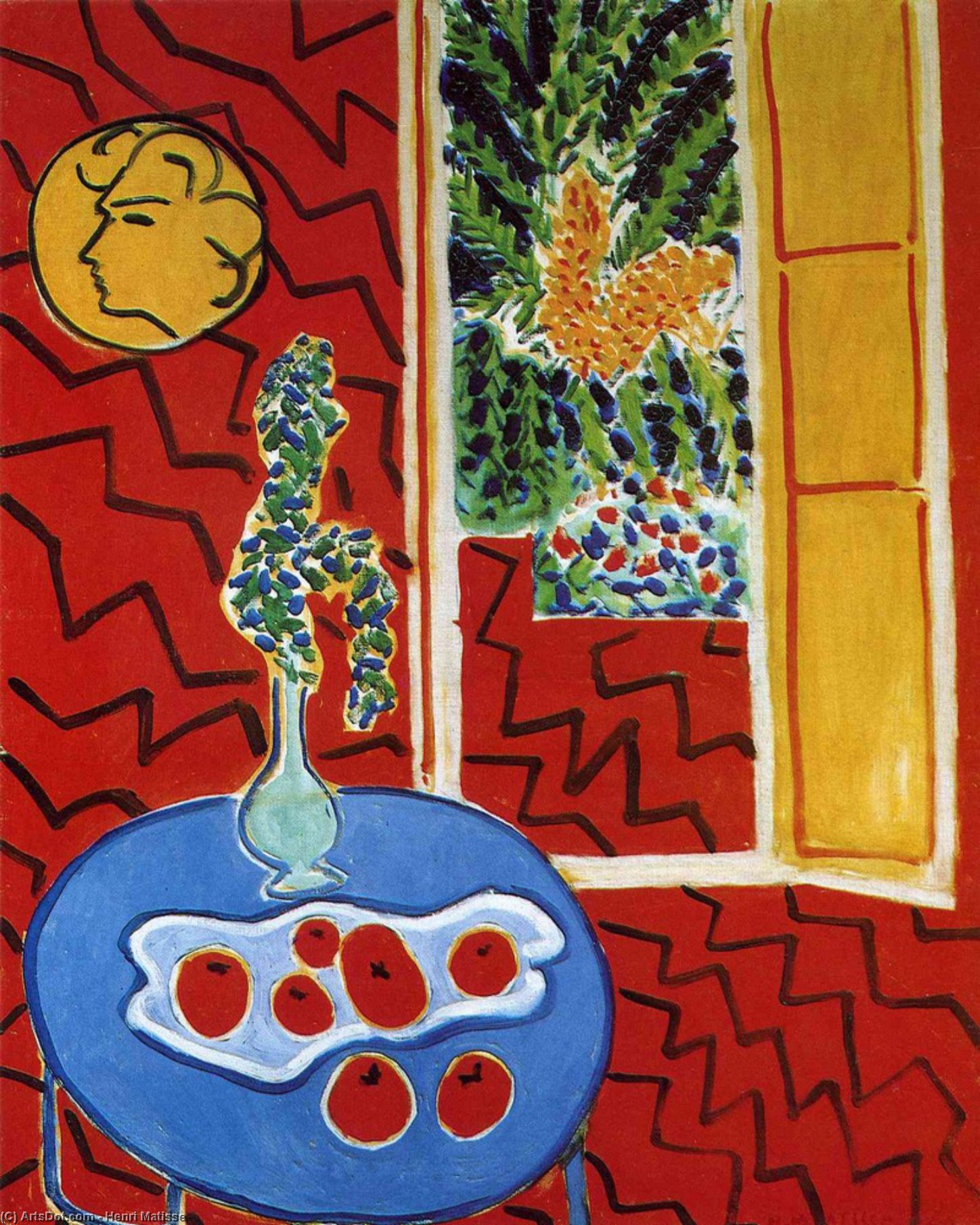
Red Interior. Still Life on a Blue Table
Henri Matisse’s “Red Interior. Still Life on a Blue Table,” created in 1947, stands as an emblem of his mature artistic vision—a testament to the enduring power of color and form within the realm of modern art. Measuring 116 x 89 cm and executed in oil on canvas, this artwork transcends mere representation; it embodies Matisse’s profound exploration of emotion and perception through a meticulously crafted visual language.
Artistic Context: Fauvist Innovation Revisited
Matisse's artistic journey began with the audacious experimentation of Fauvism—a movement that championed unrestrained color as expressive force rather than merely descriptive accuracy. Following his initial foray into Impressionism, Matisse swiftly embraced this revolutionary aesthetic, aligning himself with artists like André Derain and Maurice Denis to challenge prevailing artistic conventions. This bold stance solidified his reputation as one of the “wild beasts” of the art world, marking a pivotal moment in his career and establishing him as a pioneer of color theory. However, unlike his early works which were characterized by vibrant hues, Matisse’s later paintings—including "Red Interior"—demonstrated a refined mastery of composition and tonal subtlety, reflecting an ongoing dialogue with classical traditions while retaining the distinctive spirit of Fauvist innovation.
Painting Analysis: Harmony Amidst Bold Color
The painting's central focus is a blue table adorned with several apples and a vase containing greenery—a deceptively simple arrangement that belies the complex interplay of color and texture within its confines. Dominating the canvas is an overwhelming expanse of red, skillfully deployed to create a warm, inviting atmosphere and simultaneously drawing the viewer’s gaze toward the focal point. Complementing this dominant hue are subtle shades of yellow and green—particularly evident in the potted plants positioned strategically around the room—which contribute to the overall sense of depth and spatial harmony. Matisse's meticulous attention to detail is palpable throughout the composition, from the precise rendering of the fruit’s surfaces to the delicate brushstrokes that capture the nuances of light and shadow. Notably, a black zigzag pattern traverses the red walls and floor, amplifying the color intensity and enhancing the visual dynamism of the artwork—a technique reminiscent of Matisse's earlier explorations with cut-out collages and reflecting his unwavering commitment to expressive abstraction.
Artistic Influences: Echoes of Classical Tradition
Matisse’s artistic sensibilities were profoundly shaped by a diverse range of influences, spanning from Impressionism to Expressionism. Like many artists of his time, he wrestled with the challenge of reconciling formal experimentation with aesthetic ideals rooted in classical art—a preoccupation evident in his unwavering admiration for masters such as Jean-Baptiste Siméon Chardin and Nicolas Poussin. Furthermore, Matisse’s engagement with decorative patterns—particularly inspired by Islamic art—influenced his compositional choices and contributed to the overall elegance of his paintings. As evidenced by works like “Fleurs et céramique Huile sur Toile” and “Interior with Etruscan Vase,” Matisse consistently sought to distill artistic concepts into visually arresting forms, prioritizing clarity and balance while simultaneously conveying profound emotional resonance.
Legacy and Impact: A Timeless Masterpiece
Henri Matisse’s legacy extends far beyond the confines of his own lifetime—his influence continues to resonate within contemporary art practice and inspires countless artists worldwide. His pioneering use of color—particularly his exploration of chromatic harmony—established him as a cornerstone of modern painting, paving the way for subsequent generations of artists to embrace expressive abstraction while retaining an appreciation for formal elegance. For those seeking inspiration or contemplating acquiring a high-quality reproduction of “Red Interior,” consider visiting the Tate Modern Museum in London—a repository of international modern and contemporary art that honors Matisse’s enduring contribution to artistic history.