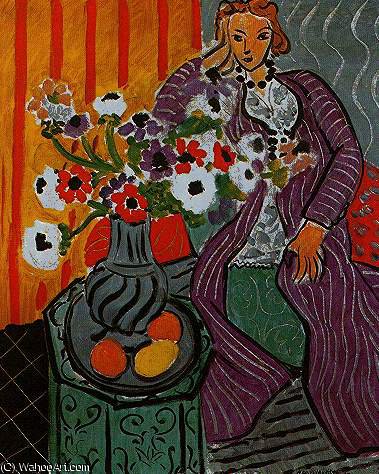
Admire Henri Matisse's masterpiece 'Robe Violette et Anémones,' a vibrant depiction of a woman and flowers, showcasing his revolutionary use of color and masterful draughtsmanship. Explore the beauty of Fauvist art!
Explore Henri Matisse (1869-1954): Fauvism's master of color! Discover iconic paintings, cut-paper collages & his influence on modern art. A leading French painter.
Robe Violette et Anémones: A Symphony of Color and Tranquility
The painting “Robe Violette et Anémones” by Henri Matisse stands as an emblem of Fauvist artistry—a bold declaration against the muted palettes of Impressionism, prioritizing vibrant hues to convey emotion rather than objective representation. Executed in 1937 during Matisse’s prolific period in Nice, this artwork embodies his masterful command of color and form, cementing its place within the canon of twentieth-century art history. It's a piece that invites contemplation and rewards repeated viewing with layers of subtle beauty.
Subject Matter and Composition
At first glance, “Robe Violette et Anémones” presents a deceptively simple scene: a woman seated before a vase brimming with anemones—flowers known for their delicate petals and upward-reaching stems. Matisse’s deliberate positioning of the figure centrally within the canvas emphasizes her stillness and serenity. The woman's hand resting gently on her face adds to this sense of introspection, suggesting a moment of quiet reflection amidst the vibrant floral display. This careful composition isn’t merely decorative; it serves as a conduit for conveying an emotional state—peaceful contemplation and appreciation for natural beauty.
Style and Technique: Fauvist Boldness
Matisse's signature style is unmistakably Fauvist, characterized by its unrestrained use of color – a radical departure from academic conventions. He eschewed blending colors to create subtle gradations, opting instead for juxtaposing pure hues—violet dominating the robe and contrasting sharply with the reds and oranges of the anemones. This technique isn’t simply about visual stimulation; it's about channeling emotion directly onto the canvas. Matisse achieved this effect through thick, expressive brushstrokes that capture the texture of the fabric and the vibrancy of the flowers. The flattened perspective—a hallmark of Fauvist painting—further enhances the impact of color by minimizing spatial depth, prioritizing surface appearance over realistic representation.
Historical Context: Embracing Modernity
“Robe Violette et Anémones” emerged during a period of significant artistic upheaval in Europe. Following World War I, artists like Matisse were rejecting traditional styles and exploring new avenues for expression—a reaction against the perceived pessimism and disillusionment of the era. The Fauvist movement championed color as a primary means of conveying emotion and experience, aligning with broader intellectual currents that questioned established norms. Matisse’s embrace of this stylistic innovation reflects his belief in art's ability to transcend mere imitation of reality and instead communicate profound psychological truths.
Symbolism and Emotional Impact
The violet robe itself symbolizes dignity and grace—a visual allusion to Matisse’s own artistic ideals. The anemones, with their upward-reaching stems and delicate petals, represent resilience and beauty amidst fragility. Together, they evoke a mood of tranquility and contemplation—a celebration of the natural world and an affirmation of inner peace. Matisse's masterful use of color achieves this emotional resonance by bypassing rational thought and tapping into primal instincts. The painting’s enduring appeal lies in its ability to transport viewers to a moment of serene beauty, reminding us of the transformative power of art.
Conclusion: An Icon of Fauvist Expression
“Robe Violette et Anémones” remains an unforgettable masterpiece—a testament to Matisse's genius and a cornerstone of Fauvist aesthetics. Its bold color palette, simplified forms, and contemplative composition continue to inspire artists and collectors alike, securing its place as one of the most beloved pieces within the Cone Collection at Baltimore Museum of Art. A high-quality reproduction allows admirers to experience this extraordinary artwork’s emotional depth and visual splendor firsthand.