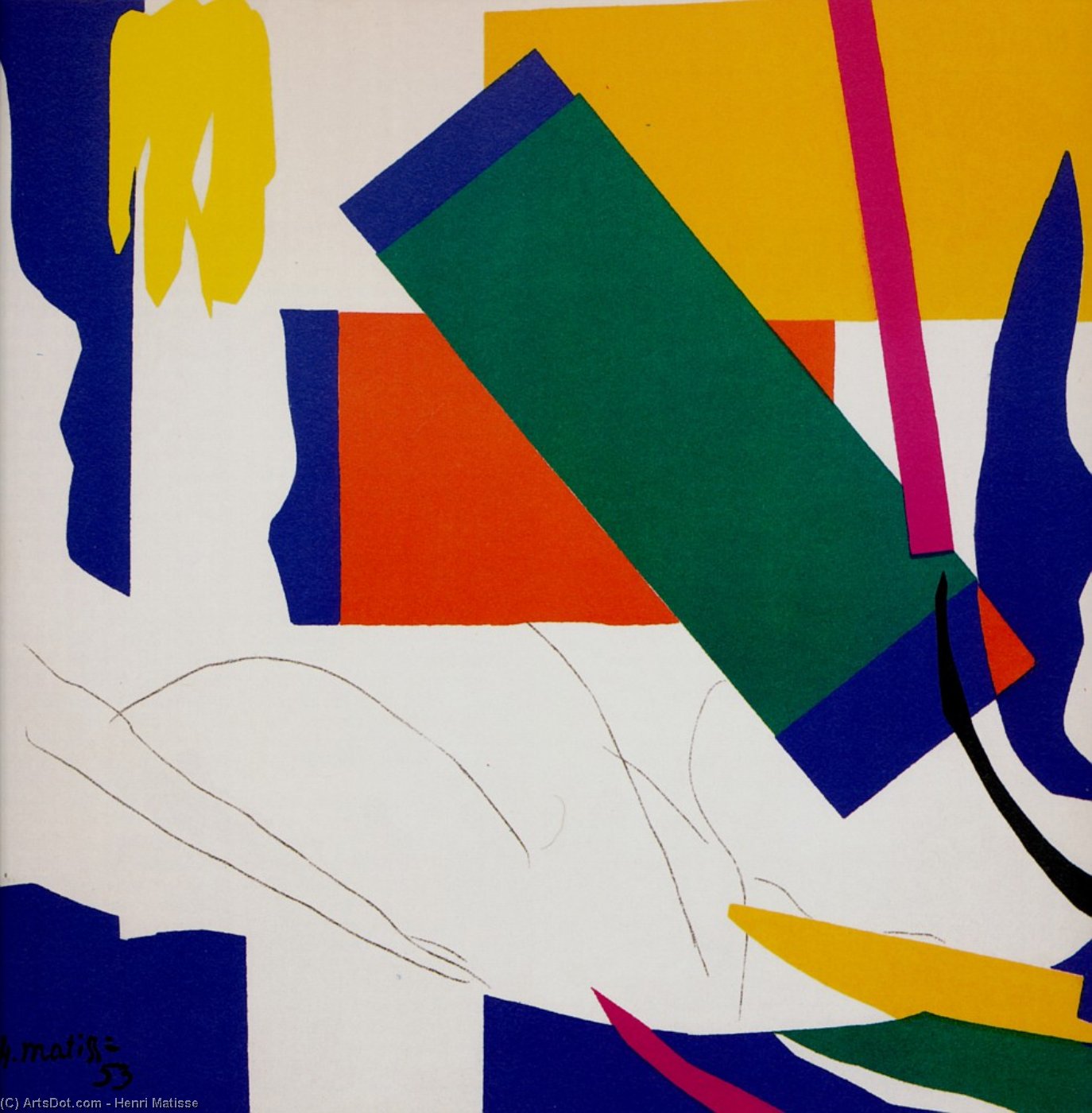
A Symphony of Color and Form: Exploring Matisse’s *Souvenir d'Océanie*
Henri Matisse’s *Souvenir d'Océanie*, a monumental work housed at The Museum of Modern Art in New York, is far more than just a visually striking composition; it represents a pivotal moment in the artist’s career and a bold declaration of Fauvist principles. Measuring an impressive 284 x 286 cm, this gouache découpée masterpiece envelops the viewer in a world of vibrant color and dynamic form, evoking a sense of tropical warmth and serene contemplation.
Decoding the Composition
At first glance, *Souvenir d'Océanie* presents a seemingly abstract arrangement of brightly colored shapes. However, closer inspection reveals a central reclining female figure – a recurring motif in Matisse’s oeuvre – surrounded by an exuberant array of geometric forms. These aren’t merely decorative elements; they function as both spatial indicators and emotional cues. The squares, rectangles, and organic cutouts interlock and overlap, creating a flattened perspective reminiscent of Polynesian textiles and the artist's own fascination with non-Western art. Two subtly placed figures – one near the top left and another at the bottom right – add depth and complexity to the composition without disrupting its overall harmony. The white background serves not as empty space but as an active element, allowing the colors to truly sing.
The Revolutionary Technique of Gouache Découpée
Matisse’s innovative use of *gouache découpée* – literally “cut gouache” – is central to understanding this work. Rather than applying paint directly to canvas, Matisse painted sheets of paper with vibrant gouache and then meticulously cut out shapes with scissors. This allowed him a freedom from traditional brushwork and an unprecedented control over color and form. The process itself was deeply satisfying for the artist, who described it as “drawing with scissors.” It also enabled him to create compositions that were both spontaneous and carefully considered, achieving a unique balance between intuition and intellect.
Fauvism and Beyond: Historical Context
*Souvenir d'Océanie* emerged from Matisse’s involvement in the Fauvist movement (meaning “wild beasts”), which shocked the art world with its radical use of color. Rejecting representational accuracy, the Fauves sought to express emotion through intense, non-naturalistic hues. While *Souvenir d'Océanie* retains the vibrant palette characteristic of Fauvism, it also marks a departure from earlier works. The simplification of forms and the emphasis on decorative patterns foreshadow Matisse’s later explorations in abstraction and his celebrated paper cutouts. This piece represents a bridge between his early Fauvist period and his mature style.
Symbolism and Emotional Resonance
The title, *Souvenir d'Océanie* (Memory of Oceania), hints at the inspiration behind this work: Matisse’s recollections of Polynesian art and culture. The flattened perspective and bold patterns echo the aesthetics of tapa cloth and other indigenous crafts. However, the painting is not a literal depiction of Oceania; rather, it’s an *impression* – a distillation of sensory experiences and emotional responses. The reclining figure embodies tranquility and sensuality, while the vibrant colors evoke feelings of joy, warmth, and vitality.
The artwork invites viewers to escape into a world of pure aesthetic pleasure.
A Lasting Legacy
*Souvenir d'Océanie* stands as a testament to Matisse’s artistic genius and his unwavering commitment to innovation. It continues to inspire artists, designers, and art lovers alike with its bold colors, dynamic composition, and masterful technique.
Its enduring appeal lies in its ability to transcend cultural boundaries and speak directly to the human spirit. For those seeking to bring a touch of modern elegance and vibrant energy into their spaces, a high-quality reproduction of this iconic work is an exceptional choice.
- Explore more about Henri Matisse: Wikipedia
- Discover The Museum of Modern Art: MoMA Website
- View related artworks by Matisse:
- La Leçon de piano:
- Poissons rouges et palette