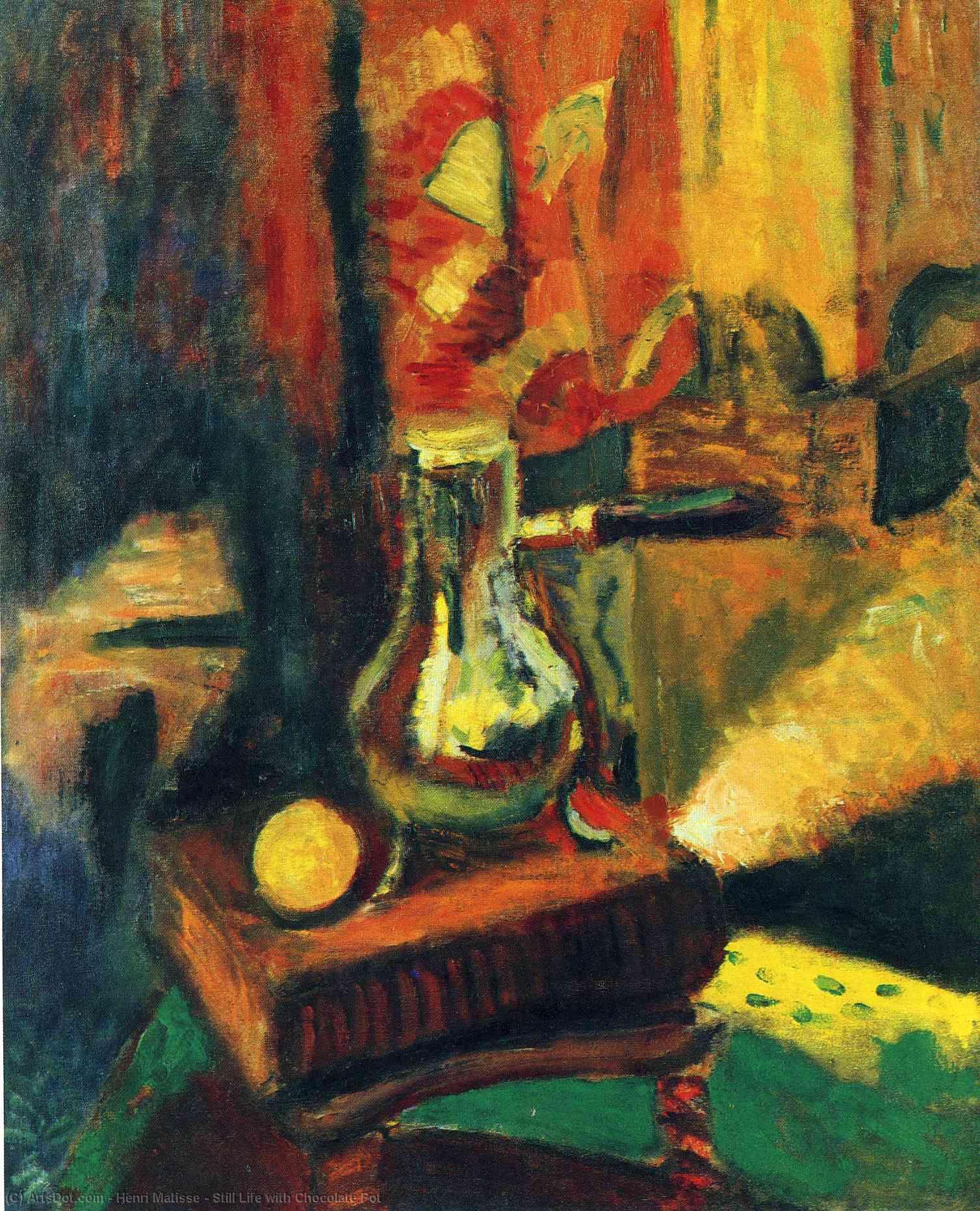
Discover "Still Life with Chocolate Pot" by Henri Matisse (1900). A vibrant Fauvist masterpiece showcasing bold colors, dynamic forms & everyday beauty. Explore its artistic context and legacy!
Explore Henri Matisse (1869-1954): Fauvism's master of color! Discover iconic paintings, cut-paper collages & his influence on modern art. A leading French painter.
Still Life with Chocolate Pot: A Fauvist Echo of Domestic Tranquility
Henri Matisse’s “Still Life with Chocolate Pot,” painted in 1900, transcends mere representation; it embodies the spirit of Post-Impressionism and foreshadows the bold experimentation that would define Fauvism. This unassuming composition—a vase perched atop a table alongside two bottles—holds within its vibrant hues and simplified forms a profound reflection on artistic innovation and the beauty found in everyday objects.
Composition and Elements: Beyond Surface Appearance
At first glance, the painting presents itself as a straightforward arrangement of domestic items. However, Matisse’s masterful technique elevates this simplicity into complexity. The vase dominates the visual field, its form subtly distorted to emphasize its presence. Positioned symmetrically on either side are two bottles—one leaning slightly—creating a balanced yet dynamic equilibrium. Beneath them rests a bowl, strategically placed to draw the eye downward and contribute to the overall sense of depth. Furthermore, three figures – delicately rendered in muted tones – inhabit the background, subtly grounding the scene and hinting at human presence within this idealized domestic space. The inclusion of a chair and couch reinforces this impression of comfort and serenity. Matisse skillfully employs oil on canvas, layering brushstrokes with meticulous care to achieve remarkable textural richness—a tactile quality that invites contemplation.
The Fauvist Breakthrough: Color as Emotion
“Still Life with Chocolate Pot” marks an important step in Matisse’s artistic journey toward Fauvism, a movement he spearheaded alongside Picasso. Unlike Impressionists who sought to capture fleeting moments of light and atmosphere, Matisse prioritized color—not as it objectively appears but as it conveys emotion. He deliberately rejected naturalistic hues, opting instead for intense shades of crimson, ochre, and cobalt blue—colors that pulsate with vibrancy and imbue the painting with an undeniable warmth. This chromatic boldness wasn’t merely stylistic; it represented a fundamental shift in artistic philosophy—a conviction that color could communicate feelings directly to the viewer. The deliberate simplification of forms – flattening planes and reducing detail – further underscores this expressive intent, prioritizing visual impact over precise realism.
Historical Context: A Moment of Artistic Transformation
Painted at the cusp of the 20th century, “Still Life with Chocolate Pot” arrived on the heels of Impressionism’s dominance. However, Matisse recognized that Impressionism's focus on optical perception was insufficient to capture the complexities of human experience. He sought inspiration in Symbolist art—particularly the works of Gustave Moreau—whose use of color and decorative patterns foreshadowed Fauvist principles. The painting reflects a broader cultural preoccupation with capturing inner states rather than external appearances, mirroring the burgeoning interest in psychology and introspection during this period. It stands as a testament to Matisse’s pioneering spirit and his unwavering belief in the transformative power of art.
Symbolism and Emotional Resonance: An Invitation to Contemplation
The choice of objects—the vase, bottles, bowl, figures—is laden with symbolic significance. The vase represents beauty and refinement, while the bottles symbolize stability and permanence. The muted tones of the figures convey a sense of tranquility and contemplation, inviting viewers to pause and appreciate the quiet dignity of domestic life. Ultimately, “Still Life with Chocolate Pot” succeeds in conveying an emotion – peace—through its masterful use of color and form. It’s a painting that speaks not just to the eye but also to the soul, reminding us that profound beauty can be found in the simplest of gestures and objects.