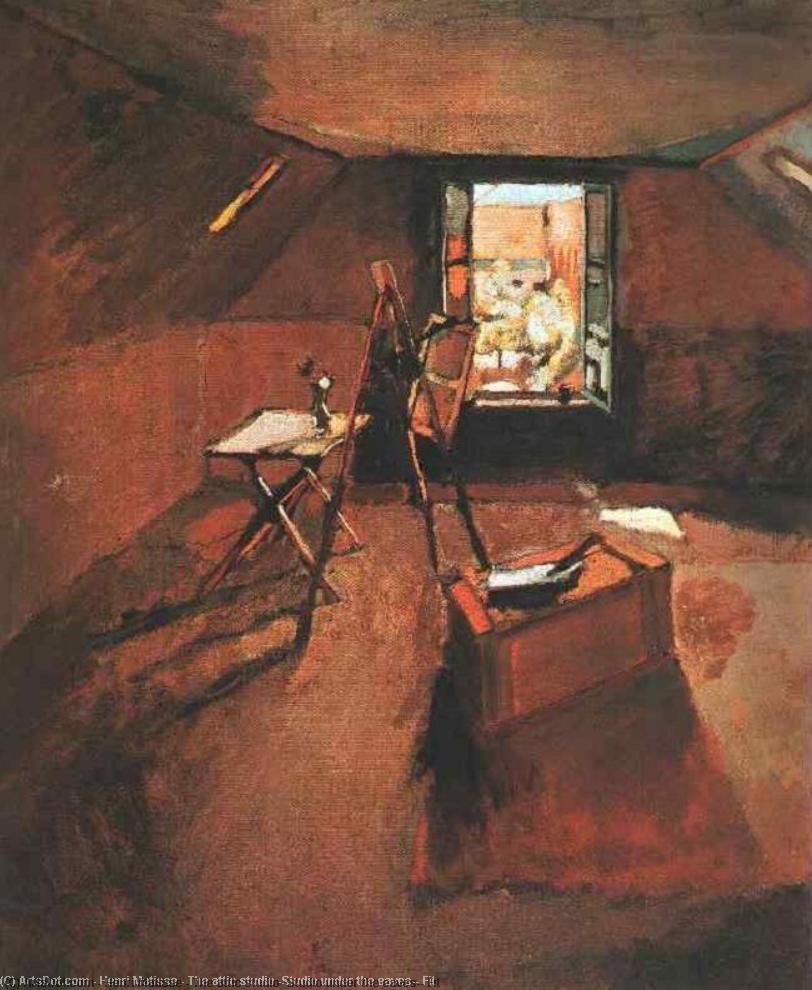
The Attic Studio (Studio under the eaves), Fit
Henri Matisse’s *Studio Under the Eaves*, painted in 1903, stands as an arresting testament to both artistic struggle and profound observation—a cornerstone of Fauvist expressionism that continues to resonate with audiences today. More than just a depiction of a workspace, it embodies Matisse's deeply personal response to circumstance, channeling anxieties about familial responsibility and capturing the essence of creative immersion within a deceptively simple composition.
- Historical Context: The painting emerged during a period of considerable upheaval for Matisse personally—a time marked by financial difficulties stemming from his wife’s involvement in a scandalous fraud case orchestrated by Thérèse Humbert. This crisis fueled an atmosphere of uncertainty and prompted Matisse to seek refuge in the quietude of his parents' home in Bohain-en-Vermandois, where he wrestled with reconciling artistic ambition with familial obligations.
- Style & Technique: Matisse’s approach distinguishes itself from Impressionism’s focus on fleeting light effects; instead, he employs a deliberately flattened perspective—a technique borrowed from Cézanne—to heighten the sense of spatial depth and to emphasize the importance of form over mere surface appearance. The palette is restrained, dominated by muted tones punctuated by splashes of vibrant color—primarily reds—that draw attention to the central window and its luminous glow. Matisse’s brushstrokes are loose and expressive, conveying a palpable feeling of movement and capturing the immediacy of observation.
- Composition & Symbolism: The studio's arrangement is meticulously considered, with furniture positioned strategically to direct the viewer’s gaze towards the dominant element—the window—which serves as a conduit for natural light and symbolizes hope amidst adversity. The inclusion of objects like a chair, table, and books reflects Matisse’s intellectual curiosity and underscores the creative atmosphere of the space. Notably, the placement of the easel and palette reinforces the artist's preoccupation with his craft and embodies the dedication required to sustain artistic practice.
- Emotional Impact: Beyond its formal qualities, *Studio Under the Eaves* communicates a powerful emotional resonance—a palpable sense of vulnerability and determination conveyed through Matisse’s masterful use of color and brushwork. The painting captures not only the physical realities of Matisse's life but also his inner turmoil, reflecting his profound engagement with the world around him and embodying the artist’s unwavering commitment to artistic expression.
Further Exploration: To delve deeper into Henri Matisse’s oeuvre and the broader context of Fauvist art, consider visiting
https://ArtsDot.com/@/Henri-Matisse for biographical information and critical analyses. Also explore reproductions of *Studio Under the Eaves* at
https://fitzmuseum.cam.ac.uk/explore-our-collection/highlights/PD14-1964 to appreciate the painting's visual richness and enduring artistic significance.