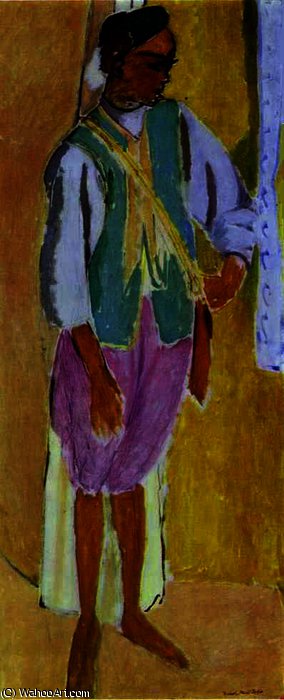
A Window into Matisse’s Soul: The Luminous World of ‘The Moroccan Amido’
The Moroccan Amido, Left-hand Panel of a Triptych stands as a breathtaking testament to the transformative power of color and the serendipitous nature of artistic destiny. Henri Matisse, an artist whose name is now synonymous with the vibrant pulse of modernism, did not initially set out to redefine the visual language of the twentieth century. His early life in Bohain-en-Vermandois was marked by the steady, predictable rhythms of a family of grain merchants and the looming shadow of a legal career. Yet, it was a sudden bout of appendicitis in 1889 that fundamentally altered his trajectory. During the quiet, forced convalescence of his recovery, Matisse discovered an innate talent for painting—a discovery that would eventually lead him away from the courtroom and into the luminous, expressive realms of Fauvism and beyond.
In this particular panel, we encounter a moment of profound stillness captured through Matisse’s signature mastery of form and hue. The subject matter presents a woman seated before a window, her posture suggesting a quiet, introspective gaze directed toward the world outside. There is an intimate, almost voyeuristic quality to the scene, as if the viewer has stumbled upon a private moment of contemplation. Through his use of bold simplification and flattened planes of color, Matisse rejects the heavy-handed illusionism of traditional realism. Instead, he invites us into a space where emotional resonance takes precedence over meticulous anatomical detail, allowing the essence of the subject to breathe through the very pigment itself.
Technique and the Alchemy of Color
The technical execution of this piece reveals the profound depth Matisse achieved even when working with seemingly simplified structures. Utilizing gouache on canvas, the artist employed a sophisticated method of layering thin washes of pigment to achieve a remarkable luminosity. This technique creates a tonal richness that feels both velvety and radiant, as if light were trapped beneath the surface of the paint. The application of a matte varnish further enhances this effect, providing a soft, tactile texture that invites the eye to linger on the subtle transitions of shade.
For the discerning collector or interior designer, this artwork offers more than mere decoration; it provides a focal point of sophisticated energy. The interplay between the subject and her environment—the way the light from the window seems to interact with the textures of her attire—creates a sense of atmospheric depth that is rare in much more literal works. The presence of subtle elements, such as the hint of a handbag or the delicate placement of accessories, adds layers of narrative intrigue, suggesting a life lived with grace and quiet purpose.
A Legacy of Emotional Resonance
Beyond its formal beauty, ‘The Moroccan Amino’ serves as a bridge to the revolutionary spirit of the early twentieth century. As a key figure in the Fauvist movement, Matisse sought to liberate color from its descriptive duties, using it instead as a direct conduit for emotion. This piece embodies that liberation, offering a sanctuary of harmony and joy. The painting does not merely depict a woman by a window; it captures the very feeling of light, the weight of silence, and the beauty of a captured moment.
- Style: Expressive abstraction characterized by bold simplification and vibrant color palettes.
- Emotional Impact: A sense of tranquil contemplation and luminous warmth.
- Ideal For: High-end interior spaces seeking a sophisticated, modern, yet timeless atmosphere.
Whether one is drawn to the historical significance of Matisse’s evolution or the sheer aesthetic pleasure of his color theory, this panel remains an enduring masterpiece. It is a piece that continues to inspire, offering a window not just into a Moroccan interior, but into the very heart of a genius who saw the world through a prism of infinite possibility.