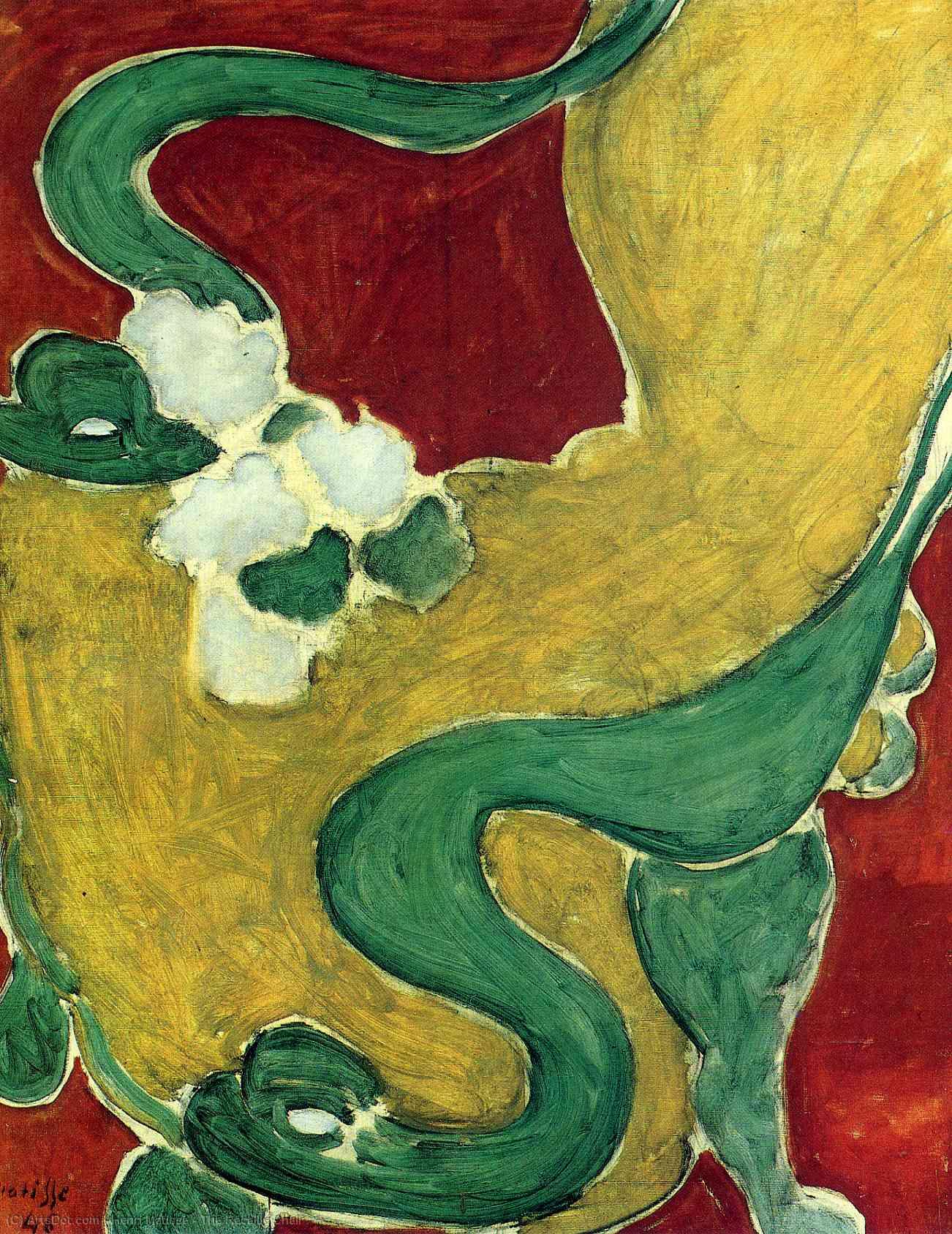
The Racaille Chair – A Fauvist Symphony of Color and Form
Henri Matisse’s “The Racaille Chair,” completed in 1946, stands as a cornerstone of Expressionism and a testament to the artist's unwavering commitment to exploring the emotive power of color. Housed at the Musée Matisse in Nice, France, this interior genre painting transcends mere depiction; it embodies Matisse’s revolutionary approach to artistic representation—a deliberate departure from realism toward conveying feeling and atmosphere.
- Dimensions: 92 x 73 cm
- Date: 1946
- Location: Musée Matisse, Nice, France
Composition and Symbolism – A Dragon’s Embrace
The artwork immediately captivates with its bold chromatic palette. Dominating the canvas is a vibrant red background—a deliberate choice by Matisse that pulsates with energy and dynamism. Against this fiery backdrop unfolds an arresting image: a stylized serpent or dragon-like creature rendered in shades of yellow and green, actively consuming what appears to be a bird.
This symbolic gesture speaks volumes about Matisse’s artistic vision. The serpent represents primal instinct and transformation, while the bird symbolizes vulnerability and innocence—a juxtaposition that underscores themes of struggle and resilience. The careful positioning of the figures flanking the chair adds depth and complexity to the composition, inviting contemplation on the interplay between form and emotion.
Matisse's Expressionistic Technique – Fluid Lines and Vibrant Color
Matisse’s masterful technique exemplifies the core tenets of Fauvism. He eschewed meticulous detail in favor of loose brushstrokes—a deliberate decision to prioritize color over precise representation. Thick impasto creates textural richness, enhancing the visual impact of the painting and conveying a palpable sense of movement.
The artist’s use of color is particularly noteworthy. Matisse employs hues that are deliberately intensified beyond naturalistic standards—resulting in an almost hallucinatory vibrancy. This technique serves not merely to stimulate the eye but also to evoke profound emotional responses, mirroring the artist's own inner state and reflecting his belief in art as a vehicle for conveying subjective experience.
Henri Matisse – A Pioneer of Modern Art
Born December 31, 1869, Henri Émile Benoît Matisse was a French painter who profoundly shaped the trajectory of modern art. Initially pursuing law, he discovered his true vocation through painting after an illness sidelined him from legal studies. Influenced by artists like Cézanne and Gauguin, Matisse embraced Fauvism—a movement characterized by unrestrained color and expressive brushwork—establishing himself as a leading figure alongside Pablo Picasso.
Throughout his prolific career spanning over five decades, Matisse explored diverse mediums including painting, printmaking, sculpture, and drawing. His iconic works such as “Le rideau jaune,” “La Chaise aux pêches,” “Zorah sur la terrasse,” “Les Tapis rouges” continue to inspire artists and collectors alike—solidifying his legacy as one of the most influential painters of the 20th century.
Explore more about Henri Matisse’s artistic journey and discover stunning reproductions of his masterpieces at WikiArt!