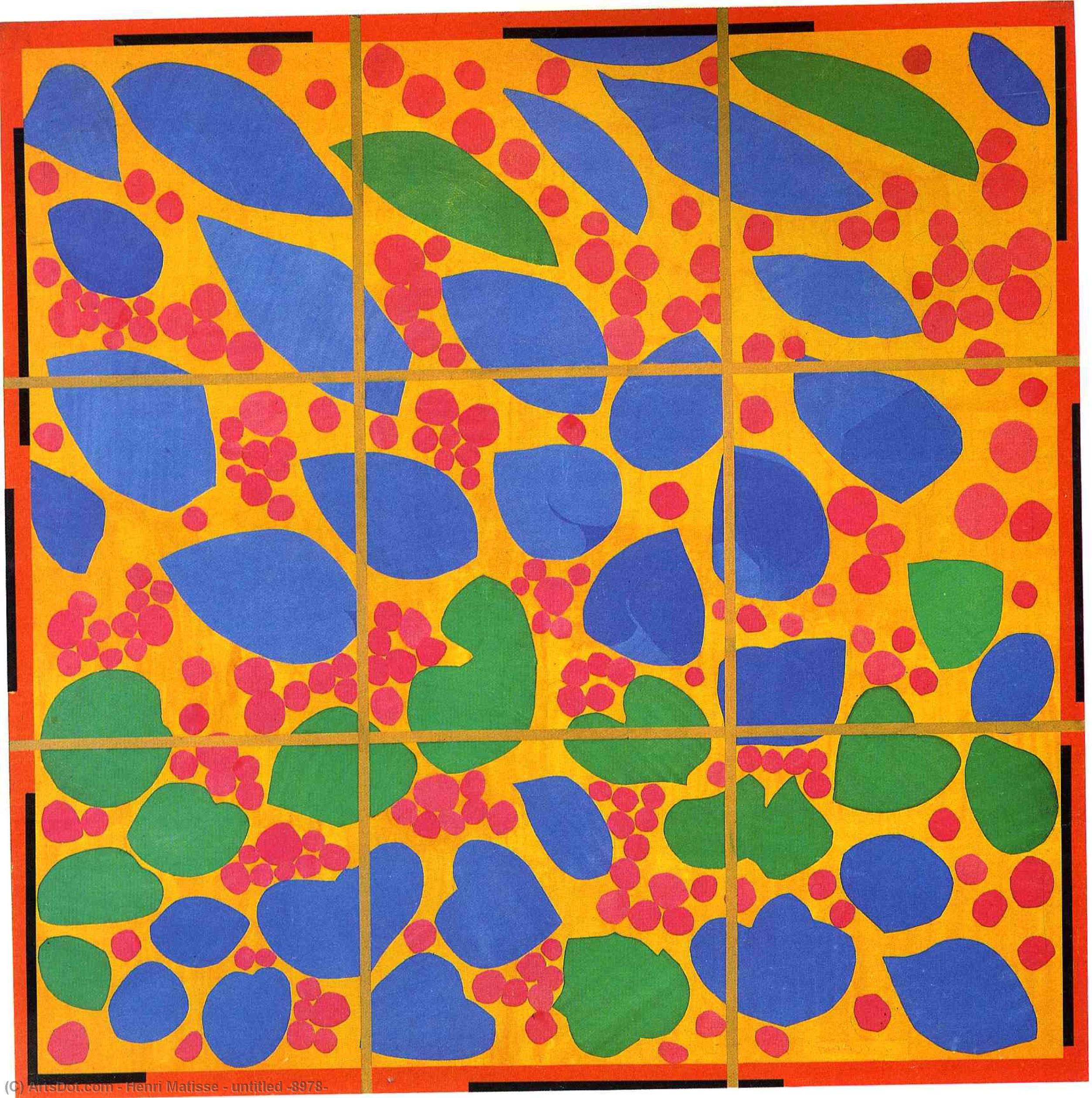
Explore 'untitled (8978)' by Henri Matisse, a captivating abstract composition of vibrant colors and geometric shapes. Discover the essence of Fauvism and Matisse's innovative style.
Explore Henri Matisse (1869-1954): Fauvism's master of color! Discover iconic paintings, cut-paper collages & his influence on modern art. A leading French painter.
A Symphony of Form and Color: Decoding Matisse’s Untitled Composition
Henri Matisse, a name synonymous with vibrant color and joyous expression, stands as a titan of 20th-century art. While many recognize his iconic depictions of domestic bliss or the lush sensuality of his odalisques, this particular untitled work – designated ‘8978’ – offers a fascinating glimpse into another facet of his artistic exploration. The piece presents itself as an intimate study in abstraction, a captivating arrangement of geometric shapes and hues that invites prolonged contemplation. Rather than representing a specific scene or object, the painting operates on a purely visual level, prioritizing the interplay of color, form, and texture. Squares of red, blue, and green dominate the composition, some adorned with delicate leaf-like motifs, creating a mosaic-like effect. Horizontal bands subtly divide the canvas, lending structure to the seemingly spontaneous arrangement. This isn’t merely decoration; it's a carefully orchestrated visual experience.
The Fauvist Legacy and Beyond
To understand this work, we must consider Matisse’s artistic journey. Emerging in the early 20th century, he became a leading figure of the Fauvist movement – “fauves” meaning “wild beasts” – characterized by its radical use of intense, non-naturalistic color. While ‘8978’ doesn't possess the unrestrained exuberance often associated with early Fauvism, it clearly demonstrates Matisse’s lifelong fascination with color as an independent expressive force. The boldness of the reds and blues isn’t intended to mimic reality but rather to evoke emotion and create a dynamic visual rhythm. However, this piece also hints at a later evolution in his style. After the initial fervor of Fauvism subsided, Matisse increasingly sought simplification and order. He moved towards more decorative patterns and flattened forms, influenced by his travels to North Africa and his study of Islamic art. ‘8978’ embodies this shift, showcasing a refined sense of composition and a deliberate reduction of pictorial elements.
Technique and the Pursuit of Harmony
The technique employed in ‘Untitled (8978)’ is particularly intriguing. The image suggests a collage-like construction, with individual colored squares meticulously arranged to create a cohesive whole. This approach aligns with Matisse’s later experiments with cut paper collages – *découpages* – where he liberated color and form from the constraints of traditional painting. While this work appears to be painted rather than cut, it shares the same spirit of playful experimentation and emphasis on surface design. The subtle variations in tone within each square, along with the delicate leaf patterns, reveal Matisse’s masterful control of his medium. He wasn't simply applying color; he was building a harmonious visual structure, balancing contrasting hues and creating a sense of depth through layering and repetition.
An Emotional Resonance
Ultimately, ‘Untitled (8978)’ transcends its formal qualities to evoke a powerful emotional response. The vibrant colors radiate energy and optimism, while the geometric arrangement provides a sense of calm and order. It’s a work that invites viewers to lose themselves in its visual intricacies, to appreciate the beauty of pure form and color. This piece is not about *what* it depicts but rather *how* it makes you feel. Its abstract nature allows for personal interpretation, making it a truly engaging and thought-provoking artwork. For those seeking to infuse their spaces with a touch of modern elegance and artistic sophistication, a reproduction of ‘Untitled (8978)’ offers a captivating focal point – a testament to Matisse’s enduring legacy as a master of color and form.