Matisse himself described his aim as "creating anew," prioritizing emotional resonance over objective observation. He sought to capture the essence of Collioure—its radiant sunlight, its vibrant colors—through a simplified visual language that prioritized feeling.
“Everything must be created anew,” he proclaimed, encapsulating the Fauvist ethos.
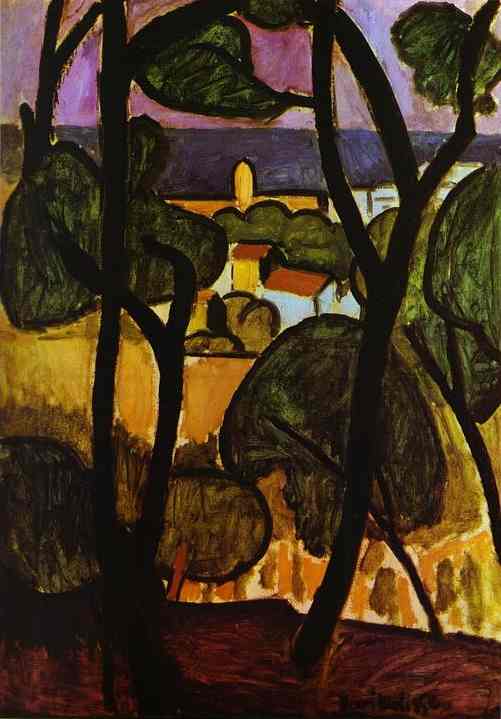
Vue de Collioure, le Clocher Collection Kate Steichen: A Fauvist Masterpiece
Henri Matisse’s “View of Collioure,” painted in 1907, stands as a cornerstone of Fauvist art—a movement that irrevocably altered the course of twentieth-century painting. More than just a picturesque depiction of the Catalan coastal town, it embodies Fauvism's audacious embrace of color and its rejection of traditional representational conventions.
- Subject Matter: The canvas captures Collioure’s vibrant landscape—rolling hills dotted with umbrella pines overlooking the azure Mediterranean Sea. Dominating the scene is the belltower of Collioure’s church, a focal point for Matisse's compositional strategy.
- Style & Technique: Matisse employed a revolutionary technique characterized by flattened planes of color applied directly to the canvas without blending or shading. This approach prioritizes visual impact over meticulous realism, resulting in an intensely expressive image. Thick impasto—heavy application of paint—creates textural surfaces that amplify the vibrancy of the hues.
- Color Palette: The painting’s palette is astonishingly bold and unconventional. Matisse eschewed naturalistic color gradations, opting instead for jarring juxtapositions of saturated reds, oranges, yellows, blues, and pinks. These colors aren't merely decorative; they convey emotion—joyful exuberance and a palpable sense of warmth.
- Historical Context: Fauvism emerged in Paris during the Belle Époque (1871–1914), reacting against Impressionism’s subtle tonal harmonies. Matisse and André Derain spearheaded this movement, challenging artistic dogma and paving the way for Abstract Expressionism decades later.
- Symbolic Significance: The deliberate use of white canvas—areas untouched by pigment—serves as a crucial element in conveying Matisse's vision. These blank spaces illuminate the colors surrounding them, enhancing their luminosity and creating an ethereal atmosphere. Furthermore, the composition itself suggests harmony between humanity and nature—a reflection of Matisse’s humanist philosophy.
“View of Collioure” continues to captivate viewers with its uncompromising chromatic intensity and masterful execution. It exemplifies Matisse's belief that “everything must be created anew,” cementing his legacy as one of the most influential artists of the modern era. Its enduring appeal resides in its ability to transport us back to a moment of artistic liberation—a testament to Fauvism’s transformative impact on art history.