A Fauvist Portrait of Serenity: Exploring Matisse’s ‘Woman’
This captivating oil painting by
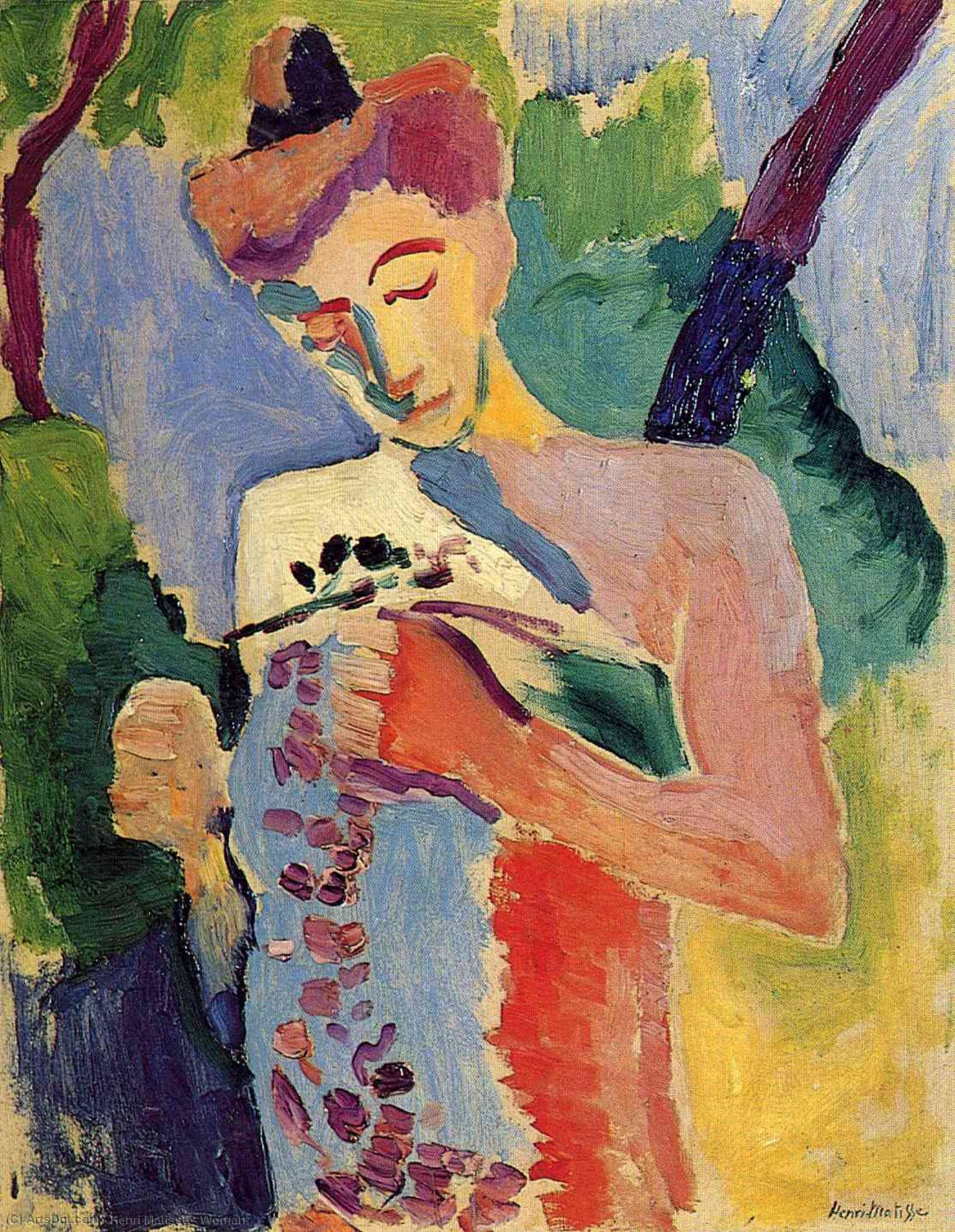
Henri Matisse embodies the revolutionary spirit of Fauvism – a short-lived but profoundly influential movement in early 20th-century art. The work presents a solitary woman, rendered not as a precise likeness, but as an explosion of color and emotion. It’s a piece that invites contemplation and offers a powerful example of Matisse's dedication to expressing inner feeling through bold artistic choices.
Subject & Composition
The painting centers on a woman holding a bouquet of flowers, her figure dominating the vertically oriented canvas. Her dark hair frames a face characterized by simplified features and a serene expression. She is dressed in a striking red gown that immediately draws the eye, contrasting vividly with the surrounding environment. The composition isn’t about realistic depiction; instead, Matisse prioritizes the arrangement of color and form to create an impactful visual experience. The background, a dense tapestry of greens, blues, and pinks, doesn't represent a specific location but rather serves as an emotional echo of the figure herself.
Fauvism & Artistic Technique
Matisse was a leading figure in the Fauvist movement (meaning “wild beasts” in French), which rejected traditional Impressionist and Post-Impressionist approaches to painting. Instead, Fauvists embraced
arbitrary color – using colors not to represent reality but to express emotion. This is brilliantly demonstrated here. The thick application of oil paint, known as *impasto*, creates a rich texture and adds to the artwork’s tactile quality. Notice how Matisse employs loose, gestural brushstrokes; these aren't intended to define form with precision, but rather to convey energy and feeling. Perspective is deliberately ambiguous, further emphasizing the emotional impact over accurate spatial representation.
Historical Context & Matisse’s Evolution
Born in 1869, Henri Matisse initially pursued a conventional path, studying law before discovering his passion for art. He trained at prestigious academies like the Académie Julian and École Nationale des Beaux-Arts, absorbing classical influences from artists such as Chardin, Poussin, and Watteau. However, he quickly moved beyond these traditional foundations, becoming a pioneer of modern art. The period in which this painting was created (date unknown) represents Matisse’s exploration of radical color and simplified forms – a pivotal moment in his artistic development that would ultimately redefine the landscape of 20th-century painting.
Symbolism & Emotional Resonance
While open to interpretation, the symbolism within the artwork is compelling. The flowers held by the woman likely represent beauty, fragility, and perhaps even remembrance. The red dress could symbolize passion or vitality, standing out against the cooler tones of the background. More broadly, the painting evokes a sense of quiet contemplation and inner peace. It’s not a narrative scene; it's an exploration of mood and emotion through color and form. The diffused lighting contributes to a dreamlike atmosphere, inviting viewers to project their own feelings onto the subject.
For Collectors & Interior Designers
This artwork – or a high-quality reproduction – would be a stunning addition to any collection. Its bold colors and expressive style make it a focal point in a modern interior. The painting’s emotional depth adds sophistication and intrigue, while its Fauvist aesthetic provides a vibrant counterpoint to more traditional décor. Consider pairing it with neutral tones to allow the artwork's colors to truly shine or incorporating complementary shades of green and blue from the background into your space for a cohesive look.
- Style: Fauvism
- Medium: Oil on Canvas
- Key Features: Bold Color, Simplified Forms, Expressive Brushwork