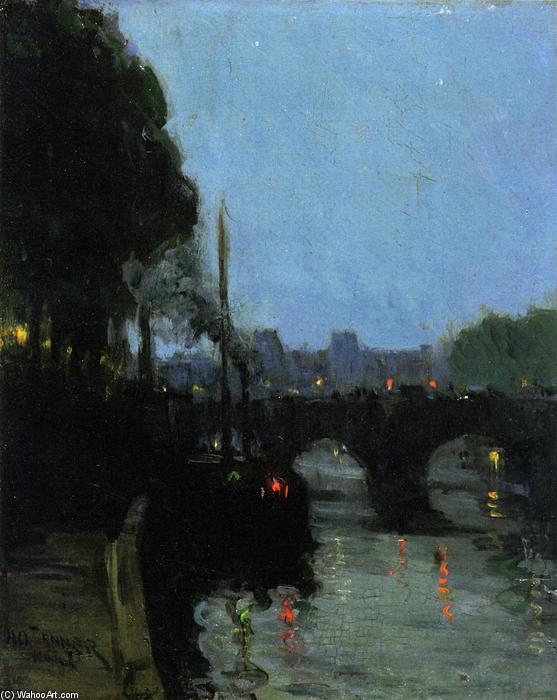
A Glimpse into Twilight: The Essence of Paris
Henry Ossawa Tanner’s “The Seine – Evening” isn't merely a depiction of a river; it’s a carefully constructed distillation of the soul of Paris at dusk. Painted in 1900, this oil on canvas transports us to the banks of the Seine, capturing not just its physical form but also the palpable sense of romance and quiet contemplation that permeated the city during that era. Tanner, a pioneering African American artist who navigated both artistic and racial barriers with remarkable grace, imbued this scene with an almost dreamlike quality – a testament to his ability to translate observation into profound emotional resonance.
The painting immediately draws the eye to the luminous water, rendered in subtle shades of blue and grey. It’s not a harsh, reflective surface; instead, it possesses a velvety depth, hinting at the secrets held within its currents. The buildings lining the river are suggested rather than precisely defined, their outlines softened by the gathering darkness and the atmospheric haze characteristic of Parisian evenings. This deliberate ambiguity invites the viewer to project their own memories and emotions onto the scene, transforming it into a personal experience.
The Artist’s Hand: Technique and Style
Tanner's mastery lies in his ability to capture light and shadow with exquisite precision. He employs a technique that blends realism with impressionistic touches – a hallmark of his style. Notice the delicate gradations of color, particularly in the reflections shimmering on the water’s surface. He utilizes broken brushstrokes, layering pigments to create texture and depth without sacrificing clarity. The composition is carefully balanced, drawing our eye along the river's flow towards the distant train, a symbol of movement and progress against the backdrop of timeless beauty.
- Color Palette: Dominated by blues, greys, and subtle browns – evoking the twilight hour.
- Brushwork: A blend of smooth, blended areas and delicately broken strokes, creating a sense of both realism and atmosphere.
- Composition: Balanced and flowing, guiding the viewer’s eye along the river's path.
A Reflection of an Era: Historical Context
“The Seine – Evening” was painted during a period of significant social and artistic change in France. The late 19th century witnessed the rise of Impressionism, challenging traditional academic styles and embracing fleeting moments of light and color. Tanner’s work reflects this shift, while simultaneously retaining a strong sense of realism and narrative. He lived and worked primarily in Paris during this time, immersing himself in the vibrant artistic community and drawing inspiration from the city's rich cultural heritage.
Furthermore, it is important to acknowledge Tanner’s position as one of the first African American artists to achieve international recognition. His success was all the more remarkable considering the systemic racism that limited opportunities for Black artists at the time. “The Seine – Evening” stands as a powerful symbol of his perseverance and artistic vision.
Symbolism and Emotional Resonance
Beyond its technical brilliance, "The Seine - Evening" resonates with deeper symbolic meaning. The river itself represents the flow of life, while the darkening sky suggests both mystery and tranquility. The distant train symbolizes progress and connection, yet it also hints at the transient nature of time. The scene evokes a sense of nostalgia – a longing for simpler times and a quiet appreciation for the beauty of everyday moments. It’s a painting that invites contemplation, prompting us to reflect on our own experiences and connections to the world around us.
Reproductions of this captivating artwork offer a wonderful opportunity to bring a touch of Parisian elegance into any space. Its serene atmosphere and evocative imagery make it an ideal choice for living rooms, studies, or any area where you seek a moment of peaceful reflection.