A Glimpse into the Regency Era: The Presence of Archibald Buchanan
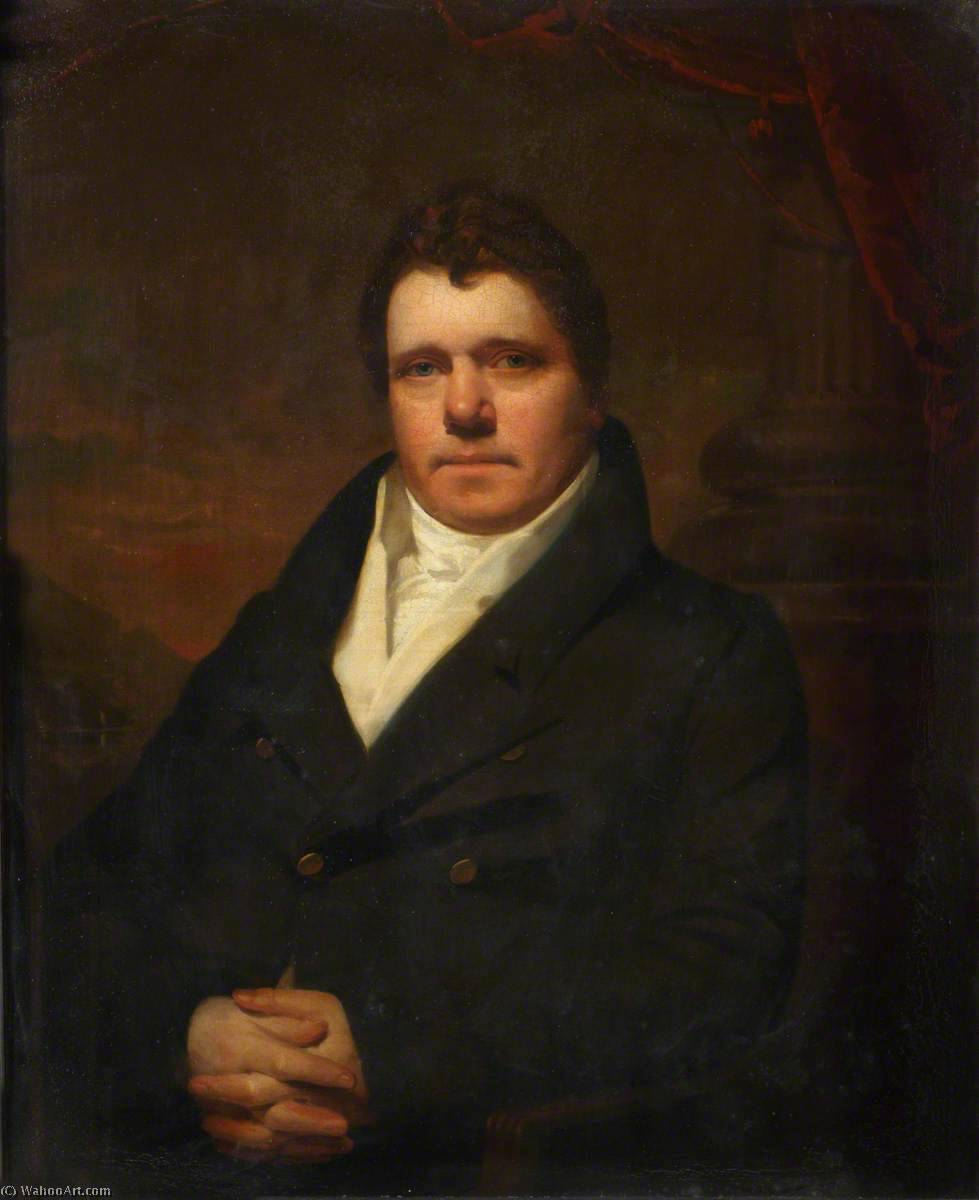
In this masterful portrait from 1823, Sir Henry Raeburn captures more than just a likeness; he captures an era of profound dignity and social refinement. The subject, Archibald Buchanan, stands before the viewer with a quiet, commanding confidence that speaks to the burgeoning importance of the professional class in early nineteenth-century Scotland. Dressed in the sophisticated attire of his time, featuring a meticulously rendered suit and tie, Buchanan possesses an air of understated elegance. His hands, tucked casually yet poised within his pockets, suggest a man at ease with his station, while his direct gaze establishes an intimate connection with anyone who stands before the canvas. The composition is enriched by the subtle presence of a heavy curtain in the background, which provides a sense of theatrical depth and classical grandeur, framing the subject in a way that elevates him from a mere individual to a figure of historical significance.
The artistry of Raeburn, often celebrated as a master of Scottish realism, is on full display through his command of light and texture. The painting utilizes a sophisticated interplay of shadow and illumination to sculpt the features of Buchanan, lending a three-dimensional vitality to the portrait. One can almost feel the weight of the fabric in his suit and the smoothness of the skin, achieved through a technique that balances precise detail with fluid, painterly brushstrokes. This approach allows the light to dance across the surfaces, creating a luminous quality that draws the eye toward the subject's face. The background, though softly focused, contains hints of other figures and textures that prevent the space from feeling hollow, instead creating a rich, atmospheric environment that surrounds the sitter in a cocoon of historical permanence.
For the discerning collector or interior designer, this reproduction offers much more than a decorative element; it serves as a window into the soul of the Enlightenment. The emotional impact of the piece lies in its ability to evoke nostalgia for a time of structured grace and intellectual vigor. When placed within a curated space—perhaps above a dark wood mantelpiece or in a study lined with leather-bound books—the portrait acts as an anchor of sophistication. It brings a sense of heritage and gravitas to a room, making it an ideal choice for those looking to infuse their interiors with a sense of timelessness and academic prestige. To possess such a work is to invite the quiet strength of the past into the modern home, celebrating the enduring power of human character captured through the lens of a true master.