A Vision of Command: The Soul of Captain Hay of Spot
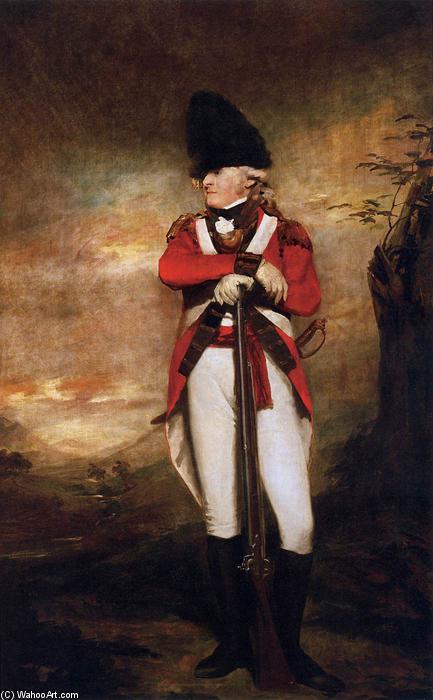
In the grand tapestry of British portraiture, few works capture the intersection of military discipline and individual character as profoundly as Sir Henry Raeburn’s “Captain Hay of Spot.” Completed in 1800, this masterpiece serves as a cornerstone of Scottish Romanticism, offering much more than a mere record of a man’s likeness. As we gaze upon Captain Robert Hay, a Colonel in the Royal Artillery, we are not simply observing a high-ranking officer; we are invited into a moment of quiet, resolute dignity. Raeburn, a master who rose from the meticulous world of goldsmithing and miniature painting on ivory, brings an unparalleled sensitivity to the canvas. Every element of the composition is designed to evoke a sense of presence, making the subject feel as though he has just stepped from the shadows of history into the light of the present.
The emotional resonance of the piece lies in its ability to balance authority with vulnerability. While the Captain’s stance—hands crossed over his chest, grasping the hilt of his saber—speaks to his martial prowess and social standing, his direct gaze engages the viewer with an intimacy that is rare in formal portraiture of the era. There is a palpable sense of solidity in his form, a weightiness that suggests a man forged by the turbulent Napoleonic Wars. For the collector or the interior designer, this painting offers a profound emotional anchor; it possesses a commanding energy that can transform a room, providing a focal point that is both intellectually stimulating and aesthetically soothing.
The Mastery of Light and Texture
Raeburn’s technical brilliance is most evident in his sophisticated use of chiaroscuro. By orchestrating a dramatic interplay between deep shadows and soft, directional light, he sculpts the Captain’s features with remarkable three-dimensionality. This technique does not merely illuminate the subject; it breathes life into the very textures of his existence. One cannot help but be captivated by the meticulous rendering of the scarlet military coat, where the heavy fabric seems to hold the warmth of a fading dusk. The crispness of the white breeches and the subtle, reflective sheen on the black leather boots demonstrate a level of precision that speaks to Raeburn’s background in fine detail work.
The artist avoids the trap of idealized perfection, opting instead for an unflinching realism that celebrates the authentic textures of life. The soft, atmospheric landscape in the background—a tapestry of rolling hills and twilight trees—provides a naturalistic counterpoint to the sharp, structured details of the uniform. This contrast between the ruggedness of the Scottish landscape and the refined elegance of the officer’s attire creates a visual harmony that is both captivating and timeless. For those seeking a high-quality reproduction, these nuances in brushwork and tonal variation are what make the piece feel truly alive, allowing the light to dance across the canvas just as it did in Raeburn's original studio.
A Legacy of Nobility and Grace
To possess or display a work inspired by “Captain Hay of Spot” is to embrace a legacy of historical significance. The painting emerged during a period of immense social upheaval, a time when the very identity of Britain was being reshaped by global conflict. In this context, the portrait serves as a symbol of stability and the enduring strength of the individual amidst the tides of change. The scarlet of the uniform acts as a bold, rhythmic pulse against the more subdued, earthy tones of the environment, making it an exquisite choice for sophisticated interior palettes that favor classic, regal accents.
Whether gracing the walls of a private library, a formal dining room, or a curated gallery space, this work transcends simple decoration. It is an invitation to contemplate the virtues of duty, honor, and the quiet strength of character. As an investment in art appreciation, a reproduction of this caliber allows the splendor of Raeburn’s Scottish Romanticism to become a permanent part of one's personal sanctuary, offering a window into an era of unparalleled grace and heroic spirit.