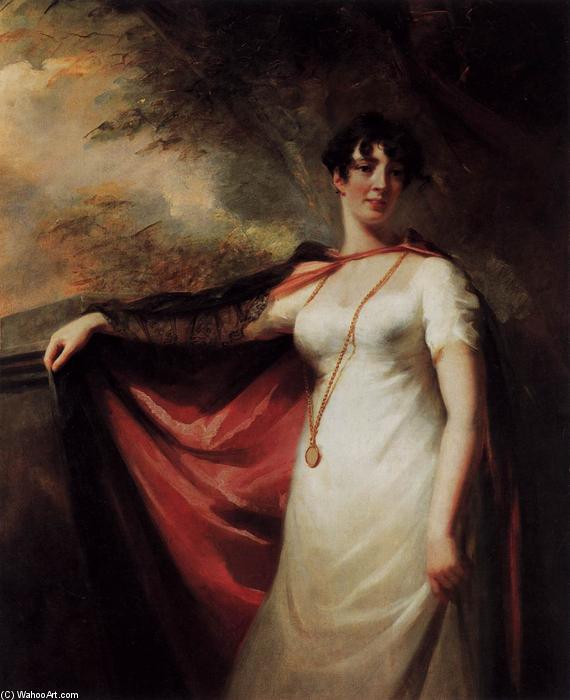
The Enigmatic Beauty of Mrs. Anne Hart
Henry Raeburn’s “Mrs. Anne Hart,” painted in 1810, is more than just a portrait; it's a carefully constructed tableau of domestic tranquility and quiet contemplation. The canvas immediately draws the eye to its subject – a woman radiating an understated elegance within a richly appointed interior. She occupies a space that feels both familiar and subtly mysterious, her gaze directed towards a distant window, seemingly lost in thought. This isn’t a boisterous celebration of wealth or social standing; instead, Raeburn masterfully captures a moment of introspective peace, a rare intimacy within the confines of 19th-century aristocratic life.
The painting's neoclassical style is evident in its balanced composition and classical references. The arrangement of figures – Mrs. Hart seated gracefully, flanked by two gentlemen on either side – adheres to established portrait conventions, yet Raeburn imbues the scene with a distinctly personal touch. Notice how he subtly incorporates elements of the room itself into the narrative; the ornate fireplace, the richly patterned wallpaper, and even the shadows cast by the window all contribute to a sense of depth and realism. The use of light is particularly noteworthy – it’s diffused and warm, bathing the scene in a gentle glow that softens the edges and emphasizes the subject's serene expression.
A Window into Georgian Society
To fully appreciate “Mrs. Anne Hart,” it’s crucial to understand the social context of its creation. The painting emerged during the early 19th century, a period of significant change in Britain – the rise of the industrial revolution, the expansion of the empire, and the gradual shift from the rigid formality of the Georgian era to the more relaxed sensibilities of the Regency. Portraits like this were not merely decorative; they served as powerful statements of status and lineage, meticulously documenting the lives and achievements of the wealthy elite. Raeburn’s depiction of Mrs. Hart reflects these values – her attire, her demeanor, and the luxurious setting all speak to her position within society.
The inclusion of the two gentlemen adds another layer of complexity to the scene. They are not simply observers; they actively participate in the narrative, suggesting a close relationship with Mrs. Hart. Their presence hints at the social obligations and expectations that governed aristocratic life – the importance of family, friendship, and maintaining appearances within one’s social circle. The subtle gestures between them—a slight nod, a shared glance—add an element of unspoken communication, inviting the viewer to speculate about their connection.
The Artistry of Detail: Technique and Symbolism
Raeburn's technical skill is immediately apparent in the meticulous detail with which he renders every aspect of the painting. The textures of the fabrics—the velvet cushions, the silk shawl draped across Mrs. Hart’s lap—are rendered with astonishing realism. He employs a technique known as “sfumato,” blurring the edges and softening the forms to create an atmosphere of depth and luminosity. This is particularly evident in the depiction of the window, where the light seems to spill out onto the scene, casting long shadows and creating a sense of atmospheric perspective.
Beyond technical mastery, Raeburn incorporates subtle symbolism into the composition. The distant landscape visible through the window—a rolling hillside dotted with trees—represents escape and contemplation. It’s a visual metaphor for Mrs. Hart's inner life, suggesting that she is seeking solace and inspiration in nature. The red sash around her neck, a vibrant splash of color against the muted tones of the room, could symbolize passion or perhaps even remembrance – a subtle nod to a past love or cherished memory.
A Timeless Portrait of Intimacy
“Mrs. Anne Hart” endures as one of Henry Raeburn’s most celebrated works, and for good reason. It's not simply a likeness; it’s a profound exploration of human emotion and the complexities of domestic life. The painting’s enduring appeal lies in its ability to evoke a sense of quiet intimacy—a feeling that we are privy to a private moment of reflection within a world of privilege and restraint. It remains a testament to Raeburn's remarkable talent for capturing not just appearances, but also the very essence of his subjects.