A Vision of Command: The Soul of Rear-Admiral Charles Inglis
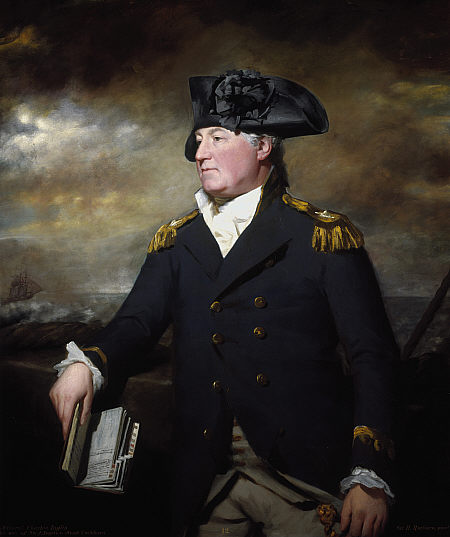
In the quiet intensity of Henry Raeburn’s 1783 masterpiece, Rear-Admiral Charles Inglis, one does not merely encounter a portrait of a naval officer; one meets the very essence of Enlightenment-era authority. As a preeminent figure of Scottish Romantic realism, Raeburn possessed a rare, almost supernatural ability to peel back the layers of social status to reveal the psychological truth beneath. In this work, the subject stands with a profound sense of purpose, his gaze directed toward an unseen horizon, suggesting a mind preoccupied with the vast, unpredictable reaches of the sea. The painting serves as a breathtaking window into a pivotal era of maritime history, capturing a man whose life was defined by the salt spray and the strategic rigors of the Royal Navy.
The composition is masterfully orchestrated to evoke a sense of dignified permanence. Clad in formal attire that speaks to his high station, Inglis is framed by elements that whisper of intellect and duty. The subtle inclusion of a book near the lower corner acts as a poignant symbol, bridging the gap between the physical prowess required of a commander and the scholarly wisdom necessary for leadership. This juxtaposition creates a narrative of a complete man—one whose strength is matched by his erudition. For the discerning collector or interior designer, such a piece offers more than decoration; it provides a focal point of intellectual depth, anchoring a room with its historical gravity and commanding presence.
The Mastery of Light and Texture
Raeburn’s technical brilliance is on full display through his revolutionary approach to oil painting. Eschewing the stiff, overly polished conventions of his contemporaries, he embraced a more naturalistic, tactile style. He achieved a remarkable luminosity by meticulously layering thin, translucent glazes, a technique that allows light to penetrate the paint and reflect from within, giving the skin of his subject a lifelike warmth. This method is particularly evident in the way Raeburn captures the varied textures of the Admiral's world—the soft, organic plume of the feather in his hat, the heavy, authoritative drape of his uniform, and the subtle play of shadow across the canvas.
His background as a trained goldsmith and miniature painter on ivory clearly informs this obsession with precision. Every brushstroke is calculated to contribute to the overall sense of materiality. When viewing a high-quality reproduction of this work, one can almost feel the weight of the fabric and the crispness of the light. This tactile quality makes the portrait an exceptional choice for sophisticated interiors, where it can interact dynamically with ambient lighting, casting a storied and atmospheric glow upon any gallery wall or study.
An Enduring Legacy for the Modern Collector
To possess a work inspired by Raeburn is to hold a piece of Scotland’s artistic soul. His ability to transcend mere likeness to achieve a sense of "unflinching honesty" ensures that his subjects remain vital and resonant centuries after their creation. Rear-Admiral Charles Inglis stands as a testament to an era of exploration, bravery, and the burgeoning scientific spirit of the late 18th century.
For those seeking to curate a space that reflects timeless elegance and historical significance, this portrait offers unparalleled inspiration. It is a piece that invites conversation, prompting viewers to contemplate the weight of command and the quiet dignity of a life lived with conviction. Whether placed in a grand library or a contemporary living space, Raeburn’s mastery continues to captivate the heart, offering a profound emotional connection to the enduring spirit of human greatness.