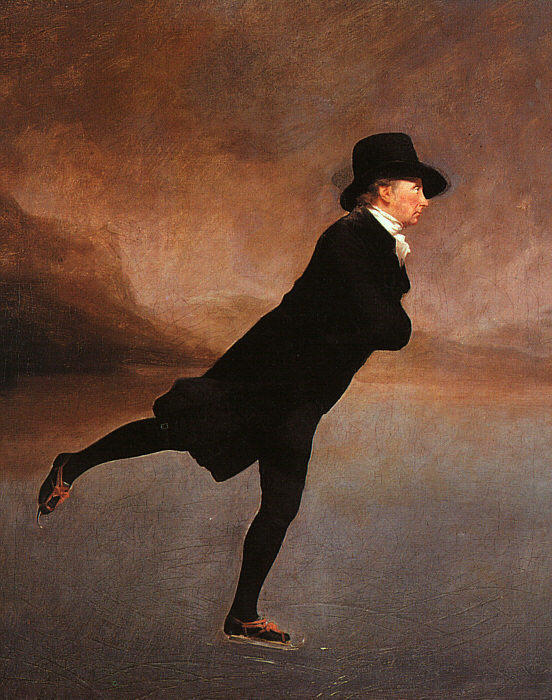
A Moment Frozen in Time: The Skating Minister by Henry Raeburn
Henry Raeburn’s “The Skating Minister” is more than just a portrait; it's a captivating snapshot of leisure and social grace, frozen in time during the winter months of 1824. This iconic work, depicting a gentleman engaged in what appears to be an impromptu skating session, reveals Raeburn’s mastery of realism and his keen eye for capturing not just physical likeness but also the very essence of human character. The painting immediately draws the viewer into a scene brimming with quiet activity – a minister, seemingly unconcerned with formal attire, lost in the joy of the moment. It's a testament to Raeburn’s ability to elevate a simple pastime into something profoundly evocative.
The Rise of Scottish Realism
Born in Stockbridge, Scotland, in 1756, Henry Raeburn was a pivotal figure in the burgeoning movement towards British realism. Unlike the prevailing Neoclassical style that favored idealized forms and mythological subjects, Raeburn sought to depict his subjects – often members of the Scottish gentry and aristocracy – with unflinching honesty and naturalism. His early training as a goldsmith instilled within him an unparalleled attention to detail, a meticulousness evident in every brushstroke. This dedication is particularly striking in “The Skating Minister,” where the texture of the man’s coat, the sheen of the ice, and even the subtle expression on his face are rendered with astonishing precision. Raeburn's success was revolutionary; he became the first native Scottish painter to achieve widespread acclaim and royal patronage, setting a new standard for portraiture in Britain.
Technique and Composition
Raeburn’s technique is characterized by loose, expressive brushwork that contributes significantly to the painting’s dynamic feel. He employed a ‘wet-on-wet’ method – applying wet paint onto wet canvas – allowing colors to blend seamlessly and creating a sense of movement. The composition itself is deceptively simple yet remarkably effective. The minister dominates the frame, his outstretched arms and posture conveying both effort and enjoyment. The mountainous background, rendered in muted tones, provides depth and context, suggesting a vast winter landscape. Note the subtle use of light – it illuminates the minister’s face and clothing, drawing attention to his form while casting shadows that add to the painting's three-dimensionality. This masterful control of light and shadow is a hallmark of Raeburn’s style.
Symbolism and Social Context
“The Skating Minister” offers a fascinating glimpse into the social customs of early 19th-century Scotland. Ice skating was a popular winter pastime among the upper classes, offering an opportunity for recreation and socializing. The minister's relaxed demeanor suggests a departure from formal protocol, highlighting the importance of leisure and personal enjoyment within this social stratum. While the precise meaning of the scene remains open to interpretation, it’s likely intended to portray a moment of uninhibited pleasure – a celebration of life amidst the beauty of winter. The painting’s enduring appeal lies not only in its technical brilliance but also in its ability to capture a timeless human experience: the simple joy of movement and connection with nature.