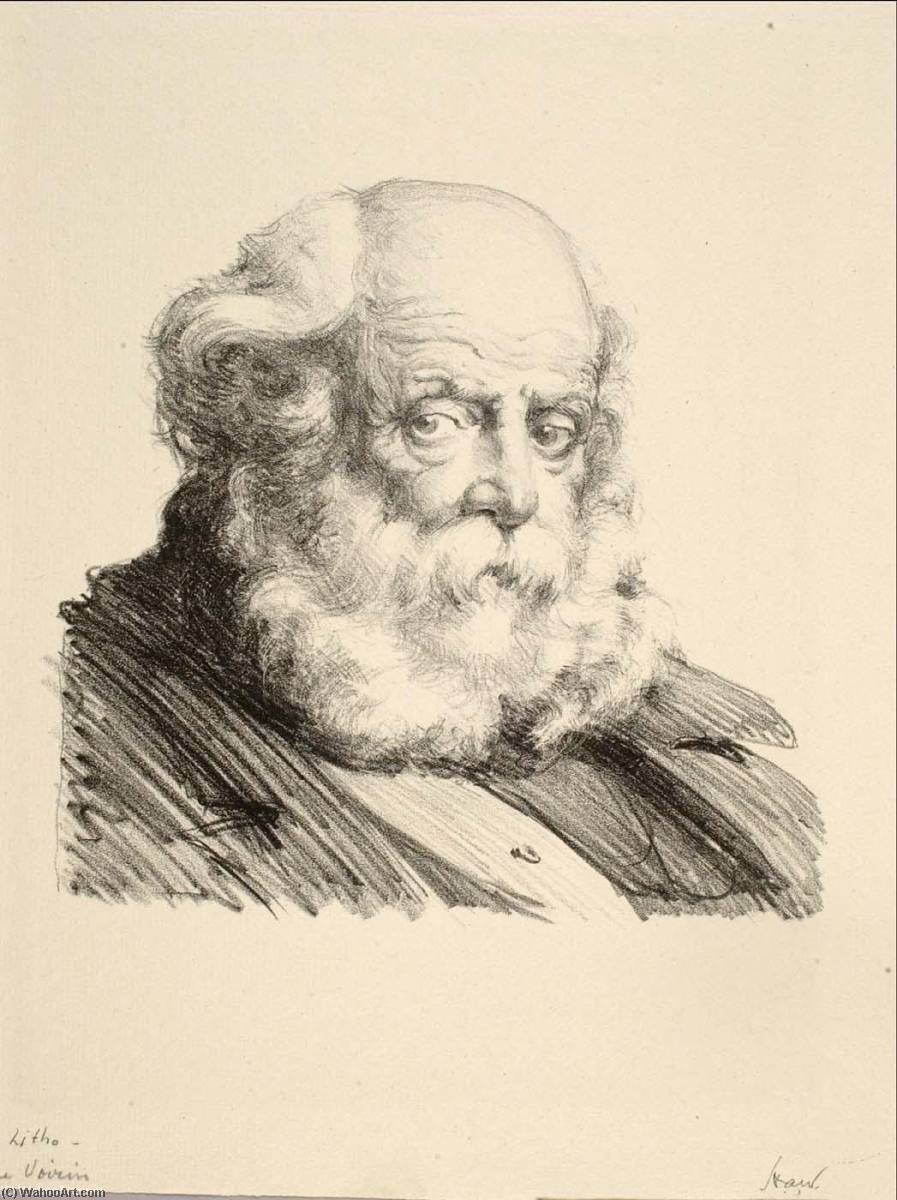
The painting
Voirin, le Pere by
Herman Armour Webster is a remarkable piece of art that showcases the artist's skill and attention to detail. Created in 1923, this lithograph measures 34 x 26 cm and is part of the collection at the
Smithsonian American Art Museum. The image is a black and white lithograph of a man with a beard and mustache, giving an impression of being serious or even angry.
Artist Background
Herman Armour Webster was an American artist, born on April 6, 1878, in New York. He studied art at the
Académie Julian in Paris, where he met
Donald Shaw MacLaughlan, a Canadian artist who introduced him to the world of printmaking. Webster's work is characterized by his use of bold lines and expressive brushstrokes, as seen in his other notable works such as
Les Chaumieres de Change pres de Maintenon.
Painting Style and Technique
The painting
Voirin, le Pere is a prime example of Webster's skill in lithography. The use of bold lines and contrasting tones creates a sense of depth and dimensionality. The subject's facial expression is particularly noteworthy, conveying a sense of intensity and emotion. This style is reminiscent of other artists such as
Mary Vaux Walcott, who also created stunning paintings of plants and flowers, like
Brook Lobelia (Lobelia kalmii).
Importance of the Painting
The painting
Voirin, le Pere is not only a beautiful piece of art but also an important part of American art history. It showcases Webster's contribution to the development of printmaking in the United States and his influence on other artists. As seen on
ArtsDot.com, this painting is a testament to the artist's skill and attention to detail.
For more information on
Herman Armour Webster and his works, visit
ArtsDot.com or check out his biography on
Wikipedia.
- Lithography is a technique used to create prints by drawing on stone or metal plates.
- Smithsonian American Art Museum is one of the largest and most comprehensive collections of American art in the world.