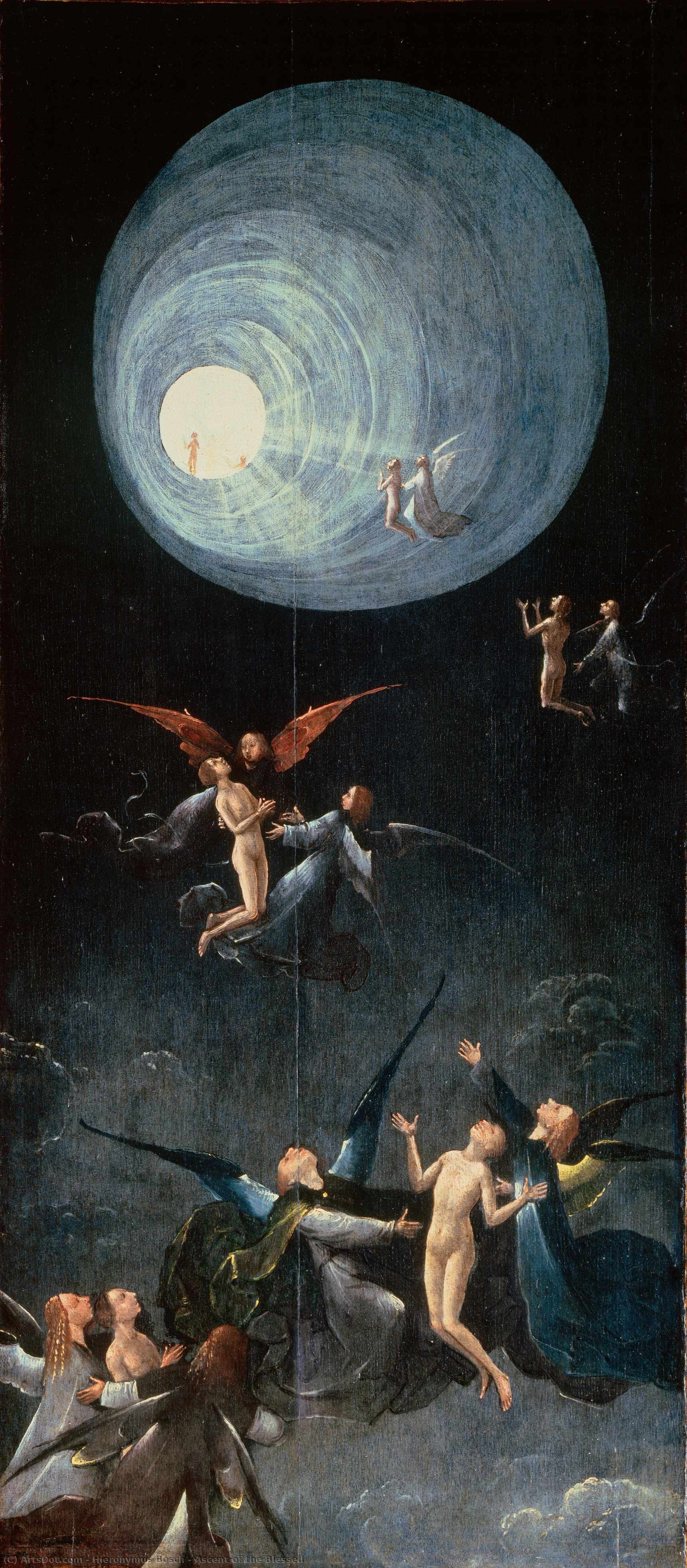
A Descent Into Divine Mystery: Hieronymus Bosch’s “Ascent of the Blessed”
Hieronymus Bosch's "Ascent of the Blessed," painted circa 1505-1515, isn’t merely a depiction of religious ascension; it’s an immersive descent into a meticulously crafted dreamscape—a visual embodiment of anxieties and spiritual yearning characteristic of the Northern Renaissance. This extraordinary polyptych panel, now housed in the Gallerie dell'Accademia in Venice, immediately captivates with its swirling blues, unsettling juxtapositions, and a profound sense of otherworldly depth. It’s a work that rewards prolonged contemplation, revealing layers of symbolism and technical mastery that continue to fascinate art historians today.
Bosch, born Jheronimus van Aken in ’s-Hertogenbosch, Netherlands, operated within a period of intense religious fervor yet also growing societal unease. His artistic vision, deeply rooted in late medieval folklore and a burgeoning sense of the unknown, manifested in works that often blended biblical narratives with fantastical imagery—a hallmark of his unique style. Unlike many of his contemporaries who adhered strictly to established conventions, Bosch deliberately subverted expectations, creating unsettling scenes filled with hybrid creatures, grotesque details, and ambiguous moral messages. “Ascent of the Blessed” is a prime example of this approach, inviting viewers not simply to observe but to actively engage in deciphering its complex symbolism.
A Symphony of Color and Form
The painting’s composition immediately draws the eye towards the central, dominant sphere—a luminous blue vortex that seems to both contain and propel the figures within. This swirling mass isn't a simple backdrop; it’s an active participant in the scene, radiating light and drawing the viewer into its depths. The color palette is predominantly cool, dominated by varying shades of blue, grey, and muted reds and yellows—a deliberate choice that contributes to the painting’s somber yet captivating atmosphere. The stark contrast between the dark background and the lighter tones within the sphere creates a dramatic sense of volume and emphasizes the figures' ascent.
Bosch masterfully employs line to define both the human and angelic forms, but these lines are rarely precise or linear. Instead, they appear somewhat blurred and sketchy, contributing significantly to the painting’s dreamlike quality. The swirling patterns within the central sphere are rendered with a dynamic energy, suggesting movement and transformation. The use of circular shapes—particularly in the sphere itself—dominates the composition, while angular shapes are present in the wings of the figures, adding visual tension and complexity.
Technique and Materials: A Layered Masterpiece
“Ascent of the Blessed” was executed primarily in oil paint on a wooden panel, a technique that allowed Bosch to achieve remarkable subtlety and layering. Close inspection reveals visible brushstrokes—a deliberate choice that adds texture and depth to the painting’s surface. The artist skillfully manipulated color gradients and employed glazing techniques to create an illusion of three-dimensionality, particularly within the central sphere, which appears to recede into the distance. The panel itself is likely a poplar wood, chosen for its affordability and workability—a common material used by artists of the period.
Symbolism and Spiritual Journey
Beyond its visual beauty, “Ascent of the Blessed” is rich in symbolic meaning. The central blue sphere is often interpreted as representing divine presence or enlightenment—a gateway to a higher realm. The figures ascending towards it are souls being drawn upwards, embarking on a spiritual journey toward salvation. However, Bosch’s work rarely offers simple answers; the scene is fraught with ambiguity and unsettling details. The presence of grotesque creatures, decaying bodies, and scenes of earthly indulgence suggests that the path to heaven is not easily attained and requires constant vigilance against temptation.
The polyptych's arrangement—with “Ascent of the Blessed” positioned alongside depictions of Hell and Terrestrial Paradise—further emphasizes the precariousness of human existence. Bosch’s work serves as a potent reminder of humanity’s dual nature—our capacity for both profound spiritual aspiration and base, earthly desires. “Ascent of the Blessed” is not merely a religious painting; it's a psychological portrait of the human condition, rendered with unparalleled skill and unsettling beauty.