The Unsettling Drama of Human Folly
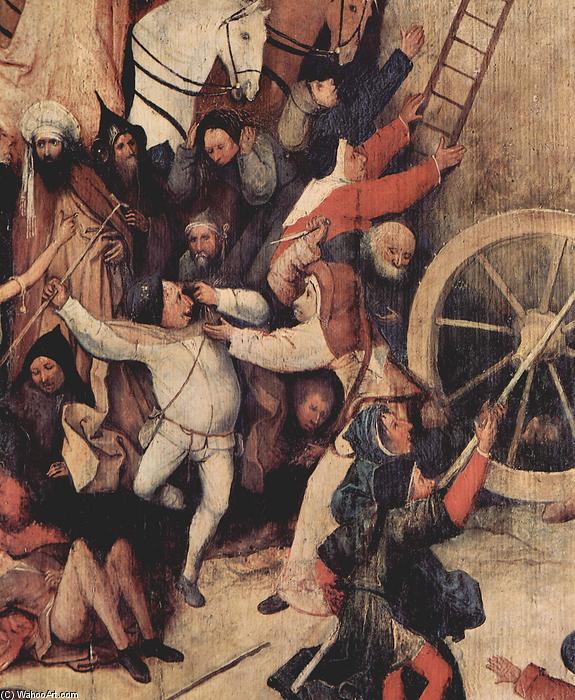
To stand before a depiction such as Haywain (detail) is not merely to observe paint on canvas; it is to step directly into the fevered, symbolic landscape of the late medieval mind. Hieronymus Bosch’s vision possesses an undeniable, almost visceral power, pulling the viewer into a tableau vivant steeped in anxiety and moral reckoning. The scene itself presents a gathering around a figure who seems suspended between life and death—a focal point of intense, unspoken drama. Around this central mystery, figures congregate, their postures suggesting a mixture of morbid curiosity, judgment, and perhaps even complicity. It is a composition that refuses easy interpretation, demanding instead the patient contemplation of its unsettling narrative threads.
Bosch's Labyrinthine Symbolism
The genius, and the enduring enigma, of Bosch lies in his unparalleled ability to weave together the mundane with the nightmarish. Here, the inclusion of tangible elements—the sturdy horse on the left, the utilitarian wheelbarrow on the right, and the scattered swords suggesting recent conflict or impending violence—grounds the chaos in a recognizable reality. Yet, these objects are imbued with symbolic weight. The multiple swords, visible at various points, do not simply denote battle; they speak to internal conflicts, moral weaponry, or perhaps the sharp edges of human judgment. Bosch rarely offered simple narratives; instead, he constructed elaborate allegories where every creature, every object, and every gesture served as a cipher for sin, folly, or divine retribution. The viewer is left sifting through layers of potential meaning, much like an archaeologist uncovering a forgotten civilization.
Technique and Emotional Resonance
Examining the technique reveals the meticulous hand of a master craftsman working within the tradition of Netherlandish painting. While the subject matter veers into the grotesque and the surreal, the execution remains remarkably detailed. The handling of paint allows for both rich, saturated color fields and delicate passages of shadow, giving the scene an almost suffocating depth. This technical mastery serves to heighten the emotional impact. There is a palpable sense of foreboding; the air feels thick with unspoken accusation. For those who appreciate art that does not whisper pretty pastoral scenes but instead confronts the viewer with humanity’s darker undercurrents, this piece offers profound resonance. It speaks to the anxieties of its time—a period marked by religious upheaval and societal flux—and translates those deep-seated fears into pigment.
A Piece for Contemplative Spaces
For collectors or designers seeking a focal point that transcends mere decoration, Haywain (detail) offers unparalleled intellectual depth. Reproducing such an intense work requires sensitivity to its dramatic tension. When considering a reproduction for an interior space, one must acknowledge that this is not art meant to soothe; it is art meant to provoke thought. It belongs in a setting where conversation is encouraged and contemplation is welcomed—a library, a study, or a gallery wall dedicated to the darker currents of human experience. Owning this piece is acquiring a visual meditation on the precarious balance between civilization and chaos.