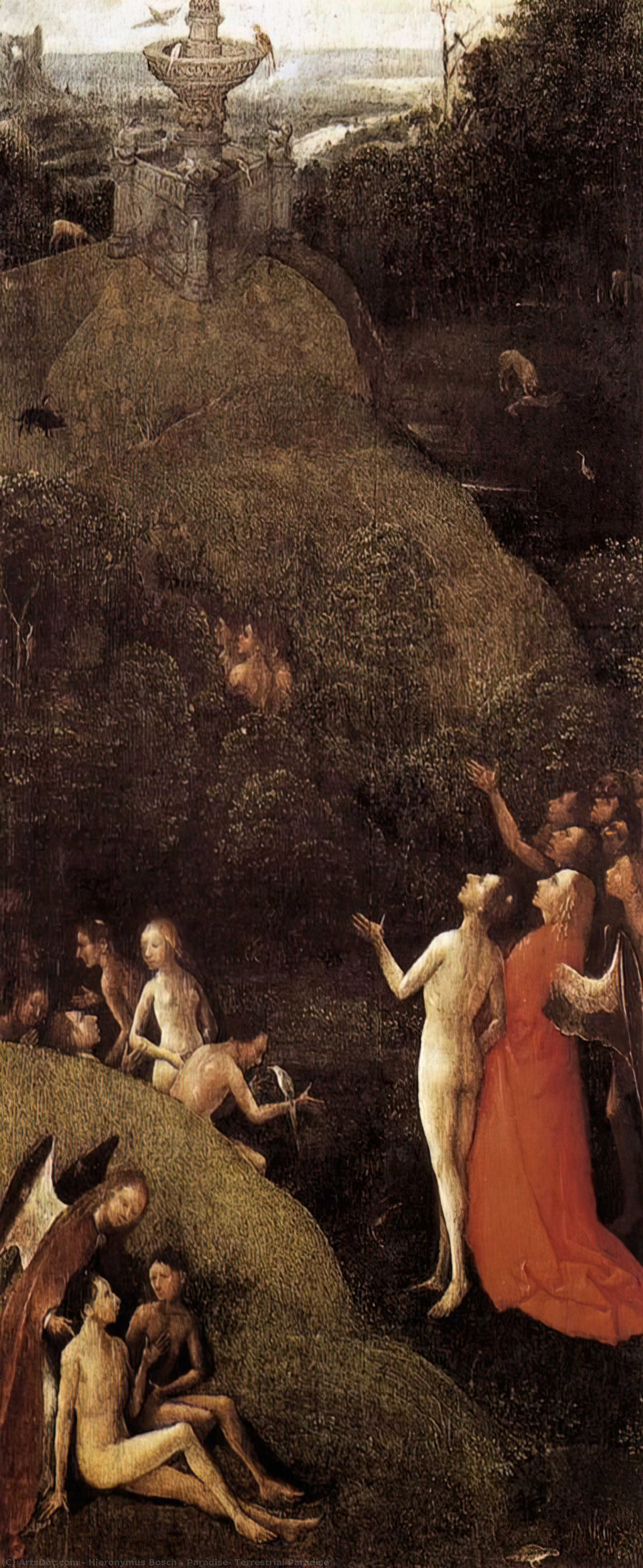
Hieronymus Bosch’s “Paradise, Terrestrial Paradise” – A Descent Into Myth and Morality
The world of Hieronymus Bosch is one perpetually poised between the divine and the demonic, a realm where beauty and horror intertwine in unsettling harmony. Among his most captivating works, "Paradise, Terrestrial Paradise" (c. 1490) stands as a monumental achievement—a sprawling, densely populated tableau that invites endless contemplation and reveals layers of biblical narrative, moral allegory, and profound psychological insight. Housed within the opulent Palazzo Ducale in Venice, this polyptych offers not merely a depiction of the afterlife but a meticulously crafted exploration of human nature’s inherent contradictions: our capacity for both sublime joy and utter corruption.
Bosch's genius lay in his ability to fuse meticulous realism with fantastical symbolism. “Paradise, Terrestrial Paradise” is executed in oil on panel, a medium he favored for its rich colors and textural possibilities. The scene unfolds within a meticulously rendered landscape—a rolling expanse of hay and grass punctuated by the shimmering Fountain of Life, positioned dramatically on a hillside. This isn’t a serene pastoral idyll; rather, it's a carefully orchestrated chaos. Observe the multitude of figures engaged in seemingly mundane activities: tending to animals, harvesting crops, building structures – yet each action is imbued with an underlying tension, a hint of transgression or impending doom. The two birds—one soaring at the upper left, another nestled near the bottom right—are not merely decorative elements; they represent divine guidance and perhaps, a subtle warning.
The Biblical Narrative and its Allegorical Core
“Paradise, Terrestrial Paradise” is part of a larger series – “Visions of the Hereafter” – comprising “Ascent of the Blessed,” “Fall of the Damned,” and “Hell.” This polyptych wasn’t intended as isolated paintings but rather as a unified narrative exploring the stages of salvation and damnation. Within this context, "Terrestrial Paradise" represents a crucial transitional phase: a realm where souls, having purged themselves of their earthly sins, await ascension to heaven. The Fountain of Life, central to the composition, isn’t simply a source of water; it symbolizes spiritual purification – a cleansing torrent that washes away the vestiges of human imperfection. The placement of the fountain on a hill suggests a deliberate ascent, mirroring the journey towards divine grace.
Decoding Bosch's Symbolism: A World of Hidden Meanings
Bosch’s work is notoriously rich in symbolism, and “Paradise, Terrestrial Paradise” offers an abundance of visual clues. The figures themselves are laden with meaning. Note the various animals—some docile and harmonious, others predatory or grotesque – representing different aspects of human nature. The presence of numerous small, seemingly insignificant details—a discarded shoe, a broken tool, a decaying fruit—contributes to the painting’s unsettling atmosphere, suggesting that even in paradise, decay and corruption are ever-present reminders of our fallen state. The sheer number of figures is also significant; Bosch often used crowds to represent the vastness of human sin and the difficulty of achieving redemption.
A Masterpiece of Renaissance Complexity
“Paradise, Terrestrial Paradise” stands as a testament to Hieronymus Bosch’s unparalleled skill as an artist and storyteller. His masterful use of color, composition, and symbolism creates a world that is both captivatingly beautiful and profoundly disturbing. It's a painting that rewards repeated viewing, revealing new layers of meaning with each encounter. More than just a depiction of paradise, it’s a profound meditation on the human condition—a haunting exploration of our desires, fears, and ultimately, our struggle to attain salvation. For those seeking an artwork that transcends mere aesthetic pleasure and offers a glimpse into the depths of the human psyche, “Paradise, Terrestrial Paradise” remains an unforgettable masterpiece.
For further exploration of Bosch’s work and other Renaissance treasures, visit Hieronymus Bosch: Paradise, Terrestrial Paradise and Hieronymus Bosch: Paradise, Ascent of the Blessed on ArtsDot. And don’t miss the opportunity to experience the Palazzo Ducale in Venice – a historic landmark brimming with artistic and cultural significance. Learn more about the Palazzo Ducale here.