A Vision of Solitude: The Enigmatic World of St. John
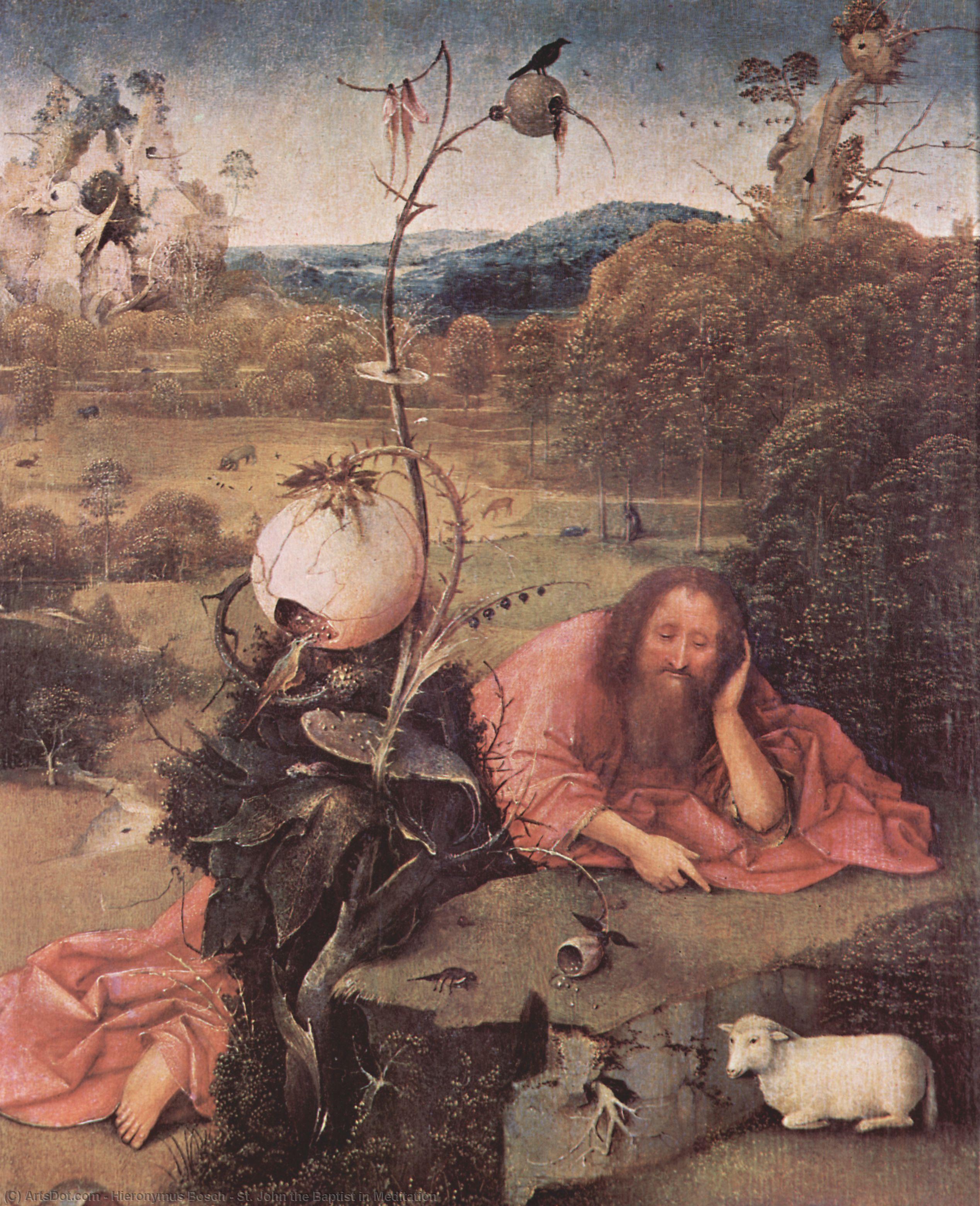
To encounter Hieronymus Bosch’s St. John the Baptist in Meditation is to step into a silent, profound dialogue between the human soul and the natural world. Executed around 1499, this masterpiece serves as a haunting testament to the artist's unparalleled ability to distill deep psychological and spiritual contemplation into visual form. The painting does not merely depict a saint; it invites the viewer into a realm of unsettling beauty and symbolic complexity. As we gaze upon the figure of St. John, seated with his head resting heavily upon his hand, we are drawn into his internal landscape—a space where the boundaries between earthly existence and divine reflection begin to blur.
The composition is anchored by a sense of heavy, introspective stillness. Bosch utilizes the landscape not merely as a backdrop, but as a deliberate emotional counterpoint. The rolling hills, distant mountains, and scattered trees establish a serene panorama that offers a visual respite from the anxieties simmering beneath the surface of the saint's thoughts. Yet, within this tranquility, there is an underlying tension. The presence of birds circling overhead and a sheep grazing peacefully in the lower corner introduces themes of fertility, innocence, and the cyclical rhythms of nature—elements that Bosch masterfully juxtappones against the figure’s profound inner turmoil.
Mastery of Detail and the Alchemy of Oil
The technical brilliance of this work lies in Bosch's obsessive precision. Employing oil paint on panel—a medium that was still relatively novel during his era—the artist achieved an astonishing level of realism within a fantastical framework. Every brushstroke serves a purpose, capturing the rough, tactile bark of the trees and the soft, delicate fleece of the grazing sheep with remarkable accuracy. This meticulous attention to texture creates a sense of tangible reality that makes the more enigmatic elements of the painting feel even more surreal.
There is a peculiar magic in how Bosch renders the natural world; while the feathers of the birds are depicted with scientific care, they possess a strange, motionless quality that contributes to the painting's pervasive sense of unease. This technique—blending hyper-realistic detail with dreamlike, almost nightmarish imagery—is what makes a high-quality reproduction of this piece so captivating for a modern collector. It offers a visual depth that rewards repeated viewing, revealing new layers of meaning and texture each time the eye wanders across the panel.
A Timeless Presence for the Discerning Collector
For the art lover or interior designer, St. John the Baptist in Meditation offers much more than mere decoration; it provides a focal point of intellectual and emotional gravity. The painting’s ability to evoke a sense of quietude and mystery makes it an extraordinary addition to any curated space, particularly those seeking to introduce a sense of history, depth, and contemplative calm. It is a piece that commands attention through its subtlety rather than through loud or garish displays.
Owning a reproduction of such a significant work allows one to bring the spirit of the Northern Renaissance into a contemporary setting. Whether placed in a quiet study, a library, or a sophisticated living area, the painting acts as a window into the late medieval psyche. It serves as a reminder of the enduring power of introspection and the beauty found in the moments when we turn inward to face the complexities of our own existence. In an era of constant noise, Bosch’s vision of silent meditation remains a profound and necessary sanctuary.