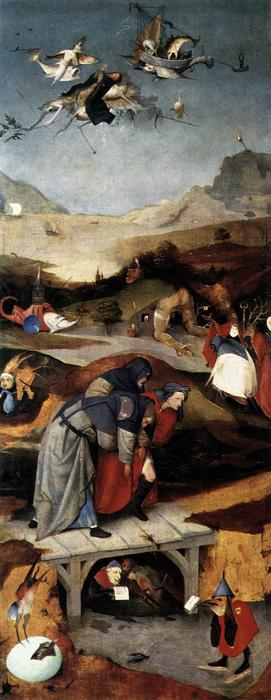
Bosch’s haunting ‘Temptation of St. Anthony,’ painted in 1506, confronts viewers with surreal horror—a meticulously detailed monochrome triptych exploring psychological torment and foreshadowing Surrealism's dreamlike vision. Explore Hieronymus Bosch’s visionary masterpiece and bring its unsettling beauty into your home.
A Descent into Surreal Horror: The Visionary World of Bosch
Hieronymus Bosch’s “Temptation of St. Anthony” stands as a singular achievement in Netherlandish art—a chilling testament to the anxieties of late medieval Europe and an enduring fascination for the subconscious mind. Painted around 1506, this masterpiece transcends mere religious depiction; it plunges viewers into a hallucinatory landscape populated by grotesque demons and unsettling symbols that continue to provoke interpretation centuries later. Bosch, a painter unlike any other of his time, cultivated an intensely personal style characterized by meticulous detail and a preoccupation with disturbing fantasies. His work does not merely illustrate a story; it creates a psychological atmosphere that foreshadows the dreamlike imagery of Surrealism, cementing his place as one of art history's most visionary figures.
The painting recounts a pivotal episode from St. Anthony's life—his struggle against temptation by demonic forces as he seeks solitude for prayer. However, Bosch’s interpretation diverges dramatically from traditional, more orderly depictions. He transforms the biblical narrative into a terrifying psychological drama where the boundaries between reality and nightmare dissolve. The composition is remarkably dynamic, featuring a chaotic assembly of figures that create a profound sense of depth and movement. Within this landscape, one might observe various individuals engaged in unsettling interactions, while birds—some soaring in the upper reaches and others perched precariously—add an element of eerie life to the unfolding chaos. It is a scene where every corner holds a new, often grotesque, discovery.
Mastery of Technique and Symbolic Depth
The artist’s unique technique, primarily utilizing oil paint on panel, allowed Bosch to achieve remarkable tonal gradations and textures that capture the eerie luminescence of his imagined realms. His meticulous attention to detail is evident in every element of the composition, from the grotesque, distorted faces of the demons to the intricate, almost microscopic patterns that adorn the environment. This precision serves a higher purpose: it lends a sense of terrifying tangibility to the impossible. By rendering the fantastic with such high fidelity, Bosch forces the viewer to confront these monsters as if they were physically present.
Beyond its visual splendor, the work is steeped in the complex symbolism of the late Middle Ages. Influenced by folklore, alchemy, and religious fervor, Bosch utilized a lexicon of strange creatures and hybrid beings to represent the various facets of sin, temptation, and spiritual warfare. For the discerning collector or interior designer, this piece offers more than just aesthetic beauty; it provides a profound intellectual engagement. A high-quality reproduction of this triptych serves as a powerful focal point in any collection, inviting conversation and contemplation. It is an evocative choice for those seeking to bring a sense of historical depth, mystery, and dramatic intensity into a curated space.