A Visionary Tapestry of Chaos and Wonder
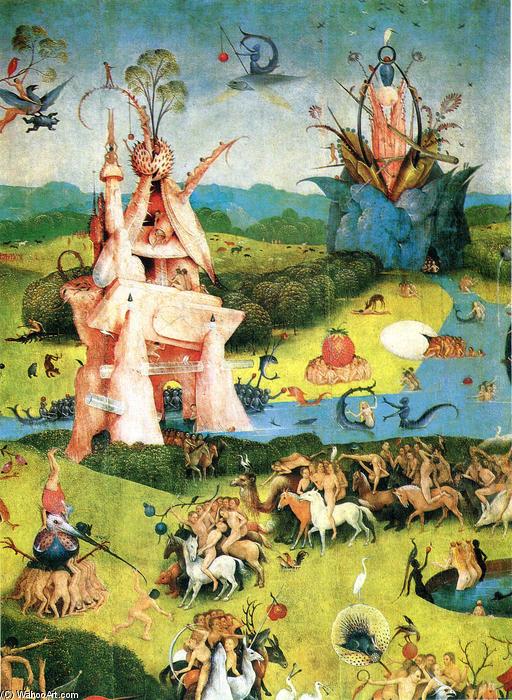
To gaze upon a detail from Hieronymus Bosch’s The Garden of Earthly Delights is to step directly into a fever dream of the late Middle Ages. This particular fragment serves as a window into one of the most complex and debated masterpieces in the history of Western art. In this intricate scene, the boundaries between reality and hallucination dissolve, replaced by a lush, teeming landscape where the natural world is reimagantly distorted. The viewer is immediately swept into a whirlwind of movement, where horses, exotic birds, and delicate insects dance alongside human figures in a state of perpetual, enigmatic motion. It is a composition that demands slow contemplation, rewarding the eye with endless discoveries hidden within its dense, vibrant layers.
The artistry of Bosch lies in his ability to marry meticulous Netherlandish precision with an almost surrealist imagination. Each brushstroke contributes to a texture so fine that it feels as though one could reach out and touch the skin of a giant fruit or the iridescent wing of a dragonfly. The technique, characteristic of the Northern Renaissance, utilizes a brilliant palette of greens, blues, and fleshy tones to create a sense of depth and vitality. For the collector or interior designer, this piece offers more than mere decoration; it provides a focal point of profound intellectual stimulation. Its ability to command attention through sheer detail makes it an unparalleled centerpiece for a gallery-style room or a sophisticated study where conversation and thought are encouraged.
Symbolism and the Subconscious Mind
Beyond its visual splendor, this work is a labyrinth of symbolism that has captivated scholars for centuries. Bosch was a master of using the mundane to represent the profound; an apple, an orange, or a cluster of berries are not merely snacks within this garden, but potent emblems of temptation, fertility, and the fleeting nature of earthly pleasure. The presence of animals—some familiar, others monstrously hybrid—serves as a cryptic language of morality and folly. As one wanders through the details, the interplay between the innocent and the grotesque creates a tension that is both unsettling and deeply alluring. It is this very duality that gives the painting its enduring emotional impact, evoking a sense of wonder mixed with a haunting awareness of human vulnerability.
For those seeking to bring a piece of art history into their personal spaces, a high-quality reproduction of this detail offers an opportunity to inhabit Bosch's enigmatic world. The painting does not merely sit upon a wall; it breathes life into a room, acting as a portal to a time when the line between the divine and the demonic was exquisitely thin. Whether placed in a contemporary setting to provide a striking contrast or in a classical environment to complement its historical weight, this artwork remains a timeless testament to the boundless reaches of human creativity.