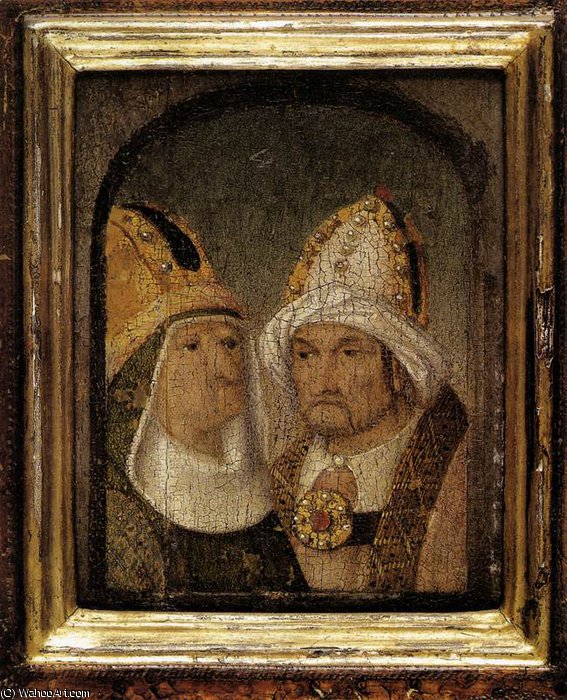
A Portrait of Intrigue and Religious Symbolism: Exploring Two Male Heads
Hieronymus Bosch’s “Two Male Heads,” housed in the Museum Boijmans Van Beuningen in Rotterdam, stands as a haunting testament to the artist's unparalleled ability to distill complex theological concepts into visually arresting imagery. Painted around 1480 during his formative years—a period marked by burgeoning humanist thought alongside deep-seated anxieties about mortality and divine judgment—this enigmatic portrait transcends mere likeness; it delves into the psychological landscape of faith and confronts viewers with unsettling questions about human nature.
- Subject Matter: The painting depicts two men dressed in robes, adorned with mitres – symbols of ecclesiastical authority – gazing intently at each other. Their faces are rendered with meticulous detail, capturing expressions of solemn contemplation and unspoken communication.
- Style & Technique: Bosch’s signature style is instantly recognizable through its characteristic blend of realism and fantastical distortion. The figures themselves appear remarkably lifelike, yet their heads are subtly enlarged, emphasizing their importance within the composition. Executed in oil on oak wood—a technique favored by Netherlandish artists of the time—the painting demonstrates Bosch's mastery of layering pigments to achieve a luminous surface texture and subtle gradations of color.
- Historical Context: Bosch’s work emerged during a pivotal moment in European history, coinciding with the rise of humanist scholarship and the Reformation. The artist wrestled with theological debates surrounding salvation and damnation, reflecting anxieties about the human condition within a framework of Christian dogma. This preoccupation with moral ambiguity is palpable throughout his oeuvre, including “Two Male Heads.”
Decoding Symbolism: Mitres and the Quest for Spiritual Understanding
The inclusion of mitres—symbols representing papal authority and divine grace—immediately establishes a connection to religious iconography prevalent during Bosch’s era. However, their placement within the portrait is not merely decorative; it invites contemplation about the role of leadership in spiritual matters. The gaze exchanged between the two men suggests an internal dialogue concerning faith, doubt, and the pursuit of enlightenment – themes central to Bosch's artistic vision.
- Mitres: Representing papal authority and divine grace, the mitres serve as a visual reminder of the spiritual hierarchy prevalent in medieval Europe.
- The Gaze: The intense stare between the figures embodies contemplation and unspoken communication, prompting viewers to consider the complexities of faith and morality.
A Masterpiece of Surrealist Precursors
"Two Male Heads" is considered a precursor to surrealism, anticipating André Breton’s movement decades later with its unsettling juxtaposition of recognizable figures within an otherworldly setting. Bosch's deliberate distortion of perspective and anatomical proportions—characteristic of his artistic style—challenges conventional notions of representation, prioritizing psychological impact over literal accuracy. This approach aligns perfectly with the broader humanist preoccupation with exploring the subconscious mind and confronting irrational fears.
- Surrealist Influence: Bosch’s stylistic innovations foreshadowed the surrealist movement's exploration of dreamlike imagery and psychological symbolism.
- Psychological Impact: The painting prioritizes emotional resonance over realistic depiction, reflecting Bosch’s conviction that art should provoke contemplation and unsettle viewers.
Conclusion: An Enduring Legacy
Hieronymus Bosch's “Two Male Heads” remains a captivating enigma—a portrait that speaks volumes about the anxieties of its time while simultaneously confronting us with timeless questions regarding human spirituality. Its masterful technique, combined with profound symbolic depth, secures its place as one of the most enduring achievements of Early Netherlandish painting and continues to inspire artists and scholars alike.