A Glimpse Behind the Curtain: Edgar Degas’s “Ballet Scene”
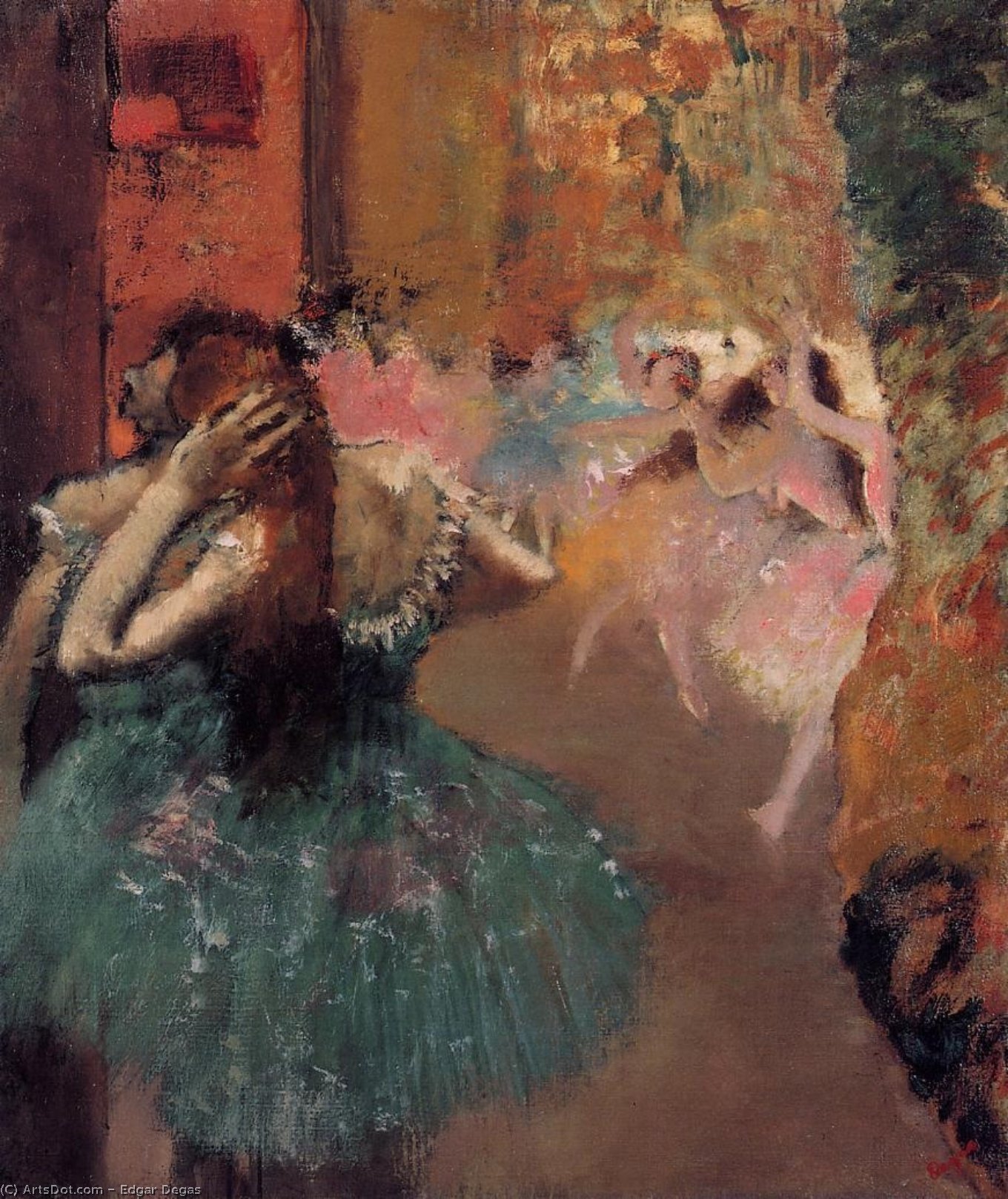
Edgar Degas's "Ballet Scene," painted in 1893, isn’t merely a depiction of dancers; it’s a meticulously observed and profoundly intimate portrait of a world rarely glimpsed by outsiders. This oil on canvas transports us to the hushed backstage atmosphere of a Parisian ballet studio, capturing not just the grace of performance but also the quiet anticipation, the focused concentration, and the subtle tensions that simmer beneath the surface of artistic creation. Degas, a lifelong devotee of dance, possessed an unparalleled ability to distill the essence of movement and emotion, and this painting stands as a testament to his unique vision.
The scene unfolds with remarkable immediacy. Two women, poised in the center stage, are clearly the focal point, their bodies subtly intertwined in a moment of preparation or perhaps a brief respite from rehearsal. Around them, other dancers occupy various positions – some stretching, others adjusting costumes, and still others observing, creating a dynamic tableau that feels both ordered and wonderfully spontaneous. Degas’s genius lies not just in his technical skill but in his ability to capture the *feeling* of this space: the warmth of the light, the texture of the fabrics, the quiet murmur of voices – all rendered with an Impressionistic brushstroke that vibrates with energy and life.
Impressionism and the Dance
Degas’s artistic style is inextricably linked to the burgeoning Impressionist movement. He shared with his contemporaries a fascination with capturing fleeting moments, light, and atmosphere—a departure from the rigid academic traditions of the time. In “Ballet Scene,” this manifests in loose, visible brushstrokes that suggest movement rather than meticulously defining form. The colors are rich and vibrant, yet subtly blended to create an illusion of depth and luminosity. Notice how Degas uses a muted palette – predominantly creams, browns, and greens—to evoke the warm glow of the studio’s lighting, contrasting it with the brighter hues of the dancers' costumes.
Crucially, Degas wasn’t simply painting *dance*; he was painting *movement*. He meticulously studied the mechanics of movement, observing how bodies shifted and flowed. This is evident in the way he captures the subtle curves of the dancers’ limbs, the tension in their muscles, and the fleeting gestures that reveal their individual personalities. The composition itself—a slightly off-center arrangement with a strong diagonal line—further emphasizes this sense of dynamism.
A Window into Parisian Society
Beyond its artistic merits, “Ballet Scene” offers a fascinating glimpse into late 19th-century Parisian society. Ballet was not just a form of entertainment; it was a highly structured and prestigious profession, deeply intertwined with the aristocracy and the cultural elite. Degas’s paintings frequently depict dancers from the Paris Opera Ballet, capturing their beauty, grace, and dedication. The presence of the “stage mothers” in the background—women observing their daughters' rehearsals—highlights the social dynamics surrounding this world, revealing a complex interplay of ambition, expectation, and maternal concern.
The inclusion of details like the water can and the scattered costumes further reinforces this sense of realism. Degas wasn’t interested in romanticizing ballet; he sought to portray it with honesty and immediacy, capturing both its beauty and its demanding nature. The painting is a testament to his ability to transform everyday moments into works of art.
Symbolism and Emotional Resonance
While seemingly straightforward, “Ballet Scene” is rich in symbolic meaning. The dancers themselves represent aspiration, discipline, and the pursuit of perfection—qualities highly valued in 19th-century France. Their poised postures and focused expressions convey a sense of quiet determination, while their vulnerability—revealed through subtle gestures and fleeting glances—adds an element of human drama to the scene. Degas’s masterful use of light and shadow further enhances this emotional resonance, creating a mood that is both captivating and melancholic.
Ultimately, “Ballet Scene” is more than just a painting; it's a poignant meditation on beauty, ambition, and the human condition. It invites us to step behind the curtain and witness the dedication, artistry, and quiet drama of the world of ballet—a world captured with unparalleled skill and sensitivity by one of art history’s most enduring figures.