A Quiet Moment in the Shadows of the Stage
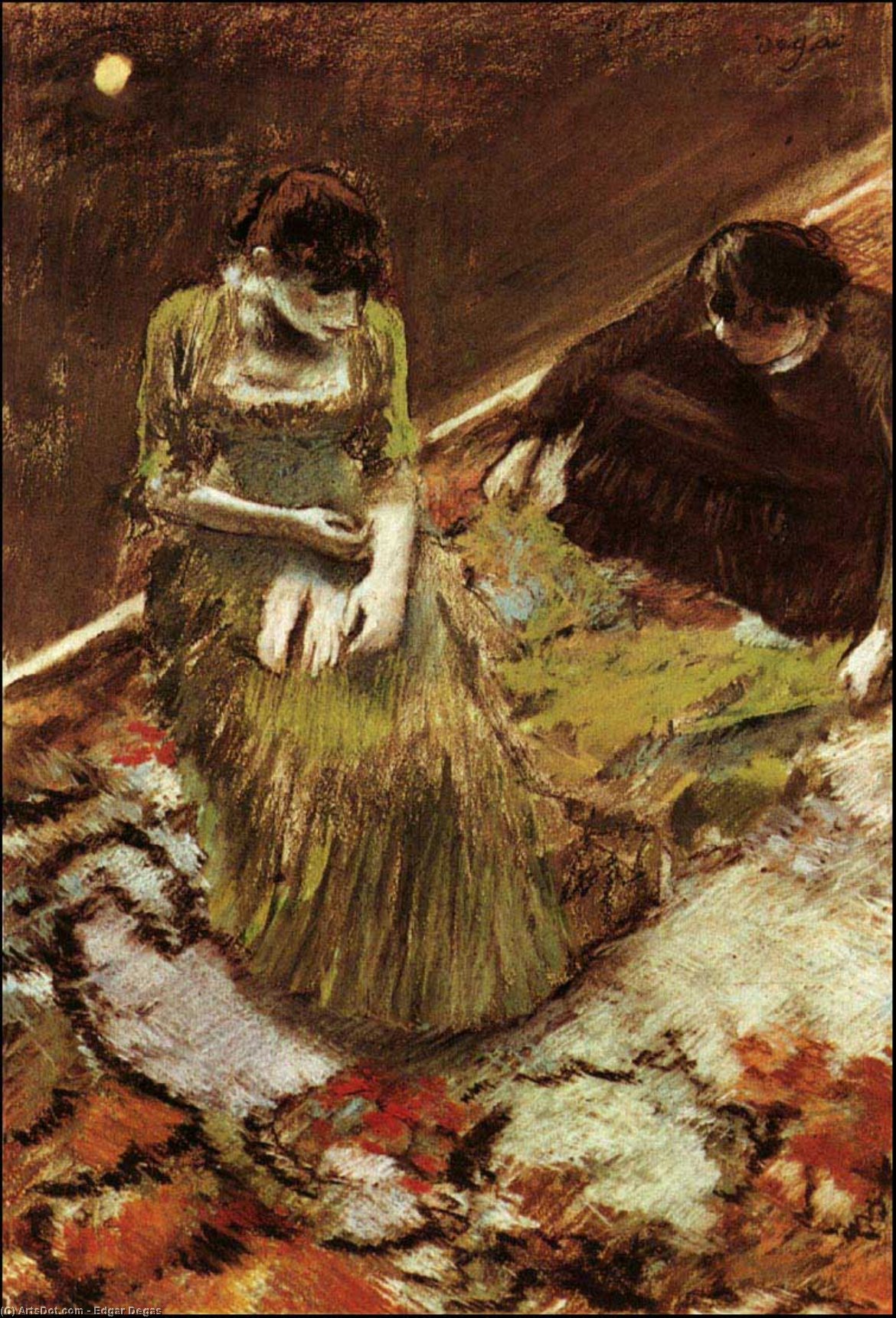
In the evocative monochrome of Before the Entrance on Stage, c. 1892, Edgar Degas invites us into a private, stolen moment that exists just behind the curtain of public performance. While the world often remembers Degas for the vibrant, swirling tutus of his ballet dancers under the bright lights of the Paris Opera, this particular work captures the profound stillness that precedes the spectacle. Two women sit closely together on the ground, their forms rendered in a striking black and pattern-rich grayscale that lends the scene an air of timelessness. One figure is lost in quiet contemplation, her gaze fixed upon something held in her hands, while her companion looks away, perhaps lost in the anticipation or the exhaustion of the evening ahead. The composition is masterfully balanced by the presence of a solitary moon hanging in the night sky, casting a soft, ethereal glow over the scene and bridging the gap between the intimate human connection and the vast, nocturnal world.
The technical brilliance of this piece lies in Degas’s ability to manipulate light and shadow without the aid of color. By utilizing a monochromatic palette, he strips away the distractions of hue to focus our attention on texture, form, and the subtle interplay of light. The presence of unexpected elements—a delicate vase, a ticking clock, and a lonely chair—creates a narrative depth that suggests a world in transition. These objects serve as silent witnesses to the passage of time, grounding the ephemeral moment in a tangible reality. For the discerning collector or interior designer, this work offers a sophisticated layer of intellectual depth; it is not merely a depiction of figures, but an exploration of the tension between the seen and the unseen, the public persona and the private soul.
Beyond its visual allure, the emotional resonance of Before the Entrance on Stage makes it a captivating centerpiece for any curated space. There is a haunting, melancholic beauty in the way the figures occupy the landscape, suggesting a sense of solitude even in companionship. This piece speaks to the quiet intervals of our own lives—those moments of waiting and reflection that occur before we step into our own personal stages. As a high-quality reproduction, this artwork brings a touch of late 19th-century Parisian realism into the modern home, offering an atmosphere of contemplative elegance. It is a work that does not demand attention through loudness, but rather commands it through its profound, whispered intimacy, making it an ideal choice for those looking to infuse their surroundings with history, soul, and artistic prestige.