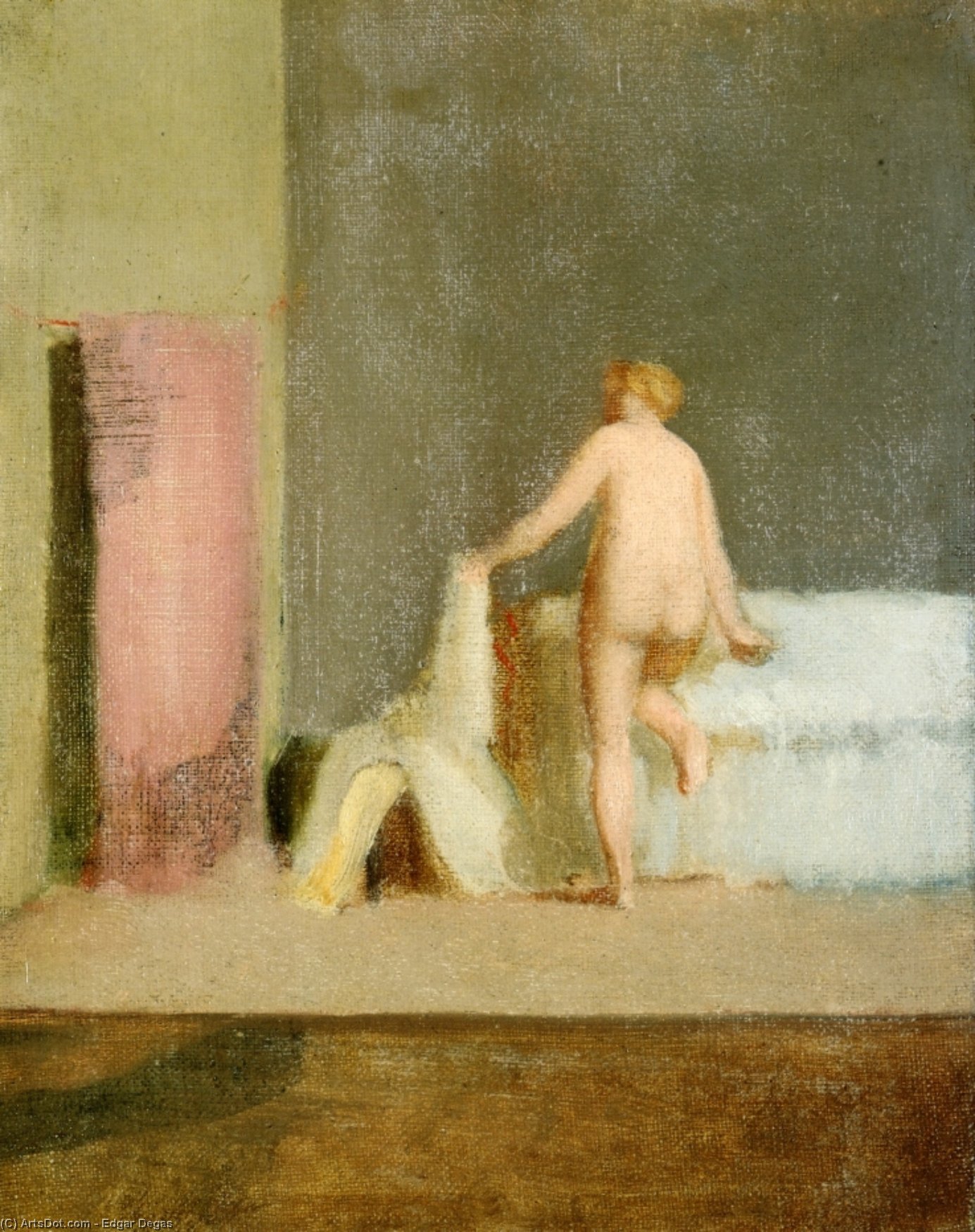
A Portrait of Mystery: Decoding Degas’s *Candaule's Wife*
Edgar Degas’s 1855 painting, *Candaule's Wife*, is not merely a depiction of a nude woman; it’s a carefully constructed tableau brimming with psychological depth and veiled narrative. Housed within the walls of The Museum Reading Museum - Town Hall (Reading, United Kingdom), this intimate oil on canvas invites viewers into a world of quiet contemplation, suspicion, and perhaps even a touch of unsettling voyeurism. Degas, a master of capturing fleeting moments and human complexities, elevates the seemingly simple scene to a profound exploration of power dynamics, female vulnerability, and the subtle art of observation.
The painting immediately draws the eye with its carefully orchestrated composition. A woman, partially draped in sheets that suggest both modesty and concealment, occupies the central space, her gaze averted, creating an immediate sense of reserve. The pink walls of the room provide a surprisingly vibrant backdrop, contrasting sharply with the muted tones of the figures and fabrics – a deliberate choice likely intended to heighten the drama and draw attention to the woman’s posture and expression. Two chairs and a couch are strategically positioned, not as mere furniture but as elements contributing to the scene's spatial depth and hinting at an unspoken narrative. The overall effect is one of contained intimacy, a private moment rendered with remarkable precision.
The Mythic Echoes: Allusion to Candaules
The title *Candaule’s Wife* directly references a pivotal episode from Greek mythology – the story of King Candaules of Lydia. According to Herodotus, Candaules, captivated by the beauty of his wife, showed her to his servant Gyges, leading to tragic consequences when she revealed the secret of a magical ring that granted invisibility. This mythological reference isn’t simply decorative; it imbues the painting with layers of meaning. Degas subtly echoes the themes of betrayal, deception, and the corrupting influence of power – mirroring the fatal flaw at the heart of the myth. The woman's posture and averted gaze can be interpreted as a reflection of the queen’s awareness of her own vulnerability and the potential for exploitation.
Degas’s Techniques: Light, Line, and Psychological Nuance
Degas’s mastery is evident in his meticulous rendering of light and shadow. He employs a delicate palette of muted tones – pinks, browns, and creams – to create an atmosphere of quiet contemplation. The soft lighting casts subtle shadows across the woman's body, emphasizing her form while simultaneously obscuring details, contributing to the painting’s enigmatic quality. Crucially, Degas’s use of line is equally significant. He employs bold, decisive lines to define the subject’s figure and the architectural elements of the room, creating a sense of solidity and presence. However, he also utilizes softer, more fluid lines to depict the folds of the sheets and the subtle nuances of expression on the woman's face – capturing both her physical form and her inner state.
A Study in Modernity: Degas’s Artistic Vision
*Candaule's Wife* represents a pivotal moment in Degas’s artistic development. Moving beyond the rigid conventions of academic painting, he embraced a more modern approach, focusing on capturing contemporary life and exploring the psychological complexities of his subjects. Influenced by artists like Ingres, yet forging his own distinctive style, Degas was fascinated by the human form, particularly the female figure. His works often delve into themes of intimacy, isolation, and the subtle power dynamics between men and women – a theme powerfully explored in this painting. The scene feels remarkably modern for its time, capturing a sense of private vulnerability rarely depicted with such psychological acuity.
Exploring Further: Degas’s Legacy and Related Works
For those captivated by *Candaule's Wife*, ArtsDot offers exquisite hand-painted reproductions that faithfully capture the painting’s beauty and nuance. Alongside this masterpiece, explore other works by Edgar Degas, such as *Nude Wiping Her Foot* (Musée d'Orsay), a similarly compelling study of female vulnerability, or Edvard Munch’s *The Funeral*, which shares a similar exploration of human emotion and mortality. Furthermore, visiting The Museum Reading Museum - Town Hall (Reading, United Kingdom) provides an opportunity to experience the painting in person and delve deeper into its historical context.