A Moment Frozen in Charcoal: Edgar Degas’s *Dancer Seated (Study)*
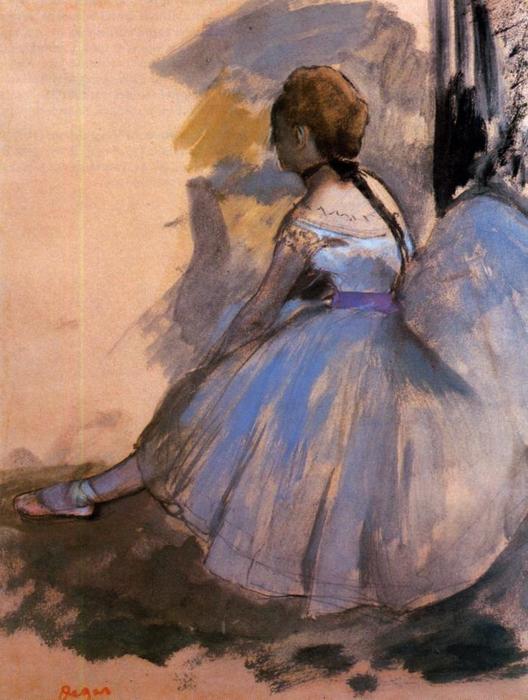
Edgar Degas's *Dancer Seated (Study)*, created in 1872, isn’t merely a drawing; it’s a whispered secret from the heart of the ballet world. This intimate study, rendered primarily in delicate pencil strokes, offers an unparalleled glimpse into the artist’s profound fascination with movement and the quiet moments between performances. Degas, famously resisting categorization as an Impressionist despite his undeniable influence on the movement, here presents a remarkably honest portrayal – not of idealized beauty, but of a young dancer's contemplative repose. The work possesses a captivating immediacy, drawing us into a private space where observation becomes almost voyeuristic, inviting us to share in the artist’s intense scrutiny.
The Anatomy of Observation: Technique and Style
Degas’s mastery lies not just in capturing a likeness but in conveying an atmosphere. The choice of pencil as his primary medium is crucial; it allows for an astonishing level of detail, yet simultaneously maintains a remarkable fluidity. Notice the subtle gradations of tone, the way he builds up layers to suggest form and texture – particularly evident in the folds of the dancer’s dress and the delicate curve of her hand. He employs a broken line technique, creating a sense of dynamism and capturing the fleeting quality of light and shadow. The background, rendered with a muted yellowish tint, isn't merely decorative; it serves to isolate the figure, intensifying our focus on her posture and expression. This deliberate use of color and line is characteristic of Degas’s approach – he wasn’t interested in replicating reality but in distilling its essence.
A Dancer’s World: Context and Symbolism
The *Dancer Seated (Study)* emerged from a period when Degas was deeply immersed in the world of Parisian ballet. He frequented the Palais Garnier, meticulously observing dancers during rehearsals and performances. This wasn't simply artistic curiosity; it was an obsession. The dancer herself is presented with remarkable realism – her youthful face, slightly turned away, hints at a private thought or perhaps a moment of quiet anticipation before stepping onto the stage. The crossed legs, the relaxed posture, speak to a brief respite from the rigorous demands of ballet training and performance. It’s a pose that suggests both vulnerability and strength, reflecting the duality inherent in the dancer's profession. The drawing can be interpreted as a study for a larger work, but it stands powerfully on its own as a meditation on youth, grace, and the ephemeral nature of beauty.
Beyond the Sketch: Degas’s Legacy and Reproduction
Degas's influence extends far beyond his immediate circle. His innovative approach to depicting modern life – particularly the dynamism of movement and the often-unromanticized realities of urban existence – paved the way for subsequent generations of artists. The *Dancer Seated (Study)* exemplifies this legacy, offering a window into a pivotal moment in art history. ArtsDot is proud to offer meticulously crafted hand-painted reproductions of this captivating work, ensuring that its delicate beauty and profound insights are preserved for future appreciation. These reproductions capture not only the visual details but also the emotional resonance of Degas’s original drawing, allowing you to bring this intimate portrait into your home or office – a testament to the enduring power of artistic observation.
- Authenticity: Each reproduction is created by skilled artists using traditional techniques.
- Quality Materials: Printed on archival-quality canvas for lasting beauty and vibrancy.
- Size Options: Available in a range of sizes to suit your space and budget.