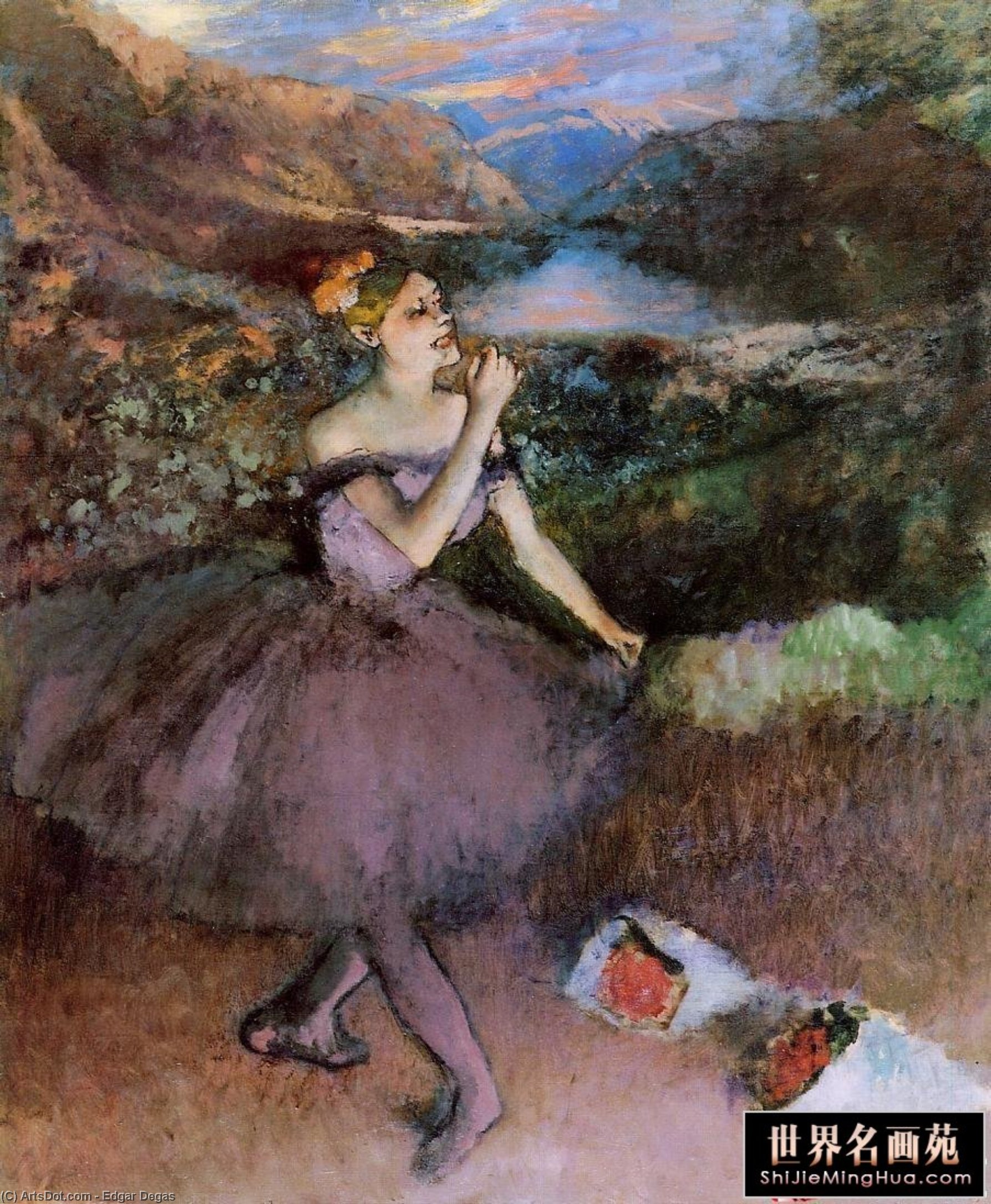
Dancer with Bouquets
Edgar Degas, a luminary of French Impressionism, captivated audiences with his unparalleled ability to portray movement and emotion—particularly within the realm of ballet. Among his celebrated works is
Dancer with Bouquets (c. 1895), a painting that embodies his distinctive artistic vision and cements his legacy as one of the most influential artists of his era. This piece transcends mere representation; it’s an exploration of grace, fleeting beauty, and the subtle nuances of human experience.
Artistic Style and Technique
Degas' approach to painting was revolutionary for its time. Rejecting the academic conventions favored by many of his contemporaries, he championed a style characterized by loose brushstrokes and vibrant hues—a hallmark of Impressionism.
Dancer with Bouquets exemplifies this technique brilliantly. Executed on canvas using oil paints, Degas meticulously layered pigments to achieve a remarkable depth of color and texture. He deliberately avoided blending colors smoothly, opting instead for visible brushstrokes that captured the dynamism of the scene—specifically, the dancer’s movement and the shimmering light reflecting off her attire. This method allowed him to convey not just what he saw but also how he felt about it.
Composition and Elements
The composition of
Dancer with Bouquets is remarkably balanced, prioritizing the dancer as its focal point. She stands poised and elegant amidst a cluster of bouquets—a deliberate choice that underscores themes of femininity and artistic appreciation. The artist skillfully utilizes perspective to create depth, drawing the viewer’s eye towards the dancer while subtly hinting at the surrounding environment. Notice how Degas places the flowers strategically around her feet, adding visual interest and reinforcing the painting's symbolic significance. Furthermore, the muted background tones serve as a counterpoint to the vibrant colors of the dancer and blossoms, enhancing their impact.
Symbolism and Interpretation
Beyond its aesthetic qualities,
Dancer with Bouquets is laden with symbolism. The bouquets themselves represent a gesture of admiration—a celebration of the dancer’s performance and an acknowledgment of her beauty. Simultaneously, they evoke ideas of transience and fleeting moments of perfection—themes central to Impressionist philosophy. Degas' portrayal of the dancer embodies grace and poise, capturing not only physical movement but also inner composure. He seeks to convey a sense of vulnerability alongside strength, inviting contemplation on the human condition.
Artistic Legacy
Edgar Degas’ influence extends far beyond his own lifetime. He challenged artistic conventions and paved the way for subsequent generations of artists—particularly those interested in capturing fleeting impressions of reality. His dedication to observation and experimentation continues to inspire creativity today. The enduring fascination with
Dancer with Bouquets speaks volumes about Degas’ ability to distill complex emotions and ideas into a single, unforgettable image—a testament to his genius as an artist and a humanist.
For more information on Edgar Degas and his works, visit
Edgar Degas on Wikipedia.