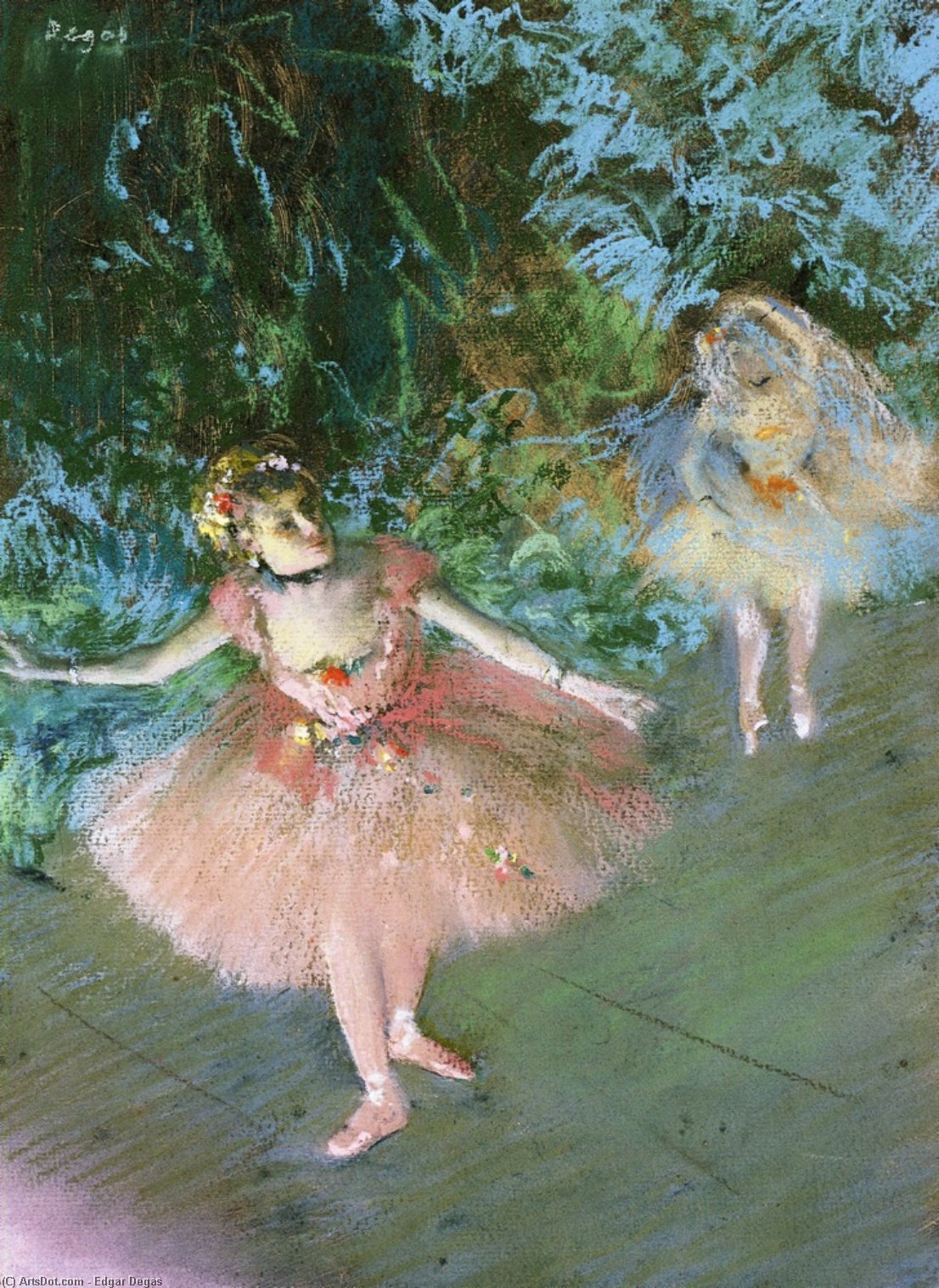
A Window into Movement: Edgar Degas’s “Dancers on Set”
Edgar Degas’s “Dancers on Set is more than just a pastel painting; it's a distillation of Impressionism’s core ethos—capturing fleeting moments of beauty and emotion through light and color. Created in 1880, this artwork transcends mere representation, inviting viewers into the backstage world of ballet and offering a glimpse into the artist’s profound understanding of movement and human psychology.
The painting depicts two young girls dancing on stage, bathed in the soft glow of artificial light. Degas meticulously rendered their postures—the graceful arabesque pose—with astonishing precision, capturing not just physical form but also the subtle nuances of expression. The artist’s masterful use of hatching and blending creates a textured surface that conveys both solidity and delicacy, mirroring the physicality of ballet while simultaneously hinting at an inner world of feeling.
The Artist's Style and Inspiration: Embracing Realism Amidst Impressionism
While Degas is undeniably associated with Impressionism—a movement that revolutionized painting by prioritizing subjective perception over objective depiction—he resisted the label’s rigid conventions. He championed a style rooted in observation, favoring detailed sketches and studies of everyday life, particularly ballet dancers. As exemplified in “Great Arabesque”—a bronze sculpture by Degas—his artistic approach was characterized by geometric forms combined with fanciful patterns, reflecting a desire to explore the underlying structure of visual experience.
This sculptural piece embodies Degas’s fascination with repetition and pattern, mirroring the rhythmic movements inherent in ballet. It demonstrates his ability to translate observation into expressive form—a hallmark of his oeuvre.
Composition and Significance: A Moment Frozen in Time
"Dancers on Set" showcases a carefully constructed scene that captures the atmosphere of a ballet rehearsal. The two dancers are positioned centrally, their arms outstretched as they execute their movements with grace and poise. Surrounding them are other figures—a pianist, a stage manager, and spectators—adding depth and context to the narrative.
Degas’s use of perspective—drawing the viewer into the space—creates an immersive experience that invites contemplation. The painting's subdued palette—dominated by shades of pink, gray, and brown—contributes to its melancholic mood, reflecting the quiet dignity of those involved in artistic pursuits.
“Dancers on Set” stands as a testament to Degas’s ability to convey emotion through visual form. It's a poignant reminder that art can capture not only what we see but also what we feel—a legacy that continues to inspire artists and collectors alike. For more information about Degas’s artistic journey, visit Hilaire-Germain-Edgar Degas page on ArtsDot.
- The painting exemplifies Impressionism's focus on capturing fleeting moments of light and color—a technique that distinguishes it from academic realism.
- Degas’s meticulous observation of ballet dancers reveals his profound understanding of movement and human psychology.
- “Dancers on Set” holds a significant place in art history, appearing alongside other masterpieces of Impressionism in exhibitions worldwide.
ArtsDot offers handmade oil paintings reproductions of famous artworks, including those by Degas. Explore “Dancers on Set” page to discover this captivating painting and delve into other works by the artist—such as “Ballet Scene”.
The Musée des Beaux-Arts Carcassonne in France houses numerous notable artworks by European masters—including Degas’s creations. Visit “Discover the Masterpieces of Musée des Beaux-Arts Carcassonne, France” to immerse yourself in the beauty and grandeur of this museum’s collection.