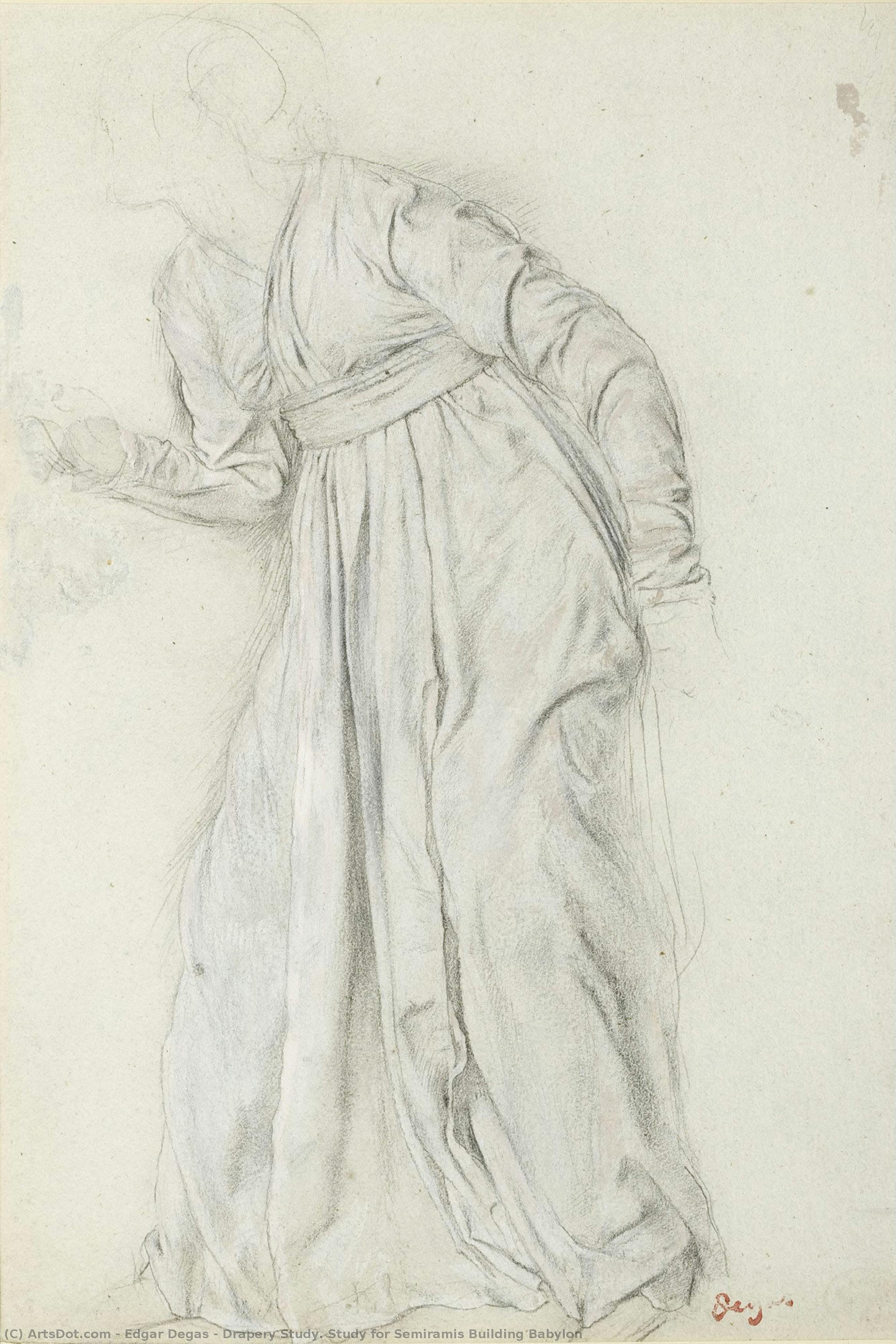
Drapery Study: A Glimpse into Degas' Preparatory Process
This captivating pencil drawing, titled "Drapery Study. Study for Semiramis Building Babylon," offers a fascinating window into the meticulous working process of Edgar Degas (1834–1917). More than just a sketch, it represents a crucial stage in the development of his ambitious historical painting, “Semiramis Building Babylon,” now housed within the Musée d'Orsay. The study itself is a testament to Degas’s dedication to anatomical accuracy and his profound understanding of how fabric interacts with form.
The Artist and His Historical Ambitions
- Born: Hilaire-Germain-Edgar De Gas in Paris, France, on July 19, 1834.
- Came from a moderately wealthy family; his mother was Creole from New Orleans and his father a banker.
- Initially enrolled in law school at his father’s urging but pursued art despite this.
- Influenced by Jean-Auguste-Dominique Ingres, who advised him to focus on drawing.
- Studied at the École des Beaux-Arts, mastering academic techniques.
- Spent three years in Italy (1856-1859), copying Renaissance masters and developing his skills.
Degas embarked on a period of intense historical painting between 1859 and 1865, driven by a desire to revive this genre within the contemporary art scene. He envisioned a series of large-scale works depicting scenes from antiquity – “The Daughter of Jephthah,” “Semiramis Building Babylon,” “Alexander and Bucephalus,” “Spartan Girls Challenging Boys,” and “Scene of War in the Middle Ages.” This "Drapery Study" is one of many preparatory drawings that reveal the challenges he faced in realizing this grand vision. Ultimately, Degas abandoned these historical compositions, finding it difficult to achieve his desired synthesis; only "Scene of War in the Middle Ages" was completed.
A Masterful Study of Form and Fabric
The artwork presents a monochromatic study of draped figures, rendered with remarkable skill in pencil. The composition centers on the torso and limbs, emphasizing the complex interplay of light and shadow across the fabric's surface. Degas’s technique is characterized by meticulous line work and layered graphite application, creating a palpable sense of depth and volume. Notice how varying degrees of pressure applied to the pencil generate smooth areas alongside heavily shaded regions that convincingly suggest the weight and texture of the material.
The lighting appears to originate from above and slightly to the side, casting shadows that further accentuate the three-dimensional form. The style leans towards realism and academic draftsmanship, reminiscent of Renaissance anatomical studies. This isn't merely a depiction of clothing; it’s an exploration of how fabric clings to and reveals the underlying human anatomy.
Beyond Representation: A Technical Exercise
While devoid of overt symbolic or emotional elements, this "Drapery Study" is far from insignificant. It serves as a technical exercise in drawing, showcasing Degas's mastery of observation and his ability to translate complex forms onto paper. The visible tooth and texture of the paper itself contribute to the artwork’s tactile quality, enhancing the viewer’s appreciation for the artist’s skill. This study provides invaluable insight into the creative process of a major Impressionist figure, revealing the dedication and precision required to achieve artistic excellence.