A Moment Frozen in Time: The Essence of Degas's Sketch
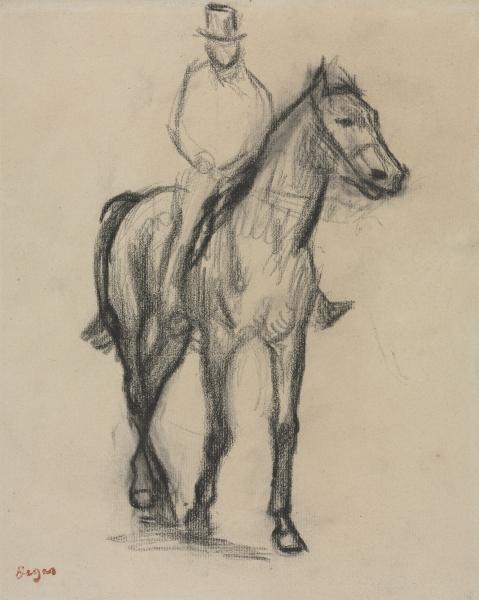
Edgar Degas’s “Horse and Rider,” a monochromatic pencil sketch, isn’t merely a depiction of equestrian activity; it’s a profound meditation on observation, stillness, and the subtle language of form. Created around 1890 – though the exact date remains elusive – this work transcends its seemingly straightforward subject matter to reveal Degas's masterful control over tonal values and line, capturing an atmosphere of quiet contemplation rather than dynamic action. The sketch’s power lies in its ability to evoke a sense of immediacy, as if we are witnessing a fleeting moment captured by the artist’s keen eye.
The composition centers entirely on the horse and rider, occupying nearly the entire frame – a deliberate choice that emphasizes their importance within the scene. Degas employs a simplified approach to shape, reducing the complex anatomy of the animal and the figure to their essential forms. Dark grey and black dominate the palette, skillfully layered through hatching and cross-hatching techniques, creating a remarkable sense of volume and texture. The artist’s meticulous attention to detail is evident in the subtle variations of tone that define the horse's musculature and the rider’s silhouette, suggesting both solidity and movement. The lighting, seemingly originating from above and slightly to the front, casts carefully considered shadows, further enhancing the three-dimensionality of the scene.
Degas: A Realist Amongst Impressionists
Understanding Degas requires acknowledging his complex position within art history. While often associated with the Impressionists – Monet, Renoir, and others who championed capturing fleeting moments of light – Degas vehemently resisted this label, identifying instead as a realist. This commitment stemmed from an unwavering dedication to portraying the world with unflinching honesty and meticulous observation. Born Hilaire-Germain-Edgar De Gas in Paris, his upbringing within a comfortable bourgeois family afforded him access to artistic training, yet he chafed against academic constraints, seeking a more direct connection between art and life.
Degas’s early years were marked by an intense study of classical art at the Louvre, honing his skills and developing a deep appreciation for the works of Michelangelo and Raphael. However, his artistic path diverged from strict tradition, as evidenced in his focus on contemporary subjects – particularly ballet dancers and racehorses – rather than historical or mythological scenes. This shift reflected his desire to capture the essence of modern life with the same precision and technical mastery he admired in the Old Masters.
Symbolism and Equestrian Pursuits
Beyond its technical brilliance, “Horse and Rider” carries symbolic weight. The subject matter itself – leisure, equestrian pursuits, and the relationship between man and animal – speaks to a broader cultural context. The sketch can be interpreted as an exploration of power, control, and the romantic allure of the outdoors. Degas’s fascination with horses is well-documented, and he frequently depicted them in motion, capturing their grace, strength, and inherent wildness. The rider's posture and the horse's stance convey a sense of poised readiness, suggesting both the potential for action and the quiet dignity of observation.
Furthermore, the sketch’s monochromatic palette contributes to its contemplative mood. The absence of color forces the viewer to focus on the interplay of light and shadow, emphasizing the textures and forms of the subject matter. The simplified composition reinforces this effect, creating a sense of timelessness and inviting us to lose ourselves in the details of the scene.
A Reproduction for Your Space
ArtsDot offers meticulously crafted hand-painted reproductions of Edgar Degas’s “Horse and Rider,” allowing you to bring this captivating artwork into your home or office. Our skilled artists replicate Degas's masterful technique, capturing the subtle nuances of tone, line, and texture with exceptional accuracy. Whether you are an art enthusiast, a collector, or simply seeking a unique piece of decor, our reproduction provides a beautiful and authentic representation of this iconic sketch. Explore our range of sizes and framing options to find the perfect addition to your collection – a timeless testament to Degas’s genius and his profound understanding of movement and observation.