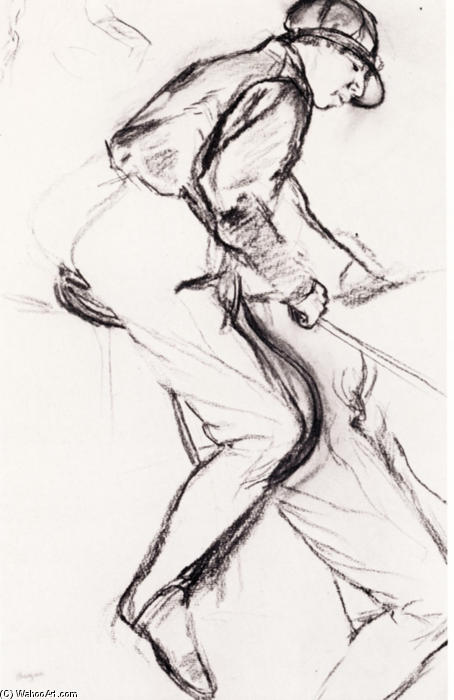
Edgar Degas’ ‘Jockeys’ (1881) – a dynamic pastel showcasing racehorses & riders in motion. Impressionistic, textured, and evocative of 19th-century French life. Explore this masterpiece!
A Moment Frozen in Motion: Edgar Degas’ Jockey
Edgar Degas, a name synonymous with Impressionism and an artist profoundly attuned to the rhythms of everyday life, produced ‘Jockey,’ a graphite sketch completed in 1882 that transcends mere depiction—it embodies a palpable sense of dynamism. Unlike many Impressionists who prioritized capturing fleeting light effects, Degas focused intently on portraying human movement and gesture, achieving this remarkable feat through masterful observation and painstaking execution.
- Subject Matter: The artwork centers around a jockey perched atop a horse, poised at the cusp of action. This familiar equestrian motif—a staple in Degas’s oeuvre—represents not just horses and riders but also themes of labor, athleticism, and the relationship between man and animal.
- Style & Technique: ‘Jockey’ firmly establishes Degas's distinctive Impressionistic style. Rather than striving for photographic realism, he employs loose charcoal strokes – characteristic of his technique – to convey texture and tonal variations. The artist prioritizes capturing the essence of the scene rather than meticulously detailing every contour; this approach aligns perfectly with Degas’s rejection of academic conventions.
- Composition: Diagonal lines dominate the frame, guiding the viewer's eye across the horse and jockey. This compositional choice emphasizes movement and creates a sense of immediacy, mirroring the energy of the moment being captured. The subtle background elements contribute to depth without distracting from the central figures.
The charcoal medium itself is crucial to understanding Degas’s artistic vision. Varying pressure allows for nuanced shading—from delicate gradations to bold textures—creating a rich surface that invites contemplation. Hatching and cross-hatching techniques are skillfully deployed to build up tonal values, enhancing the illusion of form and adding visual interest.
Beyond its formal qualities, ‘Jockey’ resonates with deeper symbolic significance. The posture of the jockey – bent forward, gripping the reins—suggests concentration and control amidst the inherent instability of movement. It speaks to Degas's fascination with capturing fleeting instants of human experience, transforming them into enduring images of grace and precision.
Consider commissioning a high-quality reproduction of ‘Jockey’ for your home or studio – allowing you to appreciate the artist’s genius and capture the spirit of Impressionism in stunning detail. Explore similar artworks on ArtsDot!