The Ballet Class (Degas, Musée d'Orsay) depicts ballet dancers at the end of a lesson led by Jules Perrot. Degas meticulously observed movement and incorporated details like stage mothers and a dog to convey realism. Painted in 1874-76, it exemplifies Impressionism’s focus on capturing fleeting moments and exploring psychological complexity.
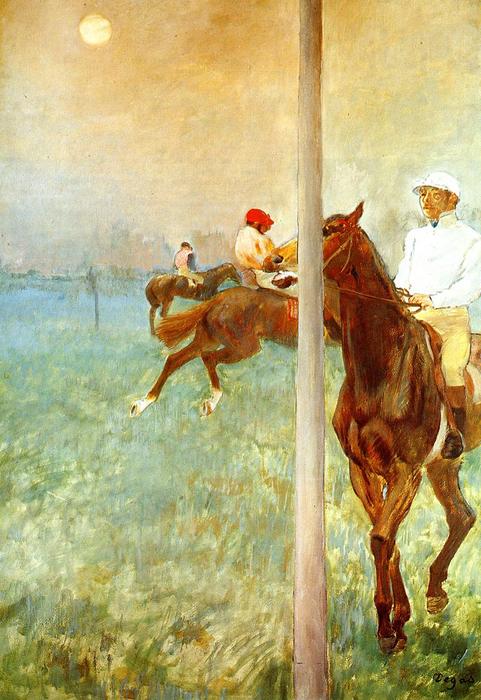
Jockeys before the Start with Flagpoll
Edgar Degas’ “Jockeys Before The Start With Flagpoll,” painted in 1879, stands as an emblem of Impressionism's fascination with capturing fleeting moments and conveying emotion through subtle visual cues. More than just a depiction of equestrian sport, it embodies Degas’ profound understanding of human psychology and his masterful manipulation of artistic technique—a testament to his enduring legacy within the art world.
Created during a pivotal period in Parisian artistic history, “Jockeys Before The Start With Flagpoll” emerged from the burgeoning Impressionist movement that challenged academic conventions and championed subjective experience. Rejecting the idealized portrayals favored by earlier generations of artists, Degas sought to represent reality as he perceived it—a raw, unfiltered glimpse into everyday life.
- Composition & Technique: The painting’s dynamic arrangement immediately draws the viewer's eye, mirroring the anticipation and energy inherent in a horse race. Degas employed a revolutionary technique combining oil paint with pastel and pigment essence – a daring departure from traditional methods that allowed him to achieve remarkable luminosity and textural nuance. Notice how he skillfully blends colors to create an atmosphere of tension and excitement, capturing not just what is visible but also what feels palpable.
- Subject Matter & Symbolism: Beyond the obvious subject—five jockeys preparing for a race—the painting delves into deeper symbolic layers. Degas’ meticulous observation of posture and gesture conveys a sense of quiet contemplation amidst the bustle of activity, hinting at the psychological complexities beneath the surface. The positioning of the horses and riders contributes to the overall feeling of movement and dynamism, mirroring the rhythm of the race itself.
- Historical Context: “Jockeys Before The Start With Flagpoll” reflects the broader cultural landscape of late 19th-century France—a time marked by rapid industrialization and social change. Degas’ interest in documenting modern life aligns with the Impressionists' desire to portray their era with honesty and immediacy, capturing both its beauty and its anxieties.
- The Musée d'Orsay & Artistic Inspiration: Currently housed in the Musée d'Orsay in Paris, “Jockeys Before The Start With Flagpoll” serves as a cornerstone of Degas’ oeuvre—a masterful distillation of his artistic vision. It draws inspiration from artists like Jean-Auguste-Dominique Ingres and Michelangelo, demonstrating Degas’ unwavering commitment to classical principles while simultaneously forging new paths for artistic expression.
The painting's enduring appeal lies in its ability to evoke a profound emotional response—a feeling of anticipation, excitement, and perhaps even melancholy. Degas’ masterful use of color and composition invites contemplation, prompting viewers to consider not only what is seen but also what is felt. “Jockeys Before The Start With Flagpoll” remains an unforgettable masterpiece, cementing Edgar Degas's place as one of the most influential artists of his time.
Explore more about this captivating artwork and its artist at ArtsDot.com – where you can discover exceptional reproductions of Degas’ celebrated paintings and delve deeper into the artistic spirit of Impressionism.