The Quiet Choreography of Domestic Life
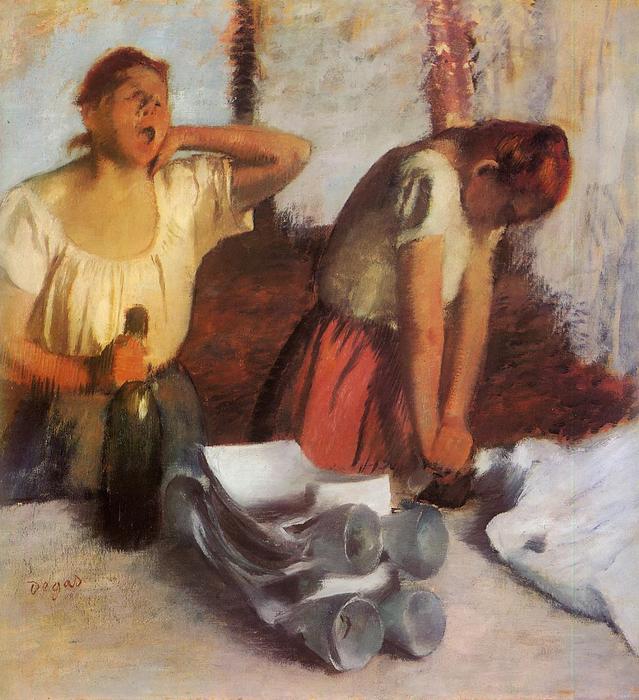
To gaze upon Degas’s Laundry Girls Ironing is to step into a moment suspended in time—a tableau vivant plucked from the heart of 19th-century Parisian domesticity. This painting transcends a mere depiction of labor; it captures the quiet, almost balletic rhythm inherent in shared human endeavor. The scene unfolds with an intimate grace, focusing on two figures whose concentration is palpable. They are immersed in the ritual of ironing, their movements suggesting a practiced harmony that speaks volumes about camaraderie and routine. Notice how the artist has populated this space not just with people, but with objects: scattered bottles hinting at the necessary supplies, the delicate gleam of a wine glass catching the light near the center, and the carefully placed cup on the right. These details anchor the viewer in a tangible reality, inviting us to breathe in the scent of steam and starch.
Mastery of Light and Movement
Edgar Degas, while often associated with the Impressionist circle, maintained his own distinct vision—one rooted in rigorous observation and structural realism. In this work, his technical brilliance shines through in how he handles light. It is not a dramatic spotlight, but rather the diffused, ambient glow of an interior space that illuminates the folds of fabric and the focused profiles of the women. The composition itself is a masterclass in asymmetrical balance. From the shirts clustered near the bottom left to the dresses draped throughout the room, every piece of clothing serves as both subject matter and compositional element. Degas uses these textiles—the two visible shirts and three distinct dresses—to guide the eye across the canvas, creating visual pathways that keep the viewer engaged in the narrative flow.
Historical Echoes and Enduring Symbolism
Painted in 1884, this piece offers a fascinating glimpse into the evolving roles of women within bourgeois society. While the subject matter—laundry work—might seem humble, Degas elevates it to high art. The symbolism here is subtle: the act of cleaning and mending clothes can be read as a metaphor for restoring order, both in the physical space depicted and perhaps even within the lives of the women themselves. It speaks to the unseen labor that underpins the grand narratives of history and society. For the modern collector or designer, this painting offers more than just decoration; it offers contemplation on diligence, interdependence, and the beauty found in the everyday rhythm.
Bringing Intimate Artistry Home
For those seeking to infuse a space with the sophisticated patina of late 19th-century Parisian life, a reproduction of Laundry Girls Ironing is an unparalleled choice. The ability to reproduce Degas’s delicate handling of form and atmosphere allows this masterpiece of genre painting to become a focal point in any room—be it a formal drawing-room or a thoughtfully curated modern space. Owning this piece means embracing a narrative rich with human connection, technical virtuosity, and the enduring poetry found within the most ordinary moments.