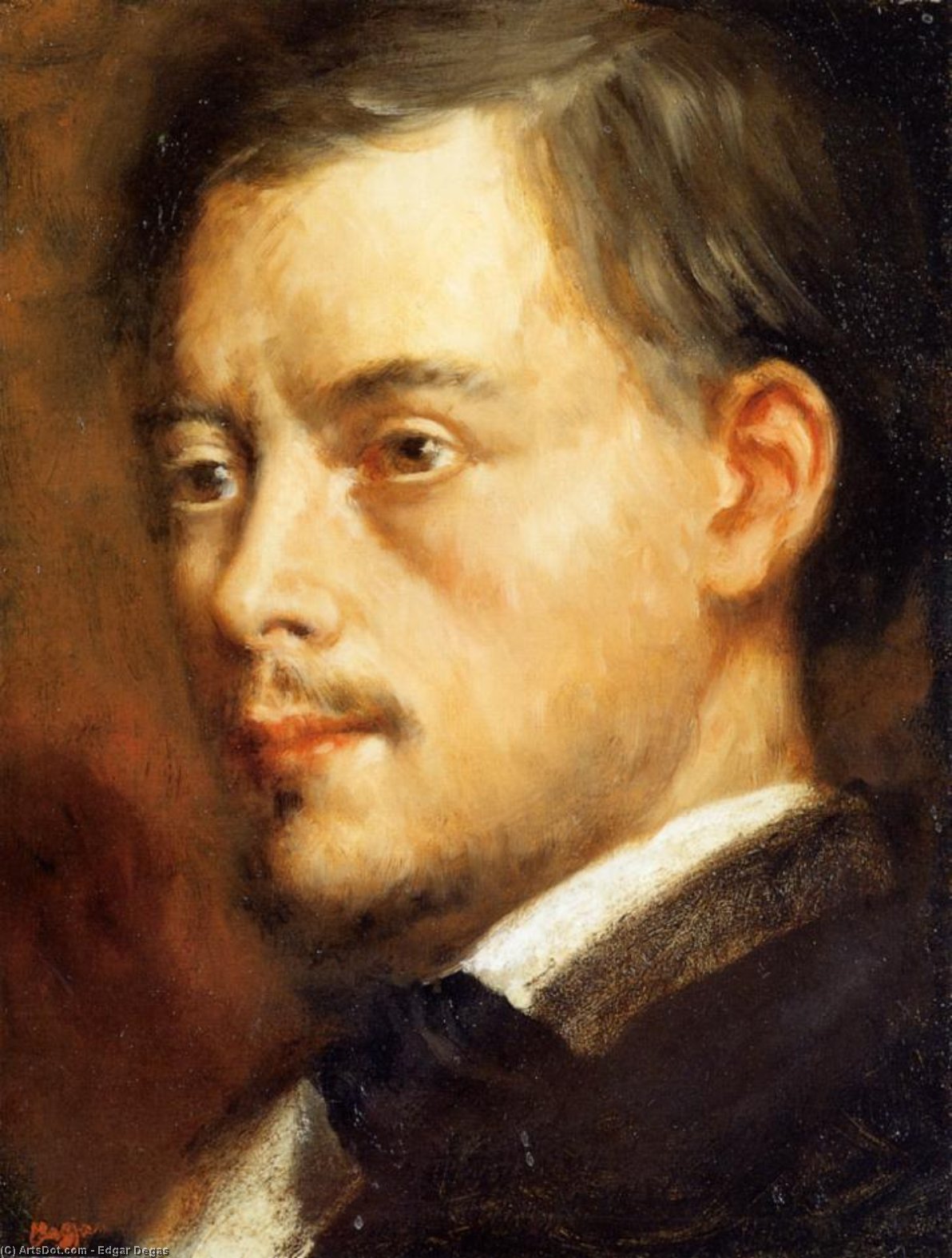
Man's Head by Edgar Degas
The painting "Man's Head" by
Edgar Degas stands as a testament to the Impressionist movement’s fascination with capturing fleeting moments and conveying psychological depth—a remarkable feat achieved through meticulous observation and masterful brushwork. Created in 1864, this oil on canvas piece isn't merely a depiction of a human face; it’s an embodiment of Degas’s artistic philosophy: to portray the world as he perceives it, prioritizing emotion and atmosphere over rigid realism.
The Painting's Composition and Style
At first glance, “Man’s Head” presents a deceptively simple subject—a man with a beard gazing off-camera—yet within this seemingly unassuming frame lies a wealth of artistic considerations. Degas skillfully employs a close-up perspective, drawing the viewer into an intimate encounter with the sitter's expression and gaze. The inclusion of a tie subtly reinforces notions of formality and social status, while simultaneously highlighting the vulnerability inherent in human contemplation. The artist’s signature style is immediately recognizable: loose, expressive brushstrokes dance across the canvas surface, capturing the interplay of light and shadow on the man’s face with breathtaking accuracy. These strokes aren't intended to create a photographic likeness but rather to convey the feeling of immediacy—the sensation of witnessing a moment frozen in time.
Historical Context and Impressionism
“Man’s Head” emerged during a pivotal period in artistic history—the burgeoning Impressionist movement, spearheaded by artists like Monet, Renoir, and Sisley. Rejecting the academic conventions of their predecessors, Impressionists sought to depict the world as perceived by the senses, prioritizing color and light over detailed representation. Degas embraced this ethos wholeheartedly, aligning himself with fellow innovators who championed spontaneity and subjective experience. The painting reflects the broader cultural anxieties surrounding industrialization and urbanization—themes prevalent in the art of the era—and speaks to a deeper concern for capturing the essence of human emotion within its visual framework.
Technique and Symbolism
Degas’s technique is characterized by layering thin glazes of oil paint onto the canvas, allowing light to penetrate through the surface and creating luminous effects that imbue the painting with vibrancy. The artist meticulously studied anatomy and musculature, striving for anatomical precision while simultaneously prioritizing expressive gesture—a hallmark of Impressionist art. Furthermore, the man’s gaze directs our attention outwards, suggesting a preoccupation with contemplation and perhaps hinting at unspoken thoughts or emotions. Some scholars interpret the painting as an exploration of masculinity and vulnerability, reflecting anxieties about societal expectations during the Victorian era.
A Legacy Enduring Beauty
The Musée Des Beaux-Arts Tourcoing, France, houses a significant collection of Degas’s artworks, offering visitors a chance to immerse themselves in the artist's oeuvre and appreciate his enduring influence on subsequent generations of painters. For those seeking to experience the profound beauty and intellectual richness of “Man’s Head,” a visit to ArtsDot.com is highly recommended—specifically,
the image page where you can examine the painting's details and contemplate its artistic significance.