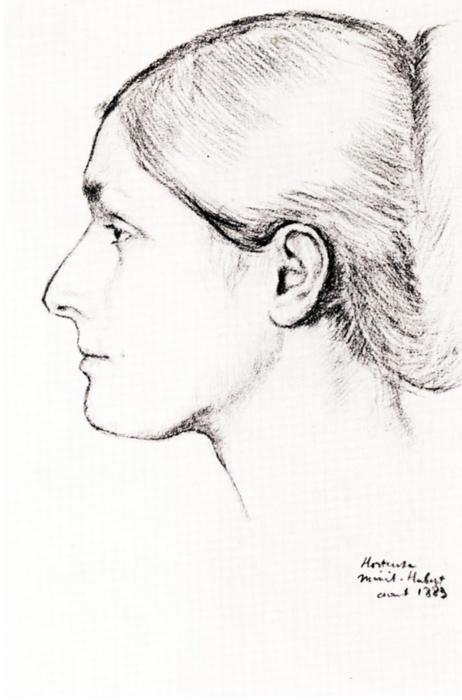
The Enigmatic Grace of Edgar Degas’s “Mme Jacques Fourchy”
Edgar Degas's "Mme Jacques Fourchy," painted in 1883, isn’t merely a portrait; it’s a carefully constructed tableau vivant—a captured moment brimming with subtle observation and quiet intensity. This graphite drawing, rendered with the meticulous precision characteristic of Degas’s later work, offers a rare glimpse into the life of Hortense Valpinçon, a woman whose identity remains tantalizingly veiled within the artist's gaze. It’s a piece that speaks volumes through its restraint, inviting viewers to contemplate the complexities of human presence and the delicate dance between observation and representation.
Degas, famously resisting the label of “Impressionist,” instead identified as a realist, dedicating himself to an unflinching portrayal of the world around him. “Mme Jacques Fourchy” exemplifies this commitment – it’s not a romanticized depiction but a grounded observation of a woman in her everyday life. The composition is strikingly simple: a profile view, emphasizing the subject's head and shoulders, creating an immediate sense of intimacy. This focus draws us into a private space, fostering a feeling of direct engagement with the sitter.
A Masterclass in Linear Technique
The drawing’s power lies largely in Degas’s masterful command of linear technique. He eschews broad brushstrokes or dramatic shading, instead employing a system of precise lines—hatching, cross-hatching, and stippling—to build up tones and textures with remarkable subtlety. These lines aren't merely delineating form; they are actively shaping the image, creating a sense of volume and depth through careful layering. Notice how the darker areas are built from denser clusters of short, broken lines, while highlights emerge from sparser, lighter applications. This technique lends the portrait an almost sculptural quality, as if the figure is emerging from the paper itself.
The geometric shapes—circles for the eye and ear, ovals for the head and face, straight lines for the nose and mouth—are not arbitrary; they reflect Degas’s rigorous approach to observation. He dissected the human form into its essential components, meticulously rendering each element with an almost mathematical precision. This deliberate structure provides a framework for understanding the overall composition while simultaneously conveying a sense of order and control.
Historical Context and Symbolism
Painted during a period of significant social change in France, “Mme Jacques Fourchy” reflects the evolving role of women within society. While the subject’s identity remains private, her dignified posture and direct gaze suggest a quiet strength and self-possession. The drawing can be interpreted as a subtle commentary on the constraints placed upon women during this era, while simultaneously celebrating their inherent grace and resilience.
Furthermore, Degas's fascination with ballet dancers—a recurring theme in his oeuvre—is evident here. The portrait’s formality and restrained emotion resonate with the disciplined world of professional dance, suggesting a connection between the subject’s inner life and her public persona. The drawing also offers a glimpse into the Parisian social scene of the late 19th century, capturing a moment of quiet contemplation within a bustling urban environment.
A Timeless Portrait of Dignity
“Mme Jacques Fourchy” is more than just a portrait; it’s an enduring testament to Degas's artistic vision and his ability to capture the essence of human experience. The drawing’s understated elegance, combined with its technical mastery and historical significance, ensures its place as a cornerstone of Impressionist art. It invites us to pause, observe, and contemplate the quiet dignity of a single moment in time—a timeless portrait that continues to resonate with viewers today.