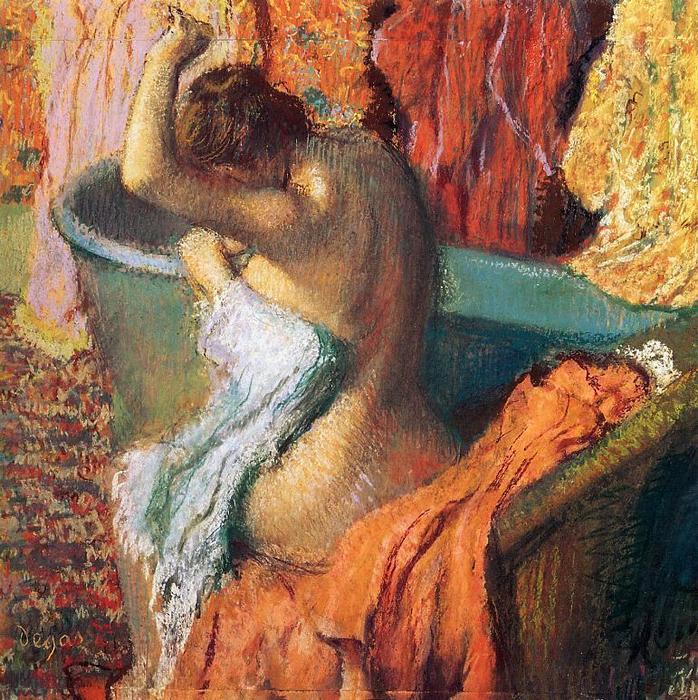
A Moment Suspended: Delving into Degas’ “Seated Bather”
Edgar Degas's “Seated Bather,” painted in 1899, is not merely a depiction of the human form; it’s an intimate exploration of vulnerability and introspection. The painting captures a woman seated within a bathtub, her arms raised to shield or perhaps conceal her face, suggesting a profound emotional state – one of sorrow, contemplation, or quiet desperation. The scene isn't overtly dramatic, yet its power lies in the subtle conveyance of inner turmoil. Degas masterfully avoids sensationalism, instead presenting a moment of raw human experience with remarkable sensitivity.
Impressionist Realism and the Modern Bather
While often categorized as an Impressionist, Degas resisted such labels, identifying more closely with realism. This distinction is evident in “Seated Bather.” Unlike the fleeting light and airy landscapes favored by many of his contemporaries, Degas grounds his subject in a tangible reality. The bathroom setting – complete with a chair casually placed nearby and personal belongings like handbags scattered around – feels strikingly modern for its time. This wasn’t about idealized nudes from mythology; it was about observing and portraying the lives of contemporary women. Degas's interest lay not just in *what* he painted, but *how* he painted it. He employed a dynamic composition, eschewing traditional academic arrangements for a more asymmetrical and naturalistic approach. The cropping of the figure, influenced by Japanese prints which were gaining popularity in Europe at the time, adds to the sense of immediacy and intimacy.
Technique and Emotional Resonance
The technique employed in “Seated Bather” is particularly noteworthy. While Degas worked across various mediums – oil paint, pastel, sculpture – his pastels are celebrated for their unique ability to capture texture and light. Though this particular work appears to be executed primarily in oil, it shares the same qualities of broken color and visible brushstrokes that characterize his pastel drawings. This approach lends a sense of spontaneity and immediacy to the scene. The muted palette further enhances the emotional weight of the painting; the subdued tones contribute to the overall feeling of melancholy and quietude. The careful arrangement of objects – the chair, the vase, the handbags – aren’t merely decorative elements but rather serve as visual anchors that heighten the sense of isolation and introspection experienced by the bather.
Degas and the Depiction of Women
Throughout his career, Degas was fascinated by the female form, particularly dancers and bathers. However, his depictions were often complex and ambiguous, challenging conventional notions of beauty and femininity. He wasn’t interested in portraying women as passive objects of desire but rather as individuals with their own inner lives and vulnerabilities. “Seated Bather” exemplifies this approach. The woman isn't presented for the viewer's gaze; she is lost in her own thoughts, seemingly unaware of being observed. This sense of privacy and psychological depth is what sets Degas apart from many of his contemporaries. He invites us not to admire, but to empathize – to connect with the universal human experience of sadness, loneliness, or simply the need for a moment of quiet reflection.