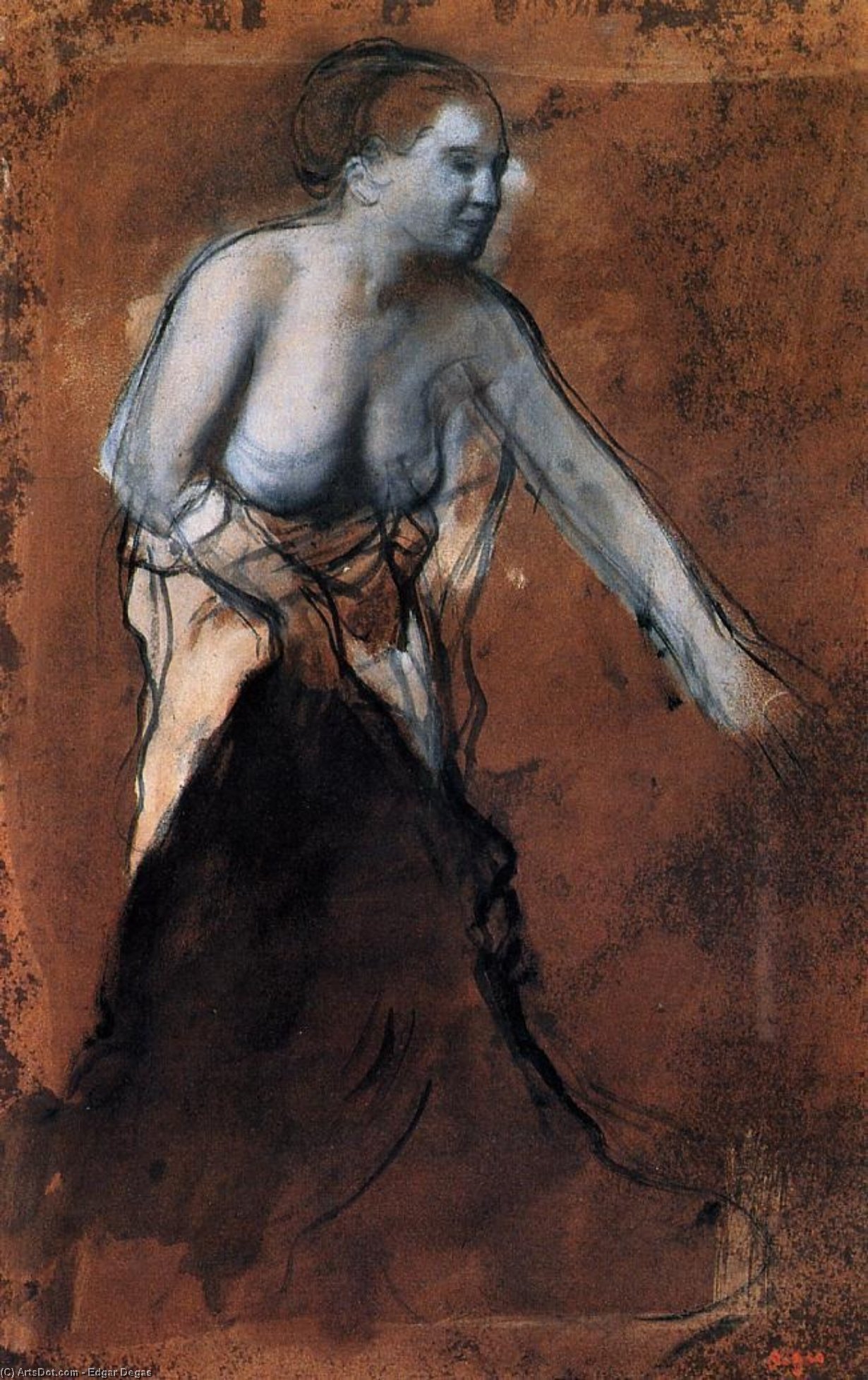
The Enigmatic Form: Edgar Degas's Standing Female Figure with Bared Torso
Edgar Degas, a name synonymous with the vibrant energy and subtle complexities of late 19th-century Parisian life, gifted us with a series of works that continue to captivate viewers over a century later. Among his most compelling creations stands “Standing Female Figure with Bared Torso,” painted in 1868 – a piece that transcends mere representation and delves into the realm of psychological observation and artistic innovation. This isn’t simply a depiction of a woman; it's an exploration of posture, movement, and the quiet intensity held within a single, arresting pose. Degas masterfully employs a limited palette of black and white, eschewing color to heighten the drama and focus attention squarely on the figure’s form and the subtle nuances of her stance.
The painting immediately draws the eye with its unconventional composition. The woman stands facing away from the viewer, a deliberate choice that forces us to actively engage with the artwork. She is not inviting our gaze; instead, she presents herself as an object of contemplation – a study in grace and contained power. Her arm raised above her head creates a dynamic diagonal line, disrupting the static nature of the pose and suggesting movement frozen in time. The slight tilt of her torso adds to this sense of dynamism, hinting at a hidden narrative or perhaps simply the natural curve of a body caught in a moment of repose.
Impressionist Techniques: Light, Line, and Movement
Degas’s approach to painting is deeply rooted in Impressionism, yet he departs from some of the movement's more conventional tenets. He wasn’t interested in capturing fleeting moments of light as much as he was in conveying a sense of underlying structure and psychological depth. The use of oil paint allows for rich textures and subtle gradations of tone – crucial elements in achieving his desired effect. Notice how Degas utilizes short, broken brushstrokes to build up the form, creating an illusion of movement and capturing the play of light on the woman’s skin and clothing.
The background, rendered in muted browns, serves not as a distraction but as a carefully considered element that emphasizes the figure's presence. The contrast between the dark background and the lighter tones of her dress creates a sense of depth and volume, further isolating the subject and drawing our attention to her posture. Degas’s meticulous attention to detail—particularly in rendering the folds of the fabric and the subtle musculature beneath—demonstrates his exceptional draftsman skills, honed through years of studying classical techniques.
A Window into Parisian Life: Context and Symbolism
“Standing Female Figure with Bared Torso” was created during a period of significant social and artistic change in Paris. The city was undergoing rapid industrialization and urbanization, leading to new forms of entertainment and leisure activities. Dance halls and theaters became increasingly popular, offering an escape from the realities of urban life. Degas’s fascination with dancers is well-documented, and this painting reflects his deep understanding of their world – a world of discipline, grace, and hidden emotions.
The act of baring her torso can be interpreted in several ways. It could represent vulnerability, strength, or even defiance. Some scholars suggest it was a subtle commentary on the changing social mores of the time, challenging traditional notions of modesty. Regardless of its precise meaning, the pose undeniably commands attention and invites interpretation. The painting’s placement within the Kunstmuseum Basel, a renowned institution dedicated to European art, underscores its significance as a masterpiece of the era.
Beyond the Canvas: Degas's Legacy and Reproductions
Degas’s influence on the course of modern art is undeniable. His innovative techniques, his focus on contemporary subjects, and his willingness to challenge artistic conventions paved the way for future generations of artists. Alongside “The Fallen Jockey” and “On the Racecourse,” both housed in the Kunstmuseum Basel, this painting exemplifies Degas’s versatility and his ability to capture a wide range of subjects with remarkable skill.
At ArtsDot.com, we are proud to offer meticulously crafted oil painting reproductions of “Standing Female Figure with Bared Torso.” Our artisans replicate Degas's masterful brushwork and nuanced color palette with the utmost care, ensuring that you receive a faithful representation of this iconic artwork. These reproductions are not merely copies; they are works of art in their own right, bringing the beauty and intrigue of Degas’s masterpiece into your home or office. Explore our collection today and experience the enduring power of Impressionism.