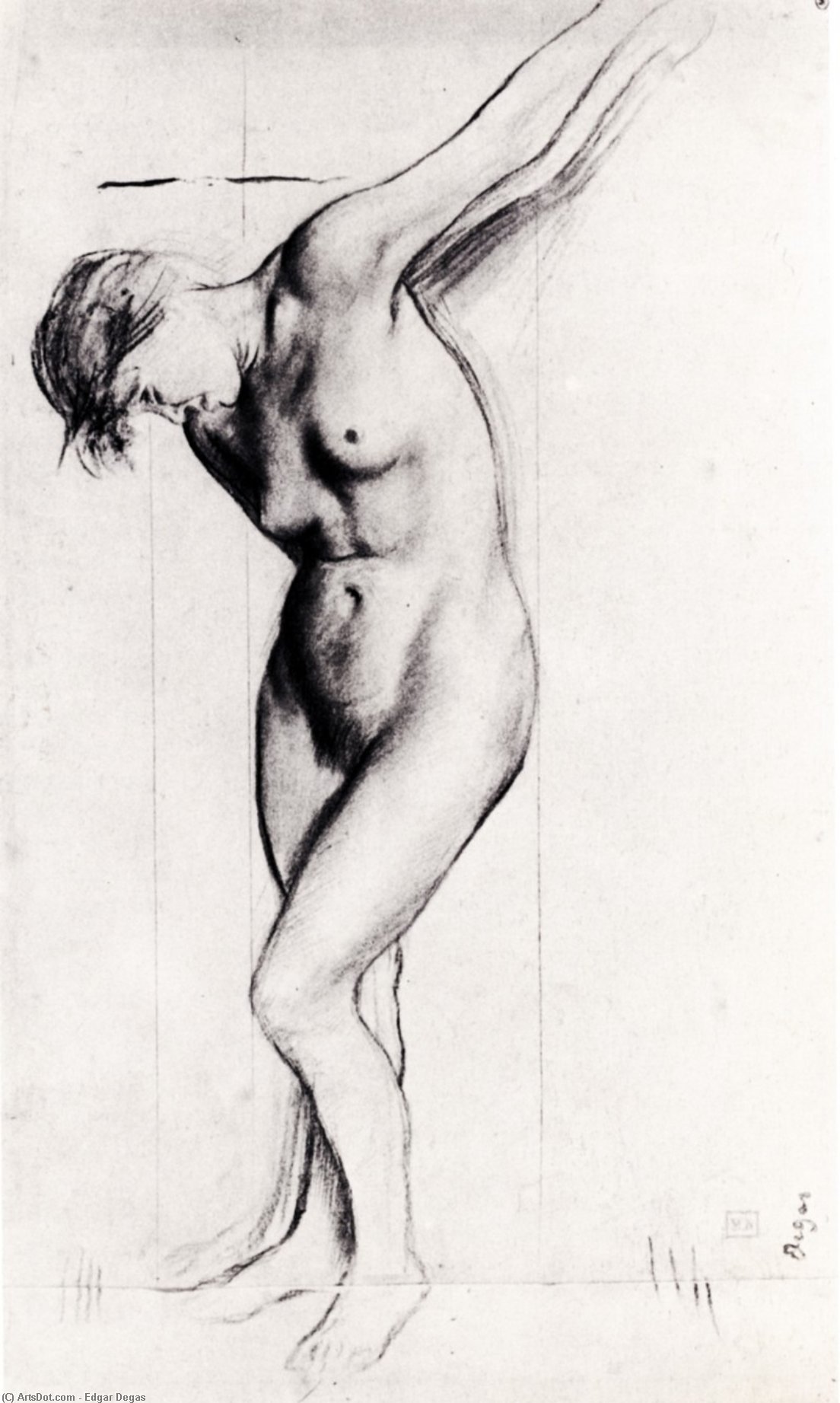
Study for the Medieval War Scene
The charcoal drawing “Study for the Medieval War Scene,” executed by Edgar Degas in 1865, stands as a testament to the artist’s unwavering dedication to observation and his masterful manipulation of tonal variation—principles that define both Impressionism and Degas's distinctive artistic vision. More than just a preparatory sketch, it embodies a profound engagement with the human form and its capacity for conveying emotion through posture and gesture, reflecting a core element of Degas’s oeuvre.
- Composition & Form: The central figure dominates the frame, positioned slightly off-center to create visual balance. Her outstretched arms establish a dynamic equilibrium, mirroring the movement inherent in the scene it intends to depict. Horizontal and vertical lines subtly guide the viewer's eye, reinforcing compositional stability while hinting at the larger canvas envisioned by Degas.
- Technique & Material: Degas’s technique—characterized by loose, gestural charcoal strokes—prioritizes capturing essence over meticulous anatomical detail. Hatching and cross-hatching skillfully build up tonal ranges, generating depth and simulating muscle definition with remarkable accuracy. The visible grain of the paper lends textural richness to the drawing, grounding it in a tangible reality.
- Style & Context: Rooted firmly within Degas’s Impressionist aesthetic, this study exemplifies his rejection of academic conventions—a deliberate choice that championed spontaneity and immediacy. It aligns with the broader artistic movement's focus on capturing fleeting moments of life and emotion, mirroring the spirit of fellow Impressionists like Monet and Renoir.
- Symbolism & Emotion: Though ostensibly a technical exercise, the pose itself communicates an underlying tension—a readiness for action—suggesting themes of conflict and resilience characteristic of medieval warfare. The expressive lines imbue the figure with vitality and convey a sense of psychological depth, inviting contemplation on human vulnerability amidst turbulent circumstances.
- Historical Significance: Created during Degas’s formative years as an artist, “Study for the Medieval War Scene” foreshadows his later explorations of dance and portraiture—subjects he pursued with unwavering conviction throughout his prolific career. It represents a pivotal moment in Degas's artistic development, demonstrating his early mastery of tonal shading and his ability to distill complex ideas into simplified visual forms.
This evocative charcoal drawing offers more than just a glimpse into Degas’s creative process; it encapsulates the artist’s profound understanding of human anatomy and emotion—qualities that continue to resonate with audiences today. Its understated elegance and masterful execution solidify its place as an exemplar of Impressionist realism and a cornerstone of Degas's enduring legacy.