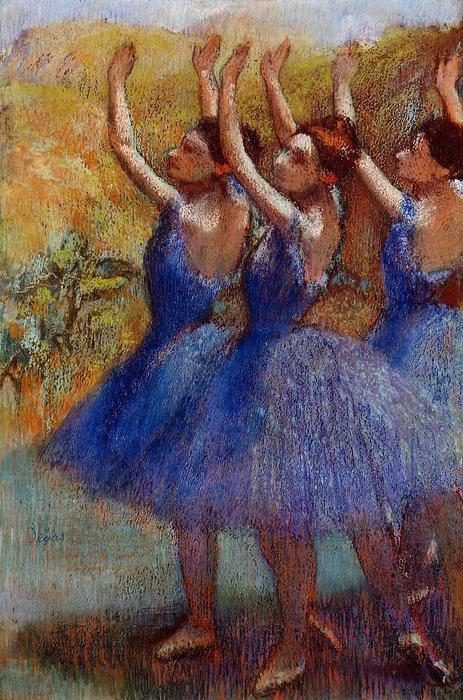
Captured in Impressionist style by Edgar Degas, ‘Three Dancers in Purple Skirts’ portrays graceful women performing on stage with mesmerizing pastel hues—a timeless masterpiece inviting you to explore its beauty.
Edgar Degas: A revolutionary French artist known for his captivating ballet dancers, Parisian scenes, and innovative techniques—a true master of modern art.
A Moment Frozen in Motion: Exploring Edgar Degas’s “Three Dancers in Purple Skirts”
“Three Dancers in Purple Skirts,” created by the French Impressionist Edgar Degas around 1898, transcends mere depiction; it captures a fleeting instant of grace and dynamism—a testament to Degas's unparalleled ability to translate movement onto canvas. This pastel masterpiece resides within The Phillips Collection’s esteemed holdings, offering viewers an intimate glimpse into the artist’s vision of balletic performance and everyday life.
The Artist's Vision: Realism Amidst Impressionism
Despite being associated with the Impressionist movement alongside luminaries like Monet and Renoir, Degas vehemently rejected categorization as an Impressionist. He insisted on labeling himself a realist, driven by his unwavering dedication to meticulous observation and truthful representation. This approach is vividly evident in “Three Dancers,” where Degas eschews idealized beauty for a nuanced portrayal of the dancers’ postures and expressions—a deliberate choice that underscores his fascination with capturing the essence of human experience.
Technique and Material: Pastel's Delicate Embrace
Degas skillfully employed pastel crayons – a medium favored by artists like Monet and Renoir – to achieve an ethereal luminescence characteristic of Impressionism. The pastel technique allowed for subtle gradations of color and texture, creating a velvety surface that captures the soft light filtering through the studio window. This careful consideration of material contributes significantly to the painting’s emotive impact, conveying both fragility and vibrancy simultaneously. The artist's meticulous layering of pigment builds upon the canvas, resulting in an image rich with tonal variations and textural nuances.
Historical Context: Ballet Reform and Artistic Exploration
“Three Dancers” emerged during a period of significant reform within the ballet world—a movement spearheaded by Sergei Diaghilev’s Ballets Russes to break away from rigid conventions and embrace expressive choreography. Degas, deeply invested in this artistic revolution, documented these performances with remarkable precision, reflecting his belief that art should engage with the realities of modern life. The painting serves as a window into the cultural landscape of late 19th-century Paris, capturing not only the beauty of ballet but also its transformative potential.
Symbolism and Emotional Resonance: Purple Skirts, Silent Grace
The choice of purple skirts for the dancers is particularly noteworthy. Purple has historically symbolized royalty, spirituality, and introspection—qualities that align perfectly with the contemplative nature of balletic performance. The dancers’ raised arms convey a sense of poise and concentration, embodying the discipline and artistry required to excel in this demanding art form. More broadly, “Three Dancers” speaks to themes of femininity, movement, and beauty—elements that resonate powerfully across generations of viewers.
A Legacy Enduring Inspiration
“Three Dancers in Purple Skirts” continues to captivate audiences today with its masterful execution and evocative atmosphere. Its delicate pastel hues and captivating depiction of balletic grace serve as a timeless reminder of Degas’s artistic genius—a legacy that inspires collectors, interior designers, and art lovers alike who seek to infuse their spaces with beauty and contemplation.