A Symphony of Motion and Light
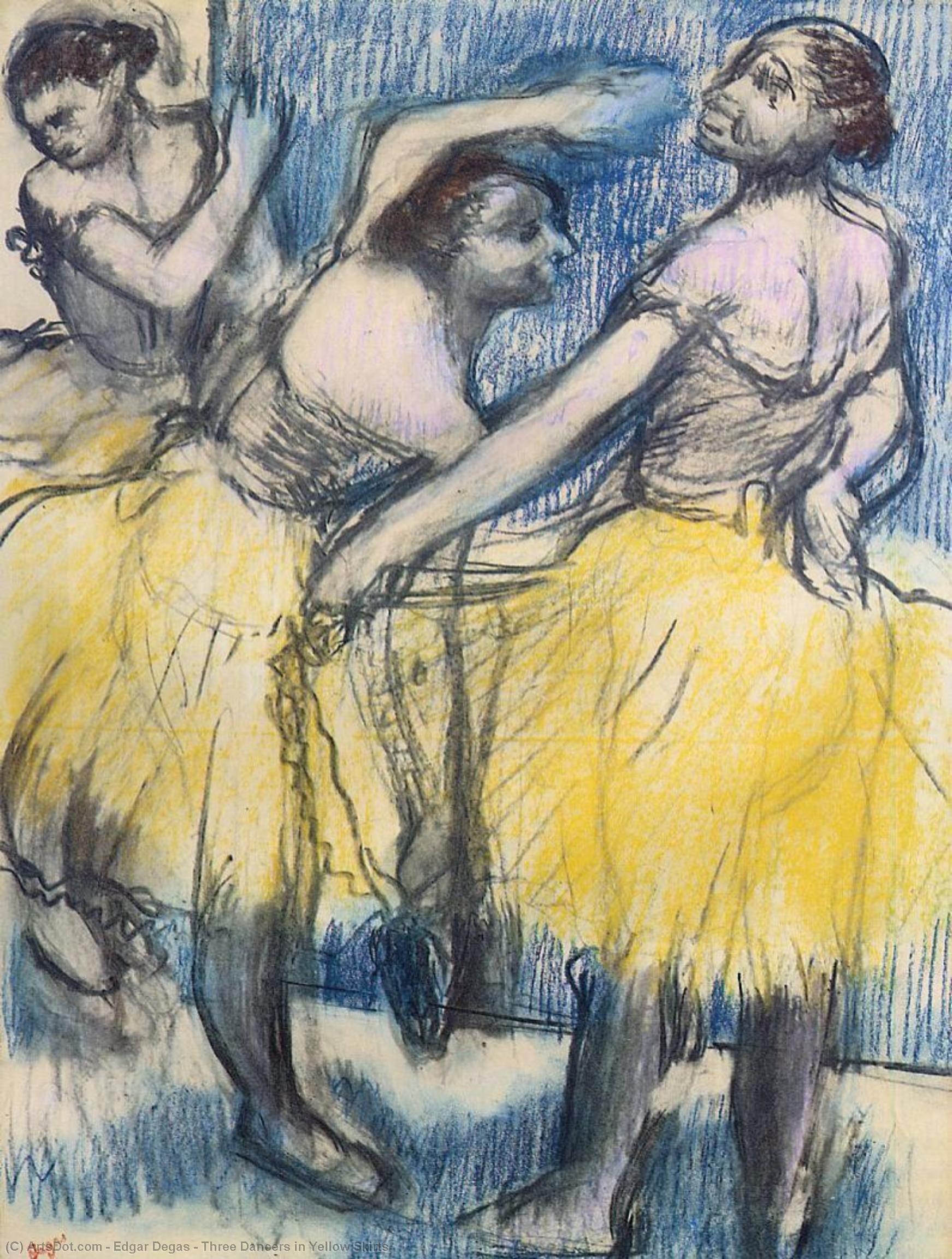
In the quiet, luminous realm of Edgar Degas’s “Three Dancers in Yellow Skirts,” time does not merely pass; it pauses in a state of breathless grace. Created during the twilight of his career around 1904, this masterpiece serves as a profound testament to the Impressionist pursuit of capturing the ephemeral. The scene unfolds with three dancers poised upon a stage, their forms caught in the midst of a rhythmic, swirling performance. As they move, their vibrant yellow skirts catch the light, creating a visual melody that guides the eye across the canvas in a continuous loop of energy and elegance. There is an undeniable magic in how Degas freezes this fleeting moment, transforming a transient theatrical gesture into an eternal dance of color and light.
The technical brilliance of this work lies in Degas’s masterful command of pastel. Unlike the heavy, opaque nature of oil paints, the pastel medium allowed him to layer soft, powdery hues that seem to vibrate against one another. This technique imparts a unique luminosity to the dancers' attire, where the brilliant yellows are not merely colors but sources of radiance. The delicate application of charcoal and pastel on tracing paper—a method that requires immense precision—results in a texture that feels both airy and substantial. For the discerning collector or interior designer, this piece offers a sophisticated interplay of soft edges and sharp, energetic lines, making it a centerpiece capable of breathing life and warmth into any curated space.
The Soul of the Impressionist Spirit
Beyond its aesthetic splendor, “Three Dancers in Yellow Skirts” is steeped in the historical tension of Degas’s own identity. While often celebrated alongside Monet and Renoir as a pillar of Impressionism, Degas himself clung to the title of Realist, driven by an unflinching dedication to observing the truth of human movement. In this work, we see that truth expressed through the physical exertion and poise of the ballet performers. The dancers are not idealized statues; they are living beings, their limbs positioned with a naturalistic complexity that speaks to Degates's deep fascination with the mechanics of dance. This commitment to realism, blended with an Impressionist’s love for atmosphere, creates a work that is both intellectually stimulating and emotionally resonant.
To possess a reproduction of this painting is to invite a sense of joie de vivre into one's environment. The symbolic weight of the yellow skirts—representing vitality, sunshine, and the fleeting joy of performance—acts as a psychological uplift. Whether placed in a sun-drenched living room or a refined studio, the artwork serves as a window into a world of disciplined beauty and spontaneous grace. It is an invitation to appreciate the subtle beauty found in motion, reminding the viewer that even the most transient moments can be captured and held forever through the power of art.